Body Tracking for Indie Developers: Cheapest Way to Animate Characters (2025)
Why Cheap Body Tracking Changes Everything for Indie Devs
Let's be honest about the elephant in the room: manual keyframe animation is slow and expensive. A skilled animator takes roughly 4-8 hours to produce 10 seconds of quality character locomotion. For a solo indie developer building a 3D action game that needs 30-50 core animations (walk, run, idle, attack, death, dodge, jump, etc.), that's 120-400 hours of animation work — before you've written a single line of gameplay code.
This is why AAA studios have relied on motion capture since the early 2000s. But until recently, "cheap body tracking" was an oxymoron. Optical mocap systems from Vicon cost $25,000-$500,000. Inertial suits from Xsens started at $12,000. Even "budget" options required dedicated studio space, trained operators, and hours of cleanup.
Three things changed in 2024-2025:
- AI computer vision matured. Models can now extract full-body 3D skeleton data from a single 2D video with 85-95% accuracy for standard movements — no markers, no suits, no multi-camera rigs.
- Cloud processing eliminated hardware requirements. You upload a video, the AI does the heavy lifting on remote GPUs, and you download clean animation data in minutes. Your laptop doesn't need a $2,000 GPU.
- Price dropped to near-zero. Free tiers from QuickMagic, Rokoko Video, and open-source tools like FreeMoCap mean you can start capturing body tracking data today without spending a cent.
The 4 Budget Tiers of Cheap Body Tracking for Indie Developers
After testing and comparing every accessible body tracking option on the market, we've mapped the landscape into four clear budget tiers. Each tier serves a different type of indie developer:
| Tier | Cost | Best For | Quality | Time Investment |
|---|---|---|---|---|
| Tier 1: Free AI | $0/month | Prototypes, game jams, learning | Low-Medium | |
| Tier 2: Budget AI | $10-20/month | Solo devs, small commercial games | Low | |
| Tier 3: Animation Packs | $50-300 one-time | Production-quality locomotion & combat | Very Low | |
| Tier 4: Entry Hardware | $1,500-3,000 | Custom performances, ongoing capture | Medium-High |
Tier 1: Free AI Body Tracking ($0)
If your budget is literally zero, you have real options in 2025. None of them will match a professional mocap studio, but for game jam prototypes, learning the pipeline, and blocking out animations, they're remarkably capable.
QuickMagic — Free Tier
Price: Free (50 seconds of processing per month, up to 30s per upload)
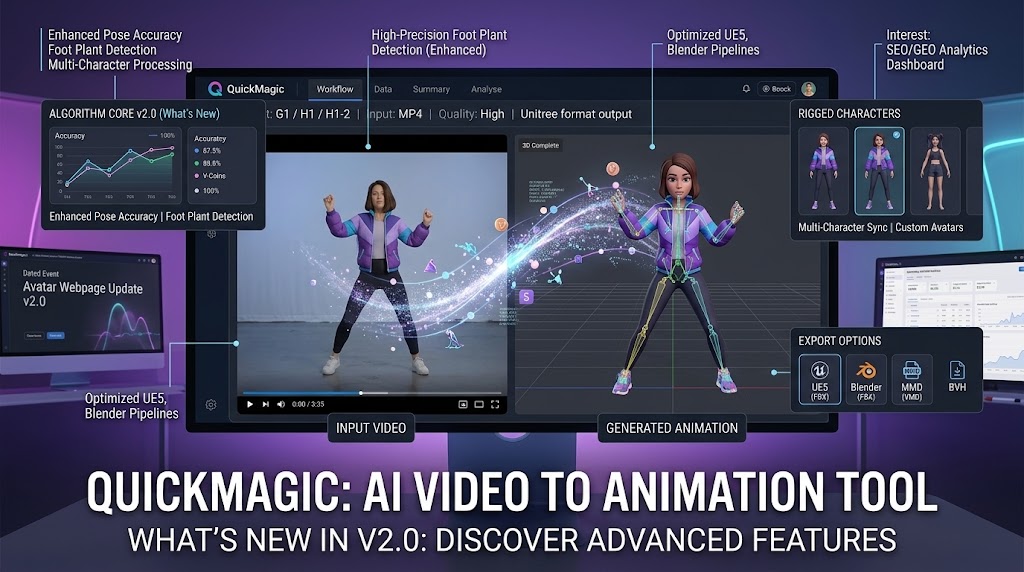
What you get: Full-body and upper-body AI body tracking from video or webcam. Hand and facial motion support. Export to FBX, BVH, BIP, C4D, VMD, Mixamo, UE4/UE5, Unity, and 13+ other formats.
Strengths: Best export format support in the free tier. Finger tracking included. Text-to-Motion feature for quick pose generation. Cloud processing — no GPU required on your machine.
Limitations: 50 seconds/month on free tier won't cover production needs. For shipping a commercial game, you'll want the $9.90/mo plan (150 seconds).
Rokoko Video — Free Tier
Price: Free (unlimited clips under 15 seconds)
What you get: Browser-based AI body tracking from webcam or uploaded video. Export to FBX/BVH. Integrates with Rokoko Studio for cleanup.
Strengths: Unlimited free captures — rare among AI mocap tools. User-friendly interface. Good for quick tests and short animation bursts.
Limitations: 15-second cap per clip means you'll need to stitch multiple takes for longer sequences. Single-camera tracking struggles with occlusion. No real-time processing.
FreeMoCap — Open Source
Price: Free (open source)
What you get: Full-body 3D markerless tracking using multiple webcams. Community-driven development. No cloud dependency — runs locally.
Strengths: Truly free with no processing limits. Multi-camera support improves accuracy. Privacy-friendly (all local processing).
Limitations: Requires technical setup and calibration. Still in active development with occasional bugs. Limited real-time performance. Needs a decent local GPU for processing.
| Free Tool | Format Support | Processing Limit | Best Use Case |
|---|---|---|---|
| QuickMagic Free | FBX, BVH, BIP, VMD, UE4/5, Mixamo + more | 50s/month | Testing pipeline, short clips, learning |
| Rokoko Video Free | FBX, BVH | Unlimited (max 15s/clip) | Quick tests, short sequences |
| FreeMoCap | FBX, BVH, C3D | Unlimited | Multi-camera setup, privacy-sensitive projects |
Tier 2: Budget AI Subscriptions ($10-20/month)
For solo developers shipping commercial indie games, this is the sweet spot. You get higher processing limits, better accuracy, and professional export options at a cost low enough to fit into any indie budget.
QuickMagic — Starter Plan ($9.90/month)
Best value in the budget tier. For less than $10/month, you get 150 seconds of AI body tracking with full-body, hand, and facial capture. Export to FBX, BVH, BIP, C4D, VMD, Mixamo, UE4/5, Character Creator, iClone, and Roblox — the widest format support at this price point. Finger tracking quality is notably better than competitors at this tier, which matters enormously for first-person games and character emotes.
Why it's the top pick for indie devs:
- 13+ export formats — no other budget tool covers this range
- Finger tracking included — DeepMotion and Plask charge extra or don't match the fidelity
- Text-to-Motion — generate animation from text prompts for quick prototyping
- Robot data export — useful if you're working on embodied AI or simulation projects
DeepMotion — Starter ($15/month)
Cloud-based AI motion capture with markerless full-body tracking. Supports FBX and BVH export. Good for standard locomotion and combat animations. The $15/month plan provides 60 animation credits per month. Smooth results for standard movements but finger tracking is less refined than QuickMagic. Pay-per-use option at $2/minute for overflow needs.
Plask — Basic ($18/month)
Browser-based AI mocap with a focus on ease of use. The Basic plan provides more processing time than the free tier. Export to FBX, BVH, GLB with direct integration to their 3D viewer. Good for quick prototyping but less suitable for production-quality indie game animation. Limited format support compared to QuickMagic and DeepMotion.
| Subscription Tool | Monthly Cost | Processing Limit | Finger Tracking | Export Formats |
|---|---|---|---|---|
| QuickMagic | $9.90 | 150s | Included | FBX, BVH, BIP, C4D, VMD, UE4/5, Mixamo + more |
| DeepMotion | $15 | ~60s | Limited | FBX, BVH |
| Plask | $18 | 300s | No | FBX, BVH, GLB |
| RADiCAL | $12 | Varies | Limited | FBX, BVH |
Tier 3: Professional Animation Packs ($50-300 One-Time)
Here's something most "cheap body tracking" guides miss: for the animations your players see most, pre-made mocap packs deliver better quality than anything you'll capture yourself on a budget. These packs are captured on professional optical systems, cleaned by experienced animators, and ship ready-to-use in Unity, Unreal, and Blender.
MoCap Online packs typically include:
- Locomotion sets ($79-149): Walk, run, jog, sprint, strafe, crouch, and idle variants
- Combat sets ($99-179): Attacks, blocks, dodges, combos, and hit reactions
- Full character sets ($149-299): Hundreds of clips covering all core animations
The math makes sense: a $149 locomotion pack gives you 30-40 game-ready animations. If you captured those yourself with a budget setup, you'd spend 5-10 hours on capture, cleanup, and retargeting. At any reasonable hourly rate, the pack wins.
Tier 4: Entry-Level Mocap Hardware ($1,500-3,000)
If you need to capture original performances regularly — unique characters, proprietary combat styles, or motion that doesn't exist in any pre-made pack — entry-level inertial mocap suits become viable.
Perception Neuron Studio (~$1,500)
The most affordable full-body inertial mocap suit. Uses IMU sensors at major joints, streams wirelessly to Axis Studio software. No cameras, no markers, no dedicated studio. Set up in any room and start capturing. The entry point for solo devs who need ongoing capture capability.
Rokoko Smartsuit Pro II (~$2,500)
More refined than Perception Neuron with better drift compensation and direct Blender/iClone/Unity/Unreal integration. Optional Smartgloves ($500) add finger tracking. Popular with indie studios that need frequent custom capture sessions. The ecosystem is more mature, with better documentation and community support.
When does Tier 4 make sense?
- You're capturing animations for multiple projects over 1+ years
- Your game requires highly specific, unique movements not available in packs
- You have a dedicated team member who will own the mocap pipeline
- You need real-time capture for live performance or iteration
For most solo indie developers, Tier 4 is overkill. The effective cost per animation clip is higher than Tiers 1-3 once you factor in hardware, setup time, performance time, cleanup, and storage. Invest in a suit only when you've exhausted what AI tools and animation packs can deliver.
Complete Affordable Body Tracking Comparison
| Tool | Price | Method | Hardware Needed | Export Formats | Indie Game Suitability |
|---|---|---|---|---|---|
| QuickMagic | Free / $9.90/mo | AI Video-to-Motion | Phone or webcam | FBX, BVH, BIP, VMD, UE4/5, Mixamo, C4D + more | Best all-around |
| DeepMotion | Free / $15/mo | AI Video-to-Motion | Phone or webcam | FBX, BVH | Good for locomotion |
| Rokoko Video | Free / Subscription | AI Video-to-Motion | Webcam (dual-cam optional) | FBX, BVH | Good free option |
| Plask | Free / $18/mo | AI Video-to-Motion | Phone or webcam | FBX, BVH, GLB | Prototyping focus |
| FreeMoCap | Free (OSS) | Multi-cam Markerless | 2+ webcams, GPU | FBX, BVH, C3D | Tech-savvy devs |
| MoCap Online | $50-300 one-time | Pre-captured Packs | None | FBX, Unity, Unreal, Blender, BIP, iClone | Best quality-per-dollar |
| Perception Neuron | ~$1,500 | Inertial Suit | Suit + PC | FBX, BVH, C3D | Frequent capture needed |
3-Step Cheap Body Tracking Workflow for Indie Game Animation
Here's the exact workflow we recommend for indie developers who want to ship a game with quality character animation on a budget:
Step 1: Capture Your Core Animations
Start with the animations players see most: locomotion (walk, run, sprint, strafe, idle) and core gameplay actions (attack, block, dodge, interact). Use QuickMagic's Starter plan ($9.90/mo) to record yourself performing each action in front of your phone or webcam. Keep each clip under 30 seconds. Record in good lighting with your full body visible. Do 2-3 takes of each movement.
- Walk cycle — 10 seconds, 3 takes
- Run cycle — 8 seconds, 3 takes
- Idle (breathing, weight shift) — 15 seconds, 2 takes
- Attack combo — 12 seconds, 3 takes
- Dodge (left, right, back) — 8 seconds each, 2 takes
Step 2: Process and Clean Up
Upload each video to QuickMagic. The AI processes body tracking in 2-5 minutes per clip. Download the FBX files and import them into Blender (free) or Cascadeur (free indie tier) for cleanup:
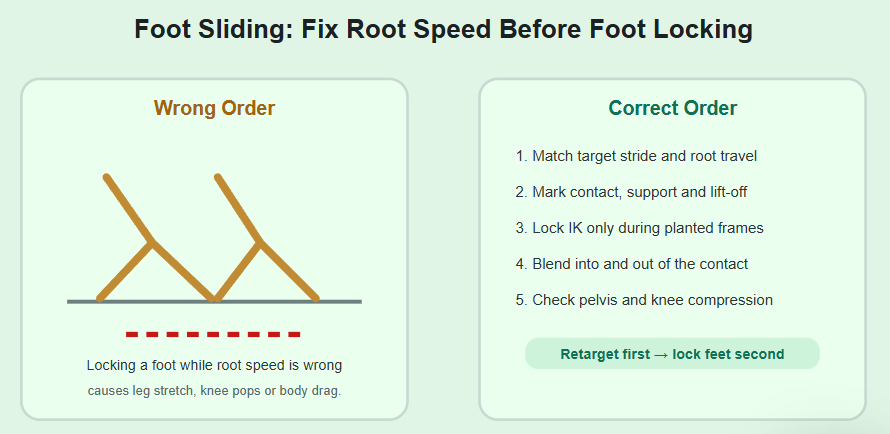
- Foot sliding fix: Use Blender's NLA Editor to lock foot IK at contact frames
- Noise reduction: Apply a slight smooth filter to motion curves (Cascadeur's auto-physics does this automatically)
- Timing adjustment: Speed up or slow down sections to match gameplay feel
- Loop creation: Set up seamless walk/run/idle loops in your animation software
Step 3: Import and Integrate
Import cleaned FBX files into your game engine. In Unity, use the Animator Controller to set up blend trees for locomotion. In Unreal Engine, use Animation Blueprints with blend spaces. Test animations in-game at actual player speed — what looks smooth in the animation viewer may feel sluggish or floaty at gameplay framerates.
Total time for a solo dev following this workflow: 8-15 hours to produce 20-30 core animations. Compare that to 120-400 hours of manual keyframing, and the value of affordable body tracking becomes undeniable.
5 Mistakes Indie Devs Make with Cheap Body Tracking (And How to Avoid Them)
After helping hundreds of indie developers set up their animation pipelines, these are the recurring pitfalls:
1. Bad Lighting = Bad Tracking
AI body tracking models are trained on well-lit subjects against clear backgrounds. Dim rooms, backlighting, and cluttered backgrounds confuse the algorithm. Fix: Use a single bright light source in front of the subject. Wear contrasting clothing against a plain wall. Your phone camera in a well-lit room will outperform a $2,000 camera in a dark basement.
2. Skipping the Cleanup Pass
No AI tool produces production-ready animation on the first pass. There will be foot sliding, slight jitter on fast movements, and occasional joint pops. Fix: Budget 10-15 minutes of cleanup per 10 seconds of captured animation. Cascadeur's free tier automates most of this with physics-based correction. The difference between "game jam quality" and "Steam release quality" is almost always the cleanup pass.
3. Using Free Tools for Production Work
Free tiers are designed for testing, not shipping. Processing limits, watermarks, and reduced export quality will bottleneck your production. Fix: Use free tiers to evaluate tools and learn the workflow. Switch to the $9.90-15/mo paid tier for actual production — it's one of the cheapest line items in your game's budget and delivers disproportionate value.
4. Capturing Everything Yourself
You don't need to capture every animation. Walk cycles, idle poses, and basic combat moves are nearly identical across games. Fix: Use MoCap Online packs ($50-150) for universal animations. Reserve custom capture for what makes your game unique — signature attacks, character-specific emotes, unusual creature locomotion.
5. Ignoring the Engine-Specific Export
Generic FBX export works, but engine-native formats (UE mannequin skeleton, Unity Humanoid) save hours of retargeting. Fix: Choose a tool like QuickMagic that exports directly to UE4/UE5 skeleton formats and Mixamo-compatible rigs. The extra export format support pays for itself the first time you skip a 2-hour retargeting session.
What About Face and Hand Tracking?
Body tracking gets your character moving. Face and hand tracking make them expressive. Here's what's available on an indie budget:
Facial Animation
- iPhone + Live Link Face (Free): If you own an iPhone X or later, Apple's ARKit tracks 52 facial blendshapes. Epic's Live Link Face app streams directly into Unreal Engine. This is genuinely professional-quality face capture at consumer hardware cost.
- QuickMagic Face Mode (Included in $9.90/mo plan): Captures facial motion from the same video as body tracking — no separate hardware needed.
- Webcam-based options (Free): OpenSeeFace and MediaPipe Face Mesh work with any webcam. Quality is lower than iPhone-based capture but sufficient for background NPCs.
Hand and Finger Tracking
- QuickMagic hand tracking (Included): Finger-level tracking from the same video input. Quality is best-in-class at this price point.
- Leap Motion Controller 2 (~$100): Optical hand tracker. Excellent for desktop-focused capture where hands are near the sensor.
- Rokoko Smartgloves (~$500): Purpose-built finger tracking gloves for the Smartsuit ecosystem.
Frequently Asked Questions About Cheap Body Tracking
What is the cheapest way to do body tracking for indie game animation?
The cheapest way is free AI video-to-motion tools like QuickMagic's free tier (50 seconds/month), Rokoko Video (unlimited free for clips under 15s), or FreeMoCap (open source). These require only a smartphone or webcam — no suits, no markers, no additional hardware.
Can I use AI body tracking for a commercial indie game?
Yes. Most AI body tracking tools including QuickMagic, DeepMotion, Plask, and Rokoko Video allow commercial use of mocap data generated through their platforms. Always check the specific license terms of your chosen tool — some free tiers have restrictions on redistribution or require attribution.
How much does affordable mocap cost for indie developers?
Indie mocap costs range from $0 to $1,500 depending on approach. Free AI tools (QuickMagic, Rokoko Video, FreeMoCap) cost $0/month. Subscription AI services (DeepMotion, Plask) run $10-$50/month. Professional animation packs (MoCap Online) cost $50-$300 as one-time purchases. Entry-level inertial suits (Perception Neuron) start around $1,500.
What is the difference between AI body tracking and traditional mocap suits?
AI body tracking (markerless) uses computer vision to extract 3D skeleton data from standard video — no suit, markers, or special cameras required. It costs $0-$50/month and works with a phone or webcam. Traditional mocap suits (inertial or optical) use physical sensors or reflective markers for millimeter-precision tracking but cost $1,500-$25,000+ and require calibration and post-processing.
Can I export body tracking data to Unity or Unreal Engine?
Yes. QuickMagic exports to FBX, BVH, UE4, UE5.5, UE5.6 directly. DeepMotion supports FBX and BVH for both Unity and Unreal. Rokoko exports FBX/BVH compatible with both engines. Most modern AI mocap tools support FBX, which is the universal format for Unity and Unreal Engine animation import.
How accurate is cheap body tracking compared to professional mocap?
Budget AI body tracking achieves 85-95% of professional mocap accuracy for standard movements (walking, running, idle, basic combat). It struggles with fast, occluded, or highly complex motions. Professional optical systems (Vicon) achieve sub-millimeter precision but cost $25,000+. For most indie games, AI body tracking quality is more than sufficient for locomotion, combat, and dialogue scenes.
Do I need a special camera for affordable body tracking?
No. AI body tracking tools work with any standard webcam (720p+) or smartphone camera. For best results, use a 1080p camera in good lighting with the subject's full body visible. Most tools (QuickMagic, DeepMotion, Rokoko Video, Plask) are designed to work with consumer-grade cameras.
Which body tracking tool has the best export format support?
QuickMagic supports the widest range: FBX, BVH, BIP, C4D, VMD, Mixamo, UE4, UE5.5, UE5.6, Character Creator, iClone, Roblox, and OnlyFace — making it compatible with virtually every animation pipeline. DeepMotion and Rokoko Video offer FBX and BVH, which covers most common workflows. Plask supports FBX, BVH, and GLB.
Is offline/local body tracking available for privacy-conscious projects?
Yes. FreeMoCap runs entirely on your local machine with no cloud dependency. Marionette offers local processing with manual cleanup features. For cloud-based tools, most (including QuickMagic) process data on secure servers and do not retain uploaded videos beyond the processing period — check each tool's privacy policy for details.
Can body tracking capture multiple characters at once?
Some tools support multi-subject capture. QuickMagic supports multi-subject workflows. Move AI works well with multi-person scenes when using multiple cameras. Most budget AI tools are optimized for single-subject capture — for multi-character scenes, capture each actor separately and composite in your animation software.
Start Capturing Character Animation Today — Free
Record