The human body communicates as a whole. A wave is not just an arm moving — it is shoulder rotation, wrist flick, finger splay, and often a smile, all happening in sync. For decades, motion capture technology treated these signals as separate problems: one system for the body, another for the hands, a third for the face. Holistic motion capture ends that fragmentation. A single AI model now reads full body hand face mocap data from one video — body skeleton, finger articulation, and facial mesh, all in one pass.
This guide explains what AI holistic tracking is, how it works under the hood, why it outperforms fragmented approaches, and how tools like QuickMagic make it accessible to anyone with a camera.
What Is Holistic Motion Capture?
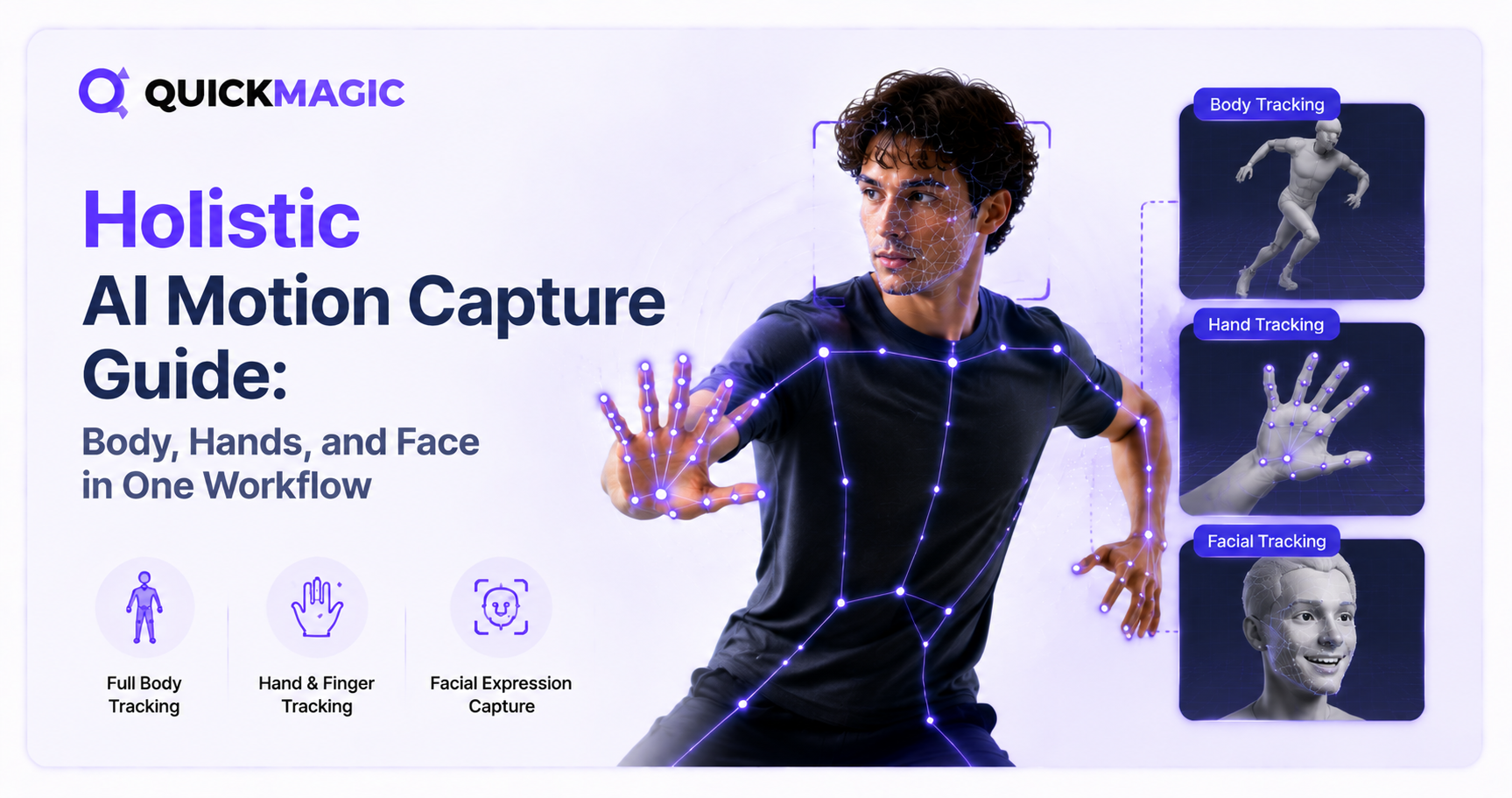
Holistic motion capture is a unified tracking approach that simultaneously estimates body pose, hand landmarks, and facial mesh from a single video using one shared AI model. The word "holistic" is key — it means the model understands the whole performer at once, not three body parts in isolation.
A holistic tracking model outputs three synchronized data streams from every video frame:
- Body skeleton — 33 joints covering spine, shoulders, elbows, wrists, hips, knees, and ankles. This captures large-scale locomotion: walking, jumping, dancing, reaching.
- Hand landmarks — 21 points per hand (42 total), covering every finger joint from knuckle to fingertip. This captures fine motor control: grips, gestures, sign language, instrument playing.
- Facial mesh — 468 dense points across the face, capturing eye gaze, brow movement, lip sync, cheek deformation, and micro-expressions.
Together, that is 543 tracked landmarks per frame — a comprehensive digital representation of a human performance from a single camera.
Holistic motion capture is the simultaneous estimation of body, hand, and facial motion from a single video using a unified AI model with shared feature extraction. Unlike fragmented approaches that run separate trackers and stitch results in post, holistic capture produces naturally synchronized, spatially consistent motion data from the moment of capture.
From Fragmented to Holistic: Why the Shift Matters
Traditional performance capture pipelines were built on fragmentation. A typical studio setup combined:
Each system operated independently. The body suit had no awareness of hand position. The gloves had no awareness of facial context. The facial camera ran on its own timecode. Stitching these into a single coherent performance required expensive post-production work — manual timecode alignment, coordinate-space conversion, and conflict resolution between systems that never communicated with each other.
The core problem was architectural: three models with no shared understanding of the performer. AI holistic tracking solves this at the model level.
Holistic vs. Fragmented Capture: Side by Side
| Aspect | Fragmented (3 Separate Systems) | Holistic (One Unified Model) |
|---|---|---|
| Architecture | 3 independent models, no shared context | 1 shared backbone, 3 coordinated branches |
| Synchronization | Manual timecode alignment in post | Inherent — same frame, same model |
| Spatial consistency | Coordinate spaces must be merged | Unified coordinate space from capture |
| Hardware | Suit + gloves + HMC + multi-camera rig | Single phone or webcam |
| Cost | $10K–$100K+ | Free tier / $9.9/mo |
| Post-production | Hours of manual merge & cleanup | Minimal — data arrives unified |
How AI Holistic Tracking Works
The technical innovation behind holistic capture is not just running three models at once — it is the shared feature backbone that lets all three branches benefit from a common understanding of the performer. Here is the pipeline:
- Shared Feature Extraction A convolutional neural network processes each video frame and extracts a rich set of visual features — edges, textures, depth cues, and motion patterns. This feature map is the shared foundation that all three tracking branches draw from, eliminating redundant computation.
- Body Pose Estimation (First Pass) The body branch runs first, predicting 33 skeletal joints in 3D space. This establishes the performer's overall pose and, critically, identifies the rough location of the head and both wrists — the anchor points for the face and hand detectors.
- ROI-Guided Hand & Face Detection Using wrist positions from the body skeleton, the system crops regions of interest (ROIs) for the left and right hands. Using head position, it crops the facial ROI. This "coarse-to-fine" strategy means the hand and face detectors search only relevant areas — not the entire frame — boosting both speed and accuracy.
- Fine Landmark Regression Within each cropped ROI, specialized sub-networks predict 21 hand landmarks per hand and 468 facial mesh points. Because these branches share the backbone features and are guided by body context, they benefit from spatial awareness that standalone detectors lack.
- Temporal Smoothing & Unified Export Frame-to-frame jitter is reduced with temporal filters (one-euro or Kalman). All three data streams — body, hands, face — share the same timestamp and coordinate space, so they export as a single synchronized animation file in FBX, BVH, BIP, VMD, or other formats.
Because body, hand, and face branches share a common feature backbone, they gain mutual context. The body tracker's wrist position guides the hand detector's search region. The head pose orients the facial mesh. This cross-branch awareness improves accuracy across all three domains compared to running isolated models — and it is what makes the approach truly "holistic" rather than merely "simultaneous."
Why the One-Workflow Approach Wins
The practical benefits of holistic capture extend well beyond technical elegance. For creators and studios, the unified workflow delivers measurable advantages:
Natural Synchronization
Because body, hand, and face data come from the same frame processed by the same model, they are perfectly synchronized by construction. There is no timecode drift, no offset between facial animation and body motion, no frame where a smile arrives before the gesture that prompted it. The performance feels coherent because it was coherent at capture time.
Spatial Consistency
All three data streams share one coordinate space from the moment of capture. Hands are positioned relative to the body skeleton. Facial orientation aligns with head pose. There is no need to reconcile conflicting coordinate systems — the data arrives internally consistent.
Dramatically Lower Barrier to Entry
Holistic AI tracking works from a single video. No mocap suit, no reflective markers, no data gloves, no head-mounted camera, no multi-camera rig. A creator with a smartphone can capture a complete performance — body language, hand gestures, facial expression — and export it as production-ready 3D animation data.
Faster Iteration
Traditional fragmented capture requires booking studio time, suiting up performers, calibrating multiple systems, and scheduling cleanup sessions. Holistic capture compresses this to: record, upload, export. Ideas can be tested in minutes, not days. For previs, prototyping, and creative iteration, this speed is transformative.
QuickMagic: Holistic Capture in Practice
QuickMagic brings holistic motion capture to anyone with a camera. The workflow is deliberately simple:
- Record a performance with any camera — phone, webcam, or professional camera. Ensure the full body, hands, and face are visible throughout.
- Upload the video to QuickMagic. Select body, hand, and facial capture together in a single workflow.
- Process — the AI model extracts all three motion layers from the same video frames, producing unified, synchronized 3D animation data.
- Preview the result in the built-in viewer to verify body movement, finger detail, and facial expression all look right.
- Export in your preferred format — FBX, BVH, BIP, VMD, Mixamo, Unreal Engine, Unity, Maya, Blender, iClone, MMD, Roblox, Cascadeur, and more.
Key capabilities that make QuickMagic effective for full body hand face mocap:
- Unified capture — body, hands, and face from one video, one model, one export.
- Multi-subject support — track multiple performers simultaneously, each with full holistic data.
- Flexible frame rates — 24, 30, 60, or 120 FPS output to match any project.
- Built-in anti-penetration — collision correction prevents fingers from clipping through palms and body.
- Static and moving camera — works with tripod shots and handheld footage alike.
- 13+ export formats — seamless integration with virtually any 3D animation pipeline.
Game developers animating characters with natural body language and expressive faces, VTubers driving avatars with synchronized gestures and emotions, indie filmmakers prototyping full performances before studio shoots, MMD creators producing dance videos with finger choreography and facial nuance, and robotics researchers generating holistic human motion references for embodied AI training.
Frequently Asked Questions
What is holistic motion capture?
Holistic motion capture is a unified approach that simultaneously tracks body skeleton motion, hand articulation, and facial expressions from a single video using one shared AI model. Unlike fragmented workflows that run separate trackers for each body part, holistic capture uses a shared feature backbone so body, hand, and face data are naturally synchronized and spatially consistent.
How does AI holistic tracking work?
AI holistic tracking uses a shared neural network backbone to extract visual features from each video frame, then dispatches them to specialized branches for body pose, hand landmarks, and facial mesh detection. The body pose branch runs first and its results guide where the hand and face detectors look, reducing redundant computation and improving accuracy.
Can I capture full body, hand, and face motion from a single video?
Yes. Tools like QuickMagic use AI holistic tracking to extract full-body motion, finger-level hand articulation, and detailed facial expressions from one standard video recorded with a phone or webcam. No mocap suit, reflective markers, depth sensors, or multi-camera studio are required.
What is the difference between holistic and separate motion capture?
Separate motion capture runs independent systems for body, hands, and face, then stitches the data together in post-production — requiring manual timecode sync and coordinate-space alignment. Holistic motion capture uses one shared model, so all three data streams are naturally synchronized and spatially consistent from the moment of capture.
How many landmarks does holistic motion capture track?
A holistic motion capture model typically tracks 543 landmarks simultaneously: 33 body skeleton joints, 42 hand landmarks (21 per hand), and 468 facial mesh points. This dense coverage captures the full range of human nonverbal expression in a single pass.
Ready to Capture the Whole Performance?
Upload a video to QuickMagic and get holistic body, hand, and face mocap data in one unified workflow. No suit, no markers, no studio — just AI-powered holistic capture from any camera.
Try QuickMagic Free