The world of AI 3D animation is evolving at breakneck speed. What once required a dedicated motion-capture studio, dozens of reflective markers, and a team of technicians can now be accomplished with a smartphone video and a browser tab. Markerless Motion Capture has gone from a niche research demo to a production-ready pipeline — and indie creators, game developers, VTubers, and MMD artists are the biggest beneficiaries.
But with four major platforms competing for your attention — QuickMagic, Plask, Move.ai, and DeepMotion — which one actually delivers the best balance of quality, speed, versatility, and price?
This in-depth comparison breaks down each tool's strengths and weaknesses, with a clear focus on helping you choose the right AI Motion Capture platform for your creative workflow.
Quick Summary: Which Tool Should You Choose?
| Feature | QuickMagic | Plask | Move.ai | DeepMotion (Animate 3D / SayMotion) |
|---|---|---|---|---|
| Video to 3D Animation | Full-body, hand & face | Full-body & hand | Multi-camera, high-accuracy | Full-body, hand & face |
| Text to 3D Animation | Built-in | Not available | Not available | SayMotion (separate tool) |
| Motion Retargeting | Extensive (UE5, Mixamo, iClone, Roblox, MMD & more) | Limited | Studio-dependent | UE5 retargeting |
| Export Formats | FBX, BVH, BIP, C4D, VMD, Mixamo, UE MetaHuman, Roblox, iClone, Unitree Robot | FBX, GLB, BVH | Not publicly listed | FBX, BVH, GLB, USD |
| MMD / VTuber Support | Native VMD export | No VMD | No VMD | No VMD |
| Robotics / Humanoid Robot Data | Unitree G1, H1 presets | |||
| Pricing Transparency | Free tier + clear paid plans | Free → $50/mo | Contact for quote | Credit-based, complex |
| Best For | All-round creators, MMD, VTuber, robotics, game devs | Beginners & web-based mocap | Enterprise studios | Text-to-motion experimentation |
1. QuickMagic — The All-in-One AI 3D Animation Powerhouse
QuickMagic has rapidly emerged as the most versatile AI Motion Capture platform on the market. It combines two core pipelines — Video to 3D Animation and Text to 3D Animation — into a single, unified browser-based workspace, eliminating the friction that plagues competing tools.
Key Strengths
Triple-Channel Capture: Body, Hand & Face
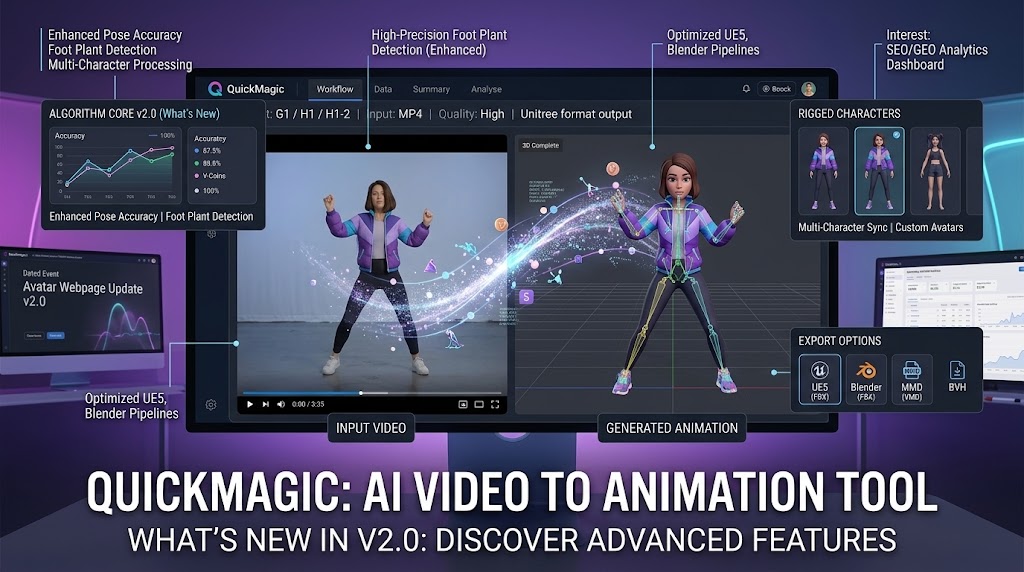
Unlike many competitors that focus solely on body movement, QuickMagic captures full-body, hand, and facial motion from a single video. For VTubers, Digital Humans creators, and MMD artists, this means you can animate an entire character performance — including subtle hand gestures and facial expressions — from one footage upload. No separate face-capture rig required.
Text to 3D Animation — Built Right In
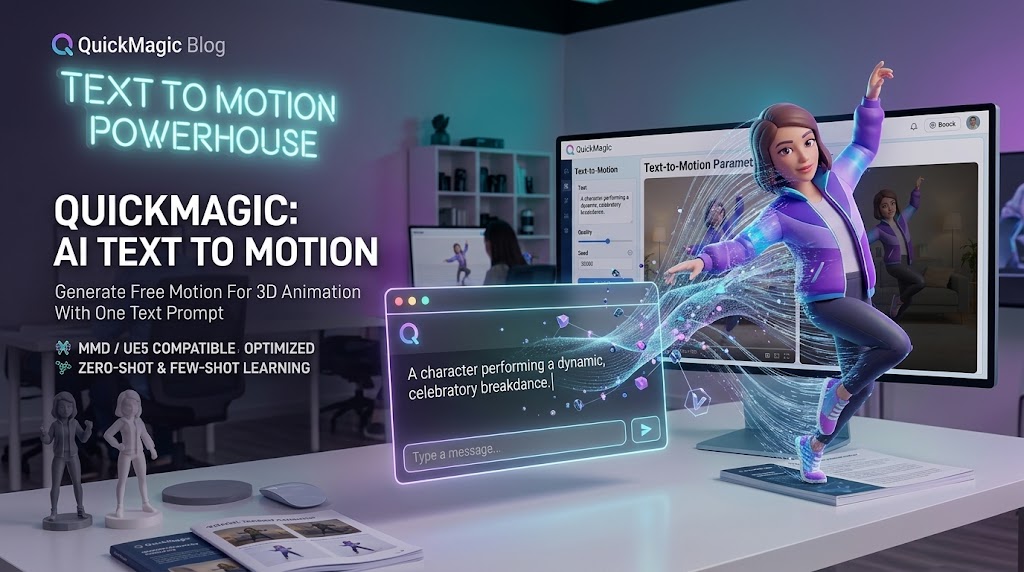
QuickMagic lets you describe an action in plain language and generates an editable 3D motion draft. While DeepMotion offers this through its separate SayMotion product, QuickMagic integrates Generative 3D Motion directly into the same platform as its video mocap pipeline. Describe a pose, preview it, export it, and refine it — all without switching tools.
Industry-Leading Motion Retargeting
This is where QuickMagic truly pulls ahead. The platform supports an unmatched range of retargeting and export presets:
- Unreal Engine (UE4, UE 5.5, UE 5.6, MetaHuman)
- Blender, Maya, 3ds Max, MotionBuilder
- Mixamo
- Character Creator & iClone
- MikuMikuDance (VMD)
- Roblox
- Cascadeur
- Cartoon Animator
- Unitree humanoid robots (G1, H1, H1_2)
No other platform in this comparison offers native VMD export for MMD, or motion presets for humanoid robotics. If you work in the MMD ecosystem, VTuber content creation, or robotics simulation, QuickMagic is the only tool that speaks your language natively.
Real-Time Body Tracking Meets Robotics
QuickMagic's Real-Time Body Tracking capabilities extend beyond entertainment. The platform can generate human-motion reference data for humanoid robot simulation, imitation-learning experiments, and behavior prototyping — with direct export presets for Unitree robot models. This opens doors for AI researchers and robotics engineers that no other consumer mocap tool even attempts.
Single- & Multi-Subject Workflows
Whether you're capturing a solo dance performance or a two-person interaction, QuickMagic handles both single- and multi-subject scenarios. It also supports both static-camera and moving-camera footage, giving you far more flexibility in how you shoot your reference video.
QuickMagic is the only platform that treats MMD, VTuber, game dev, and robotics as first-class citizens rather than afterthoughts.
2. Plask — The Beginner-Friendly Browser Mocap
Plask positions itself as an accessible, browser-based AI Motion Capture tool aimed at beginners and small teams. It offers a clean web interface, a freemium model, and built-in scene-rendering capabilities.
Strengths
- Clean, intuitive browser interface
- Full-body and hand capture
- Multi-person mocap support
- FBX, GLB, BVH export
- Real-time collaboration features
- Built-in video rendering with auto camera and lighting
Weaknesses
- No Text to 3D Animation — Plask is video-only, missing the generative AI wave
- No VMD export — MMD creators are left out entirely
- No facial capture — only body and hands
- Strict time limits — Free plan caps at 15 seconds/day; even the $50/month Pro plan only gives you 1 hour/month
- No robotics or humanoid robot support
- Limited retargeting presets compared to QuickMagic
The Verdict
Plask is a solid entry point for absolute beginners who want to dip their toes into Video to 3D Animation. But its strict time limits, lack of text-to-motion, missing facial capture, and absence of MMD/VTuber-specific features make it a stepping stone rather than a long-term production tool.
3. Move.ai — The Enterprise-Grade Studio Solution
Move.ai is the heavy hitter of the group. It pioneered multi-camera Markerless Motion Capture systems and counts Disney, Ubisoft, SEGA, Sony, Meta, Nike, and Paramount Pictures among its clients. This is enterprise-grade technology designed for professional VFX studios and large-scale productions.
Strengths
- Industry-leading multi-camera accuracy
- Data quality comparable to optical marker-based systems
- Scalable capture volumes
- Trusted by AAA game studios and Hollywood VFX houses
- No suits or markers required
Weaknesses
- No public pricing — you must book a demo and request a quote, which immediately excludes indie creators and hobbyists
- Multi-camera hardware requirements — not a simple "upload a phone video" workflow
- No Text to 3D Animation
- No browser-based solo-creator workflow comparable to QuickMagic or Plask
- No VMD, Roblox, or MMD export
- No facial capture from a single camera
- Not designed for VTubers, MMD artists, or solo indie creators
The Verdict
Move.ai is phenomenal technology — for studios with budgets, camera arrays, and production teams. For the solo creator, indie game developer, VTuber, or MMD artist, it's simply the wrong tool. It's like recommending a Hollywood sound stage to someone who wants to record a podcast. If you're an individual creator looking for AI Motion Capture that works from a single phone video, Move.ai is not your answer.
4. DeepMotion (Animate 3D & SayMotion) — The Text-to-Motion Pioneer
DeepMotion splits its offering into two products: Animate 3D for video-based motion capture and SayMotion for Text to 3D Animation. The company has been a trailblazer in Generative 3D Motion and was among the first to demo text-prompt-driven animation generation.
Animate 3D — Strengths
- Full-body, hand, and face capture from video
- Multi-person tracking
- UE5 retargeting support
- MetaHuman animation pipeline
- Free animation credit program
SayMotion — Strengths
- Text-to-3D-animation via generative AI
- Story prompt crafting and prompt enhancer tools
- Motion merging and AI inpainting
- Loop and refine animations
- API available for developers
Weaknesses
- Fragmented workflow — Video mocap (Animate 3D) and text-to-motion (SayMotion) are separate tools, not a unified pipeline
- Credit-based pricing can be unpredictable and hard to budget for
- No VMD export — MMD creators are unsupported
- No Roblox or robotics presets
- No iClone or Character Creator native presets
- Slower iteration — the split between two platforms adds friction to the creative workflow
The Verdict
DeepMotion deserves credit for pioneering text to 3D animation and Generative 3D Motion. SayMotion remains an exciting experimental tool. However, the fragmented two-product approach, credit-based pricing model, and lack of MMD/VTuber-native exports make it less practical as an all-in-one production tool compared to QuickMagic's unified platform.
Head-to-Head: The Features That Matter Most
Video to 3D Animation Winner: QuickMagic
All four platforms convert video to 3D motion, but QuickMagic wins on flexibility: it handles body, hand, and facial capture from a single video, supports both static and moving cameras, and offers single- and multi-subject workflows. Plask lacks facial capture; Move.ai requires a multi-camera setup; DeepMotion's Animate 3D is strong but lives in a separate silo from its text-to-motion tool.
Text to 3D Animation Winner: QuickMagic
Only QuickMagic and DeepMotion (SayMotion) offer text-to-motion. QuickMagic's advantage is integration — text-generated motion lives in the same workspace as video mocap, so you can combine, compare, and refine both in a single pipeline. DeepMotion requires switching between Animate 3D and SayMotion.
Motion Retargeting Winner: QuickMagic
QuickMagic is the undisputed leader here. Its export presets cover more destinations than any competitor — Unreal Engine (multiple versions + MetaHuman), Blender, Maya, 3ds Max, MotionBuilder, Mixamo, iClone, Character Creator, MMD (VMD), Roblox, Cascadeur, Cartoon Animator, and even Unitree humanoid robots. No other platform comes close to this breadth.