Interview · Computer Vision · Creativity · Retargeting
How AI MoCap Works: 15 Questions with the QuickMagic Team
A corrected and expanded interview about video-to-3D motion, depth ambiguity, markerless accessibility, source correction, target retargeting, creative control, traditional animation skills and the future of AI-assisted character performance.
Current QuickMagic facts
Workflow and correction videos
Video to 3D MoCap Animation — QuickMagic Full Tutorial
Shows the full path from ordinary footage to editable 3D animation.
Open on YouTubeQuickMagic 2D Refinement Tutorial
Demonstrates correction of observable keypoint and contact errors before regeneration.
Open on YouTubeHow the technology actually works
1What fundamental animation problem is QuickMagic trying to solve?
The goal is to reduce the time, equipment and specialist knowledge needed to turn a performance into editable character motion. AI mocap is most valuable when it shortens blocking and iteration without removing the animator’s control over acting, style, contacts and final quality.
2How does AI motion capture work for a beginner?
A system detects the performer, estimates body or facial landmarks, reconstructs a likely 3D pose across time, applies kinematic and temporal constraints and exports skeletal animation. The system estimates hidden depth; it does not directly measure invisible joints or muscle force from a standard RGB video.
3Does AI augment animators or replace them?
AI is strongest as a base-motion and iteration tool. Animators still choose the performance, edit timing and silhouette, direct emotion, adapt motion to character design, establish contacts and decide what is narratively correct.
4What makes 2D video-to-3D motion difficult?
The main challenges are depth ambiguity, occlusion, motion blur, out-of-frame body parts, left/right identity, camera movement, floor and prop contact, multiple-subject overlap and temporal consistency. Multiple views, sensors or manual constraints add evidence when exact depth is required.
5How does markerless AI make mocap more accessible?
It can start from footage recorded on a phone, webcam or camera and run through a web workflow without a marker suit or calibrated studio. Accessibility still depends on source quality, plan limits, processing queues, export compatibility and the time needed to retarget and clean the final character.
6Which applications are the best fit?
Strong starting uses include game prototypes, indie animation, previs, NPC and background-motion libraries, digital-human gestures, MMD and virtual-idol content, education and selected humanoid-robot motion-reference workflows. Precision props, severe multi-actor overlap and scientific measurement may need a more controlled or hybrid system.
7How should a product balance accuracy with accessibility?
Use automatic defaults for ordinary footage, but expose confidence, model, pose, frame-rate, root and cleanup controls for difficult shots. Correction tools should address observable source errors, while downstream retargeting should address target-skeleton and contact problems.
8What advice matters most for independent creators?
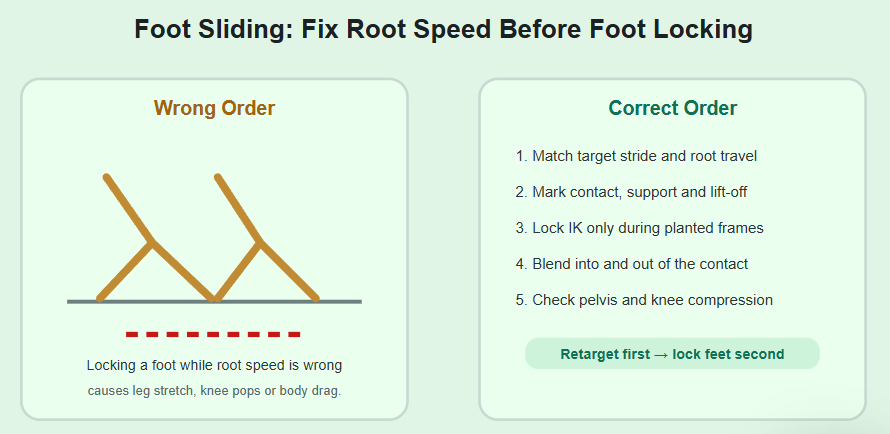
Test the hardest five to ten seconds first, use footage you recorded or have rights to use, match framing to the capture scope, preserve a raw export, correct source errors before smoothing, retarget before judging foot sliding and measure total cleanup time on the real character.
9How will the AI animation pipeline evolve?
A likely direction is a multimodal pipeline that combines video reconstruction, text or voice direction, style controls, automatic quality checks and reusable motion libraries. This is a forecast, not a statement that every feature is available today.
10What principles should guide creative AI development?
Useful principles include creator control, editable outputs, clear product limits, permission to use the source footage, privacy and retention transparency, reproducible settings and a path to correct errors rather than hiding uncertainty.
11How are subtle movement details captured?
Subtle body, hand and facial detail requires enough source pixels, sharpness and visibility. Systems can model landmarks and expression channels, but a wide full-body shot cannot provide the same finger or facial evidence as a dedicated close capture. Fixed landmark counts also vary by model and export.
12Do traditional animation skills still matter?
Yes. Staging, weight, timing, arcs, anticipation, follow-through, silhouette and acting remain essential. AI changes which frames an animator constructs manually; it does not remove the need to understand why a movement communicates a specific emotion or story beat.
13How should success be measured?
Measure source fidelity, final target contacts, root stability, deformation, processing and correction time, export reliability and the number of useful creative iterations. A smooth preview or an undefined accuracy percentage is not enough.
14What has AI mocap revealed about human movement?
Small changes in timing, balance, posture and asymmetry strongly affect how audiences read intent. These cues can inform animation, but movement should not be treated as a perfect decoder of a person’s private emotion, personality or health.
15What major challenge is still worth solving?
Style-aware motion translation is a valuable goal: preserve the performer’s timing and intent while adapting weight, exaggeration and rhythm to a character and visual style. The difficult part is making style editable and predictable rather than applying an opaque filter.
Technical notes behind the answers
Original interview media
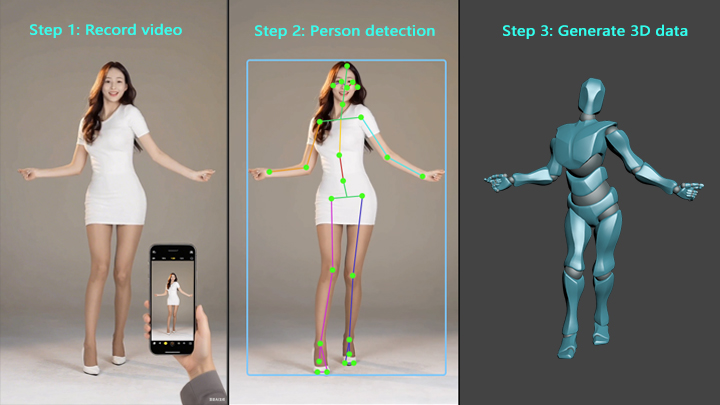
Original three-step cover
Record video, detect the person and generate 3D animation.
Original external interview
The source article was presented through Animation & VFX Jobs.
Source motion in Blender
The reconstructed skeleton still needs target-rig review.
2D Refinement
Correction is most effective when the visible source observation is wrong.
Key takeaways for creators and studios
- AI mocap estimates 3D motion; it does not directly measure hidden anatomy or force.
- Source visibility, sharpness, framing and contact evidence define the quality ceiling.
- Use 2D correction for source-observation errors and retarget tools for target-rig errors.
- Keep original footage, raw motion, optimized motion and final target animation separate.
- Use only footage and characters for which the project has appropriate rights.
- Test the hardest interval before processing a long clip or animation library.
- Judge success by final-character fidelity, contacts, deformation and total correction time.
Condensed FAQ
What fundamental animation problem is QuickMagic trying to solve?
The goal is to reduce the time, equipment and specialist knowledge needed to turn a performance into editable character motion. AI mocap is most valuable when it shortens blocking and iteration without removing the animator’s control over acting, style, contacts and final quality.
How does AI motion capture work for a beginner?
A system detects the performer, estimates body or facial landmarks, reconstructs a likely 3D pose across time, applies kinematic and temporal constraints and exports skeletal animation. The system estimates hidden depth; it does not directly measure invisible joints or muscle force from a standard RGB video.
Does AI augment animators or replace them?
AI is strongest as a base-motion and iteration tool. Animators still choose the performance, edit timing and silhouette, direct emotion, adapt motion to character design, establish contacts and decide what is narratively correct.
What makes 2D video-to-3D motion difficult?
The main challenges are depth ambiguity, occlusion, motion blur, out-of-frame body parts, left/right identity, camera movement, floor and prop contact, multiple-subject overlap and temporal consistency. Multiple views, sensors or manual constraints add evidence when exact depth is required.
How does markerless AI make mocap more accessible?
It can start from footage recorded on a phone, webcam or camera and run through a web workflow without a marker suit or calibrated studio. Accessibility still depends on source quality, plan limits, processing queues, export compatibility and the time needed to retarget and clean the final character.
Which applications are the best fit?
Strong starting uses include game prototypes, indie animation, previs, NPC and background-motion libraries, digital-human gestures, MMD and virtual-idol content, education and selected humanoid-robot motion-reference workflows. Precision props, severe multi-actor overlap and scientific measurement may need a more controlled or hybrid system.
How should a product balance accuracy with accessibility?
Use automatic defaults for ordinary footage, but expose confidence, model, pose, frame-rate, root and cleanup controls for difficult shots. Correction tools should address observable source errors, while downstream retargeting should address target-skeleton and contact problems.
What advice matters most for independent creators?
Test the hardest five to ten seconds first, use footage you recorded or have rights to use, match framing to the capture scope, preserve a raw export, correct source errors before smoothing, retarget before judging foot sliding and measure total cleanup time on the real character.
How will the AI animation pipeline evolve?
A likely direction is a multimodal pipeline that combines video reconstruction, text or voice direction, style controls, automatic quality checks and reusable motion libraries. This is a forecast, not a statement that every feature is available today.
What principles should guide creative AI development?
Useful principles include creator control, editable outputs, clear product limits, permission to use the source footage, privacy and retention transparency, reproducible settings and a path to correct errors rather than hiding uncertainty.
How are subtle movement details captured?
Subtle body, hand and facial detail requires enough source pixels, sharpness and visibility. Systems can model landmarks and expression channels, but a wide full-body shot cannot provide the same finger or facial evidence as a dedicated close capture. Fixed landmark counts also vary by model and export.
Do traditional animation skills still matter?
Yes. Staging, weight, timing, arcs, anticipation, follow-through, silhouette and acting remain essential. AI changes which frames an animator constructs manually; it does not remove the need to understand why a movement communicates a specific emotion or story beat.
How should success be measured?
Measure source fidelity, final target contacts, root stability, deformation, processing and correction time, export reliability and the number of useful creative iterations. A smooth preview or an undefined accuracy percentage is not enough.
What has AI mocap revealed about human movement?
Small changes in timing, balance, posture and asymmetry strongly affect how audiences read intent. These cues can inform animation, but movement should not be treated as a perfect decoder of a person’s private emotion, personality or health.
What major challenge is still worth solving?
Style-aware motion translation is a valuable goal: preserve the performer’s timing and intent while adapting weight, exaggeration and rhythm to a character and visual style. The difficult part is making style editable and predictable rather than applying an opaque filter.
Related QuickMagic guides
Test one difficult shot from source to final rig
Use a short clip containing the hardest turn, hand overlap, foot plant or camera move. Record every setting and compare the result after retargeting—not only in the source preview.
Official and technical references
- QuickMagic: Original 15-question interview
- QuickMagic: Current product capabilities and quality boundaries
- QuickMagic: Current plan limits, storage and export formats
- Google AI Edge: Body pose landmarks in images and video
- Google AI Edge: Hand landmarks and handedness
- Google AI Edge: Face landmarks and blendshape outputs
- VideoPose3D: Temporal 3D human pose estimation from video
- Epic Games: IK Rig animation retargeting
- Video to 3D MoCap Animation — QuickMagic Full Tutorial
- QuickMagic 2D Refinement Tutorial