Rastreamento de IA Holístico para Robótica: Dados de Movimento de Referência Humano
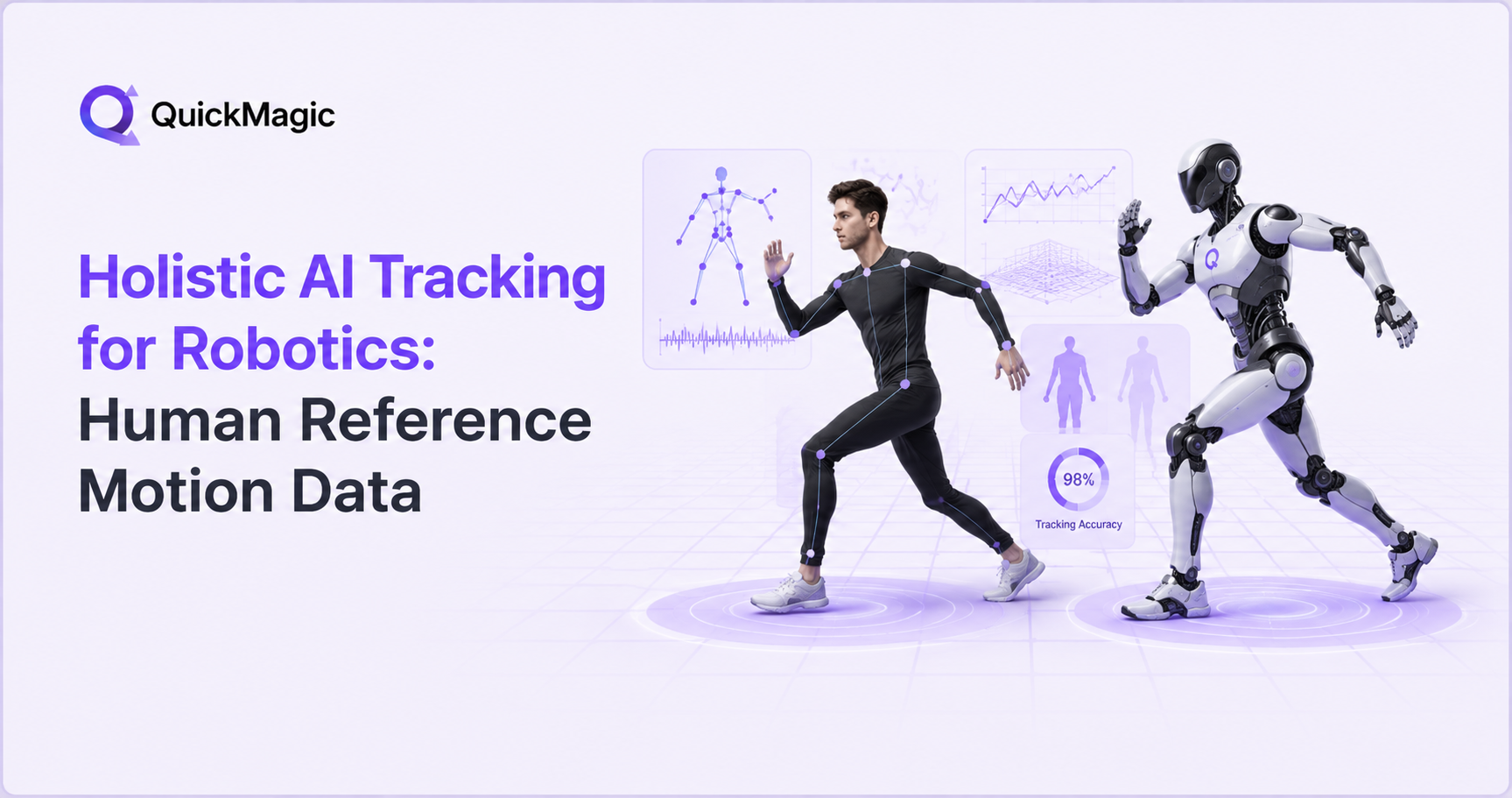
A capacidade de ensinar um robô humanóide a se mover — não codificando manualmente cada trajetória articular, mas mostrando a ele como um ser humano se move — representa uma das mudanças mais significativas na robótica moderna. No centro dessa mudança estão os dados de movimento de referência humano: gravações de alta fidelidade do movimento humano que servem como sinal de treinamento para políticas de controle de robôs. E a tecnologia que torna possível a captura em larga escala desses dados é o rastreamento de IA holístico.
Neste artigo, detalhamos o que o rastreamento holístico significa para a robótica, como a captura de movimento com tecnologia de IA gera dados de referência prontos para robôs e como plataformas como a QuickMagic estão tornando esse pipeline acessível a pesquisadores e engenheiros que trabalham com robôs humanóides da Unitree e outros.
O Que É Rastreamento Holístico em Robótica?
Rastreamento holístico refere-se à captura do movimento completo de um sujeito humano — cada articulação, cada membro, cada dedo, e a trajetória do corpo pelo espaço — e à conversão disso em dados estruturados dos quais um robô pode aprender. A palavra "holístico" importa aqui. Os sistemas tradicionais de captura de movimento geralmente focam em uma dimensão: rastreamento esquelético do corpo inteiro sem as mãos, ou rastreamento das mãos sem o contexto do corpo, ou captura facial isolada. O rastreamento holístico captura tudo junto, preservando as relações entre as partes do corpo que fazem o movimento humano parecer natural.
Para a robótica, essa completude não é um luxo. É um requisito. Quando um robô aprende a servir um copo de água, ele precisa saber como o tronco se inclina, como o braço alcança, como os dedos se fecham ao redor da alça e como o peso se desloca pelos pés — tudo simultaneamente. Dados parciais produzem comportamentos parciais. Dados holísticos produzem habilidades de corpo inteiro coerentes.
Os componentes centrais do rastreamento holístico para robótica incluem:
- Rastreamento esquelético de corpo inteiro: Ângulos articulares e posições de todos os principais segmentos do corpo — cabeça, tronco, braços, pernas, pés — reconstruídos como uma animação esquelética 3D.
- Rastreamento de mãos e dedos: Ângulos articulares individuais dos dedos, rotação do punho e formação da pegada — essenciais para tarefas de manipulação e preensão hábil.
- Rastreamento de trajetória global: A posição e orientação do corpo no espaço mundial ao longo do tempo, não apenas o movimento articular relativo. É isso que diz a um robô onde ele está na sala, não apenas como seus membros estão posicionados.
- Consistência temporal: Movimento quadro a quadro que seja suave e fisicamente plausível, sem saltos repentinos ou tremores que confundiriam um algoritmo de aprendizado.
Por Que os Dados de Movimento de Referência Humano Importam para Robôs
Os robôs não aprendem a se mover da mesma forma que os humanos. Um bebê humano passa anos desenvolvendo controle motor por tentativa, erro e imitação. Um robô, por outro lado, normalmente aprende por meio de aprendizado por reforço (RL) — um processo no qual ele tenta milhares de movimentos em simulação, recebe recompensas pelos bem-sucedidos e gradualmente desenvolve uma política de controle que mapeia entradas sensoriais para comandos motores.
O problema é que o RL do zero é extraordinariamente caro. O espaço de busca de movimentos possíveis é astronômico. Sem orientação, um robô pode passar milhões de episódios de simulação descobrindo que andar envolve dobrar os joelhos — algo que uma criança humana descobre observando os outros.
É aqui que os dados de referência de mocap para robôs mudam a equação. Em vez de aprender do nada, o robô recebe o movimento humano como um sinal de referência — um alvo a ser seguido. A política de RL é recompensada não apenas por permanecer em pé, mas por corresponder ao movimento de referência o mais próximo possível. Isso reduz drasticamente o espaço de busca. O robô não precisa inventar o andar; ele precisa adaptar o andar humano ao seu próprio corpo.
A pesquisa tem mostrado consistentemente que o RL guiado por movimento de referência produz resultados dramaticamente melhores do que o aprendizado do zero. O marco BeyondMimic e seus sucessores demonstraram que robôs humanóides podem aprender movimentos complexos e dinâmicos — incluindo artes marciais, dança e cambalhotas acrobáticas — rastreando dados de movimento humano retargetados. Trabalhos mais recentes como OmniTrack (CVPR 2025) mostraram que dados de referência fisicamente consistentes permitem que o Unitree G1 execute rodadas de carrinho e corra continuamente por mais de uma hora.
Insight fundamental: Os dados de movimento de referência humano não são apenas uma entrada de treinamento — são uma restrição que torna o aprendizado do robô viável. Ao dizer ao robô "mova-se assim", convertemos um problema de busca impossivelmente grande em um problema administrável.
Do Movimento Humano ao Movimento do Robô: O Pipeline de Retargeting
Capturar o movimento humano é apenas o primeiro passo. Humanos e robôs têm corpos fundamentalmente diferentes. Um esqueleto humano tem mais de 200 articulações com faixas específicas de movimento, distribuições de peso e forças de atuadores. Um Unitree G1 tem de 23 a 43 graus de liberdade, dependendo da configuração. Um Unitree H1 tem 27. Os dados de movimento capturados de um humano não podem ser aplicados diretamente a um robô — eles precisam ser retargetados.
Retargeting é o processo de mapear o movimento articular humano para a estrutura cinemática do robô. Envolve:
- Correspondência corporal: Identificar quais articulações humanas correspondem a quais articulações do robô. Um ombro humano corresponde a um ombro do robô, mas o movimento escapular de 3 GDL de um humano pode corresponder a um ombro de 2 GDL do robô — exigindo simplificação.
- Escalonamento e ajuste de proporções: O braço humano é mais longo que o braço de um Unitree G1. Os comprimentos dos membros devem ser escalados para que o movimento se ajuste à geometria do robô.
- Aplicação de limites articulares: Se um humano gira o quadril além do limite físico do robô, o movimento retargetado deve ser limitado ou ajustado para evitar comandos impossíveis.
- Tratamento do contato dos pés: Os pés humanos tocam o chão em padrões específicos. O movimento retargetado deve garantir que os pés do robô façam contato adequado com o chão — sem flutuação, sem penetração.
- Correção de anti-penetração: Os membros não devem atravessar uns aos outros ou o próprio corpo do robô. Retargeting de qualidade inclui detecção e correção de colisões.
Pesquisas publicadas em 2025 e 2026 deixaram claro que a qualidade do retargeting determina diretamente o desempenho da política. O estudo "Retargeting Matters: General Motion Retargeting for Humanoid Motion Tracking" (Stanford HAI, 2025) comparou três métodos de retargeting — PHC, ProtoMotions e um novo método chamado GMR — e descobriu que artefatos nos dados retargetados (penetração no chão, auto-intersecção, saltos articulares súbitos) degradavam significativamente a robustez das políticas aprendidas. Em alguns casos, retargeting de má qualidade tornava impossível para o robô aprender o movimento.
É por isso que plataformas que lidam com o retargeting automaticamente — mapeando o movimento humano para modelos de robô específicos como o Unitree G1, H1 ou H1_2 — proporcionam um valor enorme. Elas removem uma etapa complexa e propensa a erros do fluxo de trabalho do pesquisador e produzem dados imediatamente utilizáveis em ambientes de simulação.
Mocap Tradicional vs. Captura Sem Marcadores com IA
Por décadas, o padrão ouro para captura de movimento foi o sistema óptico baseado em marcadores: marcadores reflexivos colocados em pontos de referência específicos do corpo, rastreados por matrizes de câmeras infravermelhas calibradas em um estúdio controlado. Sistemas como OptiTrack e Vicon entregam precisão submilimétrica, mas vêm com limitações significativas:
| Fator | Mocap Óptico Tradicional | Mocap Sem Marcadores com IA |
|---|---|---|
| Hardware necessário | Múltiplas câmeras calibradas, marcadores reflexivos, estrutura de montagem | Câmera única (celular, webcam ou câmera profissional) |
| Ambiente | Estúdio controlado com instalação fixa | Qualquer local — interno, externo, laboratório |
| Tempo de configuração | 30+ minutos para calibração | Menos de 1 minuto — envie e processe |
| Preparação do sujeito | Traje de marcadores ou marcadores adesivos no corpo | Sem marcadores, sem traje, sem roupas especiais |
| Liberdade de movimento | Limitada ao volume de captura | Ilimitada — capture em qualquer lugar que a câmera possa ver |
| Escalabilidade | Um volume de captura, normalmente um sujeito por vez | Processamento em nuvem permite captura e processamento em lote |
| Custo | US$ 50.000–US$ 250.000+ por um sistema completo | Assinatura gratuita ou de baixo custo |
| Precisão | Submilimétrica (ideal para verdade fundamental) | Nível de centímetros (suficiente para a maioria dos dados de treinamento) |
A troca é clara. Os sistemas tradicionais vencem em precisão bruta; os sistemas sem marcadores com IA vencem em acessibilidade, escalabilidade e custo. Para a pesquisa em robótica — onde o objetivo é muitas vezes gerar grandes e diversos conjuntos de dados de treinamento em vez de alcançar precisão de nível de referência em uma única captura — as vantagens da captura com IA são decisivas.
Uma equipe de pesquisa que precisa de 100 estilos diferentes de caminhada para treinar uma política de locomoção generalista não pode viabilizar trazer 100 sujeitos para um estúdio de mocap. Mas eles podem gravar 100 vídeos com um celular, enviá-los a uma plataforma sem marcadores e receber dados de movimento do robô retargetados para cada um. Esse é o tipo de escalabilidade que os fluxos de trabalho de mocap AI da Unitree permitem.
Integração com Robôs Unitree: Do Movimento Humano ao G1, H1 e H1_2
A Unitree Robotics emergiu como uma das plataformas de robôs humanóides mais amplamente utilizadas na pesquisa acadêmica e industrial. O Unitree G1 — com 132 cm de altura, aproximadamente 35 kg, e de 23 a 43 graus de liberdade dependendo da configuração — tornou-se uma plataforma de referência para a pesquisa de locomoção bípede, com mais de 30 artigos revisados por pares publicados somente em 2025 por instituições como Caltech, SJTU, HKU e Cornell. O Unitree H1 e H1_2 — humanóides de tamanho completo com 180 cm de altura — são usados para manipulação de corpo inteiro e tarefas de locomoção dinâmica.
Integrar a captura de movimento com IA aos robôs Unitree envolve um pipeline específico:
1. Captura
O movimento humano é gravado em vídeo usando qualquer fonte de câmera — um smartphone, webcam ou câmera profissional. Os requisitos principais são visibilidade clara do sujeito, iluminação razoável e uma taxa de quadros de pelo menos 30 FPS (60 FPS ou mais é preferível para movimentos rápidos).
2. Processamento com IA
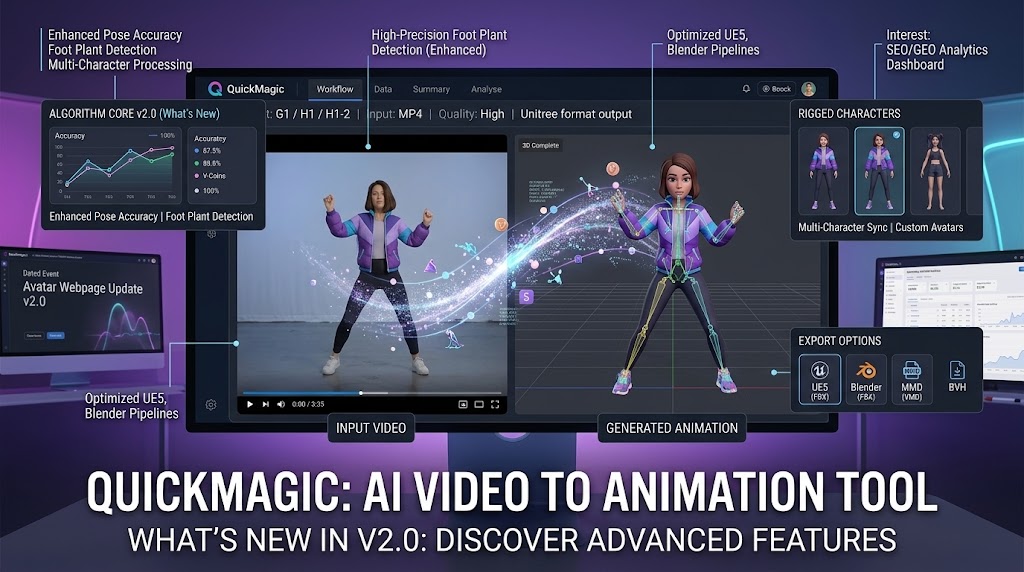
O vídeo é processado por modelos de IA que detectam pontos de referência corporais quadro a quadro, reconstroem uma animação esquelética 3D e aplicam correção de anti-penetração para garantir que o movimento seja fisicamente plausível. A saída é uma sequência de movimento de corpo inteiro em um formato padrão como BVH ou FBX.
3. Retargeting para a Cinemática do Robô
O movimento humano é retargetado para a estrutura cinemática do modelo Unitree específico. A configuração EDU de 29 GDL do Unitree G1, por exemplo, tem limites articulares e proporções de membros diferentes da estrutura de 27 GDL do H1. O processo de retargeting escala o movimento humano para se ajustar a essas restrições, produzindo trajetórias de ângulos articulares fisicamente alcançáveis pelo robô.
4. Exportação em Formato Compatível com o Robô
O movimento retargetado é exportado em formatos diretamente utilizáveis por estruturas de simulação e treinamento de robôs. O preset de exportação UniRobot da QuickMagic lida com essa etapa, produzindo dados compatíveis com as especificações do Unitree G1, H1 e H1_2 para uso no Isaac Gym, MuJoCo e no Unitree RL GYM.
5. Treinamento e Implantação
O movimento de referência retargetado serve como alvo de rastreamento para a imitação de movimento baseada em RL. A política aprende a seguir a referência o mais próximo possível enquanto mantém o equilíbrio e respeita a dinâmica física do robô. Uma vez treinada, a política pode ser implantada no robô físico via Unitree SDK.
Este pipeline — da captura em vídeo à implantação no robô — agora pode ser concluído sem qualquer hardware de mocap tradicional. Um pesquisador com um Unitree G1, uma câmera de celular e uma plataforma de mocap com IA baseada em navegador pode gerar dados de treinamento, executar simulações e implantar políticas no robô físico.
Aplicações: Onde o Rastreamento Holístico Encontra o Aprendizado de Robôs
Aprendizado por Imitação
O aprendizado por imitação — também chamado de clonagem comportamental — treina um robô para replicar comportamentos demonstrados. Dados de movimento humano holístico fornecem as demonstrações. Para robôs humanóides, isso significa aprender não apenas o que fazer (pegar um copo) mas como fazer com qualidade de movimento semelhante à humana — a transferência de peso, a trajetória do alcance, a formação da pegada. A riqueza dos dados holísticos (corpo + mãos + trajetória) produz comportamentos mais naturais e generalizáveis do que dados apenas do corpo.
Aprendizado por Reforço com Rastreamento de Referência
Na imitação de movimento baseada em RL, a política do robô é treinada para rastrear o movimento de referência enquanto mantém a estabilidade física. O movimento de referência serve como sinal de recompensa: quanto mais próximo o movimento do robô estiver da referência, maior a recompensa. Essa abordagem foi validada em múltiplas estruturas — BeyondMimic, OmniTrack, OmniH2O — e em múltiplas plataformas de robôs, produzindo consistentemente políticas mais robustas e naturais do que o RL do zero.
Prototipagem de Comportamentos
Antes de se comprometer com uma execução completa de treinamento de RL — que pode levar horas ou dias de tempo de GPU — os pesquisadores podem prototipar comportamentos usando dados de movimento de referência. A estrutura cinemática do robô suporta esse movimento? Há violações de limites articulares? O movimento será dinamicamente estável? Ao testar os dados de referência primeiro em simulação, os pesquisadores podem filtrar movimentos inviáveis antecipadamente e concentrar os recursos de treinamento em movimentos com alta probabilidade de sucesso.
Teleoperação e Controle com Humano no Circuito
O rastreamento de movimento humano em tempo real permite a teleoperação: os movimentos de um operador humano são capturados e mapeados para o robô em tempo real, permitindo o controle direto do robô para tarefas complexas. Sistemas como TWIST2 (2025) demonstraram que a teleoperação de corpo inteiro baseada em VR pode coletar 100 demonstrações de manipulação bimanual em menos de 20 minutos com taxa de sucesso próxima de 100% — uma eficiência de coleta de dados impossível com a programação manual de robôs.
Construção de Biblioteca de Habilidades
À medida que a robótica avança em direção a plataformas humanóides de propósito geral, a capacidade de construir e manter bibliotecas de habilidades de movimento reutilizáveis torna-se crítica. O rastreamento holístico permite a captura sistemática de movimentos humanos diversos — andar, correr, agachar, alcançar, agarrar, arremessar — que podem ser catalogados, retargetados para diferentes modelos de robôs e recuperados sob demanda para treinamento ou implantação direta.
Qualidade dos Dados: O Que Torna o Movimento de Referência Bom para o Treinamento de Robôs
Nem todos os dados de movimento são igualmente úteis para o aprendizado de robôs. A qualidade dos dados de referência afeta diretamente a qualidade da política aprendida. Com base em descobertas de pesquisas recentes em robótica, os seguintes critérios de qualidade são críticos:
- Plausibilidade física: O movimento deve ser alcançável por um corpo físico — sem flutuação, sem penetração no chão, sem auto-intersecção. Dados de referência fisicamente inconsistentes forçam a política de RL a aprender simultaneamente o movimento e a corrigir a física impossível, degradando o desempenho.
- Conformidade com limites articulares: Cada ângulo articular nos dados retargetados deve estar dentro da faixa mecânica do robô. Valores articulares que excedem os limites produzem erros NaN ou comportamento errático durante o treinamento.
- Suavidade temporal: Saltos súbitos nos ângulos articulares — mesmo descontinuidades de um único quadro — criam instabilidade no treinamento de RL. Os dados de movimento devem ser filtrados para remover tremores e interpolados onde houver quadros ausentes.
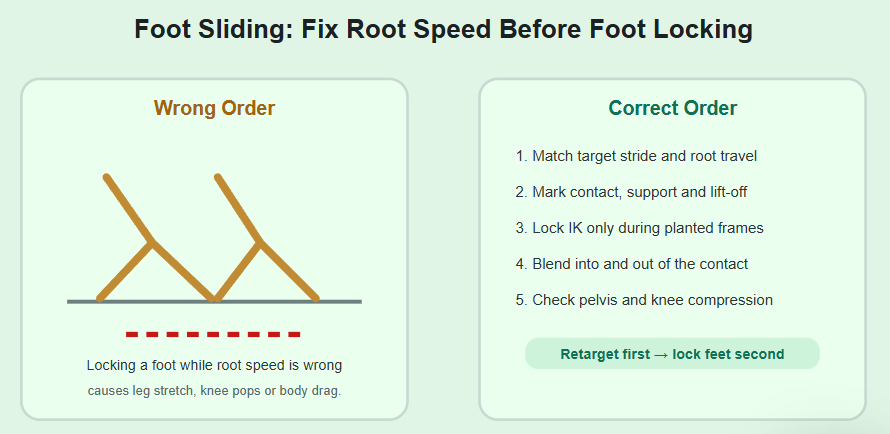
- Precisão do contato dos pés: Para tarefas de locomoção, o tempo e a posição dos contatos dos pés devem estar corretos. O deslizamento dos pés (pés deslizando quando deveriam estar plantados) é um dos artefatos mais comuns que degradam a qualidade da política de locomoção.
- Diversidade: Uma política treinada em um único estilo de caminhada produzirá apenas esse estilo. Treinar com dados de referência diversos — diferentes velocidades, diferentes terrenos, diferentes tipos de movimento — produz uma política generalista que pode se adaptar a situações novas.
As plataformas de captura de movimento com IA lidam com vários desses critérios automaticamente. Os sistemas de anti-penetração evitam que os membros atravessem uns aos outros. Os presets de retargeting aplicam limites articulares. O processamento em nuvem permite a captura em lote de conjuntos de movimento diversos. Mas o pesquisador humano ainda desempenha um papel na garantia de qualidade — visualizando o movimento retargetado em simulação antes de se comprometer com uma execução de treinamento.
A Lacuna de Corporificação e Como Superá-la
Mesmo com captura de movimento perfeita e retargeting perfeito, um desafio fundamental permanece: a lacuna de corporificação. Humanos e robôs não são iguais. O centro de massa de um humano é diferente do de um Unitree G1. Os músculos humanos produzem força de maneira diferente dos motores elétricos. As articulações humanas têm características de amortecimento diferentes das articulações dos robôs.
Quando você diz a um robô para "rastrear este movimento humano", você está implicitamente pedindo que ele faça algo para o qual seu corpo não foi projetado. Isso pode levar a:
- Flutuação: O movimento de referência coloca o robô no ar quando seu peso diz que ele deveria estar no chão.
- Penetração: Ângulos articulares retargetados fazem os membros do robô atravessarem seu próprio corpo ou o chão.
- Deslizamento dos pés: Os pés do robô deslizam porque o padrão de marcha humano não corresponde ao comprimento da passada do robô.
Pesquisas recentes abordaram essa lacuna por meio da geração de referência fisicamente consistente. A estrutura OmniTrack (CVPR 2025), por exemplo, usa uma abordagem em dois estágios: primeiro, uma política com informações privilegiadas "imagina" como o robô realizaria realisticamente o movimento humano em um simulador de física, produzindo um movimento que se parece com o original humano, mas obedece à física do robô. Depois, uma política de segundo estágio aprende a rastrear essa referência fisicamente consistente usando apenas dados proprioceptivos (o que o robô pode realmente sentir). Esse desacoplamento — separar "este movimento é fisicamente possível?" de "o robô consegue segui-lo?" — produziu resultados de última geração, incluindo o Unitree G1 executando saltos laterais, rodadas de carrinho e corrida ao ar livre por 60 minutos contínuos.
A implicação prática para pesquisadores que usam captura de movimento com IA é direta: o retargeting bruto de humano para robô fornece a referência inicial, e o refinamento baseado em física (seja por meio de execuções de simulação ou políticas de refinamento aprendidas) produz o movimento de referência final e implantável. Ambas as etapas se beneficiam de ter dados-fonte de alta qualidade — que é onde a qualidade de captura das plataformas de mocap com IA importa.
Do Texto ao Movimento: Expandindo o Pipeline de Dados
Além da captura baseada em vídeo, algumas plataformas de mocap com IA agora suportam geração de texto para movimento — a capacidade de descrever uma ação em linguagem natural e fazer a IA gerar uma sequência de movimento 3D a partir dessa descrição. Isso abre uma fonte de dados complementar para a robótica:
- Prototipagem rápida: Descreva um movimento ("andar para frente, depois agachar e alcançar um objeto no chão") e obtenha imediatamente um rascunho de movimento para testar em simulação.
- Aumento sintético de dados: Gere variações de um movimento (diferentes velocidades, diferentes ângulos de alcance) sem precisar gravar novos vídeos.
- Preenchimento de lacunas de movimento: Quando você precisa de um movimento específico que é difícil de capturar em vídeo, o texto para movimento pode gerar uma aproximação plausível.
Embora o texto para movimento ainda não seja um substituto para a captura humana real em termos de qualidade e realismo do movimento, ele fornece um complemento valioso — particularmente para prototipagem em estágio inicial e para gerar os grandes volumes de dados de treinamento diversos que o aprendizado modern