KI-Motion Capture · Body Tracking
Körperverfolgung mit bewegter Kamera: Wie KI dynamisches Filmmaterial verarbeitet
Ein praktischer Leitfaden zur Trennung von Darstellerbewegung und Kamerabewegung, zur Verbesserung der dynamischen Körperverfolgung und zur Umwandlung von Hand- oder Trackingaufnahmen in bearbeitbare 3D-Animationen.
Was ist Mocap mit bewegter Kamera?
Mocap mit bewegter Kamera ist markerlose Motion Capture anhand von Videos, bei denen die Kamera Position, Ausrichtung, Brennweite oder eine Kombination davon ändert. Die Quelle kann ein Handyclip, ein Gimbal-Follow-Shot, ein Dolly-Fahr, eine Schwenk- oder Neigebewegung, eine Drohnenaufnahme oder Filmmaterial mit allmählichem Zoom sein.
Bei einer fixierten Aufnahme bleibt der Hintergrund weitgehend stabil und der Darsteller erzeugt den Großteil der sichtbaren Bewegung. Bei dynamischem Filmmaterial bewegen sich sowohl das Motiv als auch der Blickwinkel. Das macht dynamisches Body Tracking zu einem gemeinsamen logischen Problem: Die KI muss die Gelenkpose des Körpers wiederherstellen und gleichzeitig berücksichtigen, wie die Kamera das Bild verändert.
Dies unterscheidet sich von herkömmlichem Studio-Motion-Capture. Optische Systeme verwenden typischerweise Marker, kalibrierte Kameras und einen kontrollierten Aufnahmebereich. KI-Video-Mocap schätzt Bewegung aus gewöhnlichem RGB-Video und macht vorhandenes Filmmaterial sowie leichte Produktionsaufbauten viel zugänglicher. Der Kompromiss ist, dass ein einzelnes Video keine vollständigen Tiefeninformationen direkt enthält und echtes Filmmaterial Unschärfe, Verdeckung, Beschnitt und wechselnde Perspektiven enthalten kann.
Warum dynamisches Filmmaterial schwerer zu verfolgen ist
Jeder Frame zeichnet eine 2D-Projektion einer 3D-Szene auf. Wenn sich die Kamera bewegt, ist der scheinbare Pfad des Darstellers auf dem Bildschirm nicht mehr derselbe wie der Pfad des Darstellers in der Welt.
Stell dir vor, du filmst einen Läufer, während du rückwärts gehst. Der Läufer kann in der Bildmitte bleiben, selbst während er sich schnell durch die Szene bewegt. Ein Pose-Tracker kann immer noch gebeugte Knie und schwingende Arme erkennen, aber eine zuverlässige Root-Translation erfordert ein breiteres Verständnis von Kamerabewegung, Maßstab, Bodenkontakt und Bewegung über die Zeit.
Fünf Quellen der Mehrdeutigkeit
- Kameratranslation und -rotation: Schwenks, Neigungen, Bögen und Vorwärtsbewegungen verschieben die gesamte Ansicht.
- Tiefenmehrdeutigkeit: Eine einzelne RGB-Kamera misst Entfernung nicht direkt, daher können mehrere 3D-Posen ein ähnliches 2D-Bild erklären.
- Wechselnder Maßstab: Der Darsteller wird im Bild größer oder kleiner, wenn sich Kamera oder Motiv näher oder weiter entfernen.
- Bewegungsunschärfe und Rolling Shutter: Schnelle Handbewegungen können Landmarken weichzeichnen oder gerade Bewegungen verzerren.
- Verdeckung und Beschnitt: Gliedmaßen können kreuzen, Requisiten können Gelenke verbergen, oder der Darsteller kann den Bildausschnitt verlassen.
Forschungssysteme machen das Problem explizit. Zum Beispiel beschreibt die CVPR 2023 SLAHMR-Arbeit die wahrgenommene Kamerarahmenbewegung als Zusammensetzung aus menschlicher und Kamerabewegung, während das CVPR 2024 WHAM-Projekt menschliche Bewegungsbeweise mit geschätzter Kamerawinkelgeschwindigkeit und Fuß-Boden-Kontakt kombiniert, um eine weltverankerte Flugbahn wiederherzustellen.3, 4 Diese Arbeiten veranschaulichen die allgemeine technische Richtung; kommerzielle Systeme können unterschiedliche proprietäre Architekturen verwenden.
Wie KI die Körperverfolgung mit einer bewegten Kamera handhabt
Es gibt keine einzige universelle Pipeline, aber moderne Systeme kombinieren häufig mehrere der folgenden Stufen. Wenn man sie als eine Abfolge betrachtet, wird es einfacher zu verstehen, wo Fehler auftreten.
Den Darsteller erkennen und verfolgen
Das System lokalisiert zunächst jede Person und behält eine konsistente Identität über die Frames hinweg. Stabiles Identitätstracking ist wichtig, wenn die Kamera neu einrahmt, der Darsteller sich dreht oder mehrere Personen sich kreuzen.
Sichtbare Körperlandmarken schätzen
Ein Posemodell identifiziert Hinweise für Gelenke wie Hüften, Knie, Knöchel, Schultern, Ellbogen und Handgelenke. Dies sind Beobachtungen, noch nicht die endgültige 3D-Animation.
2D-Hinweise in eine 3D-Pose überführen
Die KI nutzt gelernte Körperproportionen, Posemuster, Bildmerkmale und Perspektivenhinweise, um Tiefe abzuleiten und aus dem 2D-Frame ein 3D-Skelett oder Körperschätzung zu erstellen.
Zeitlich schlussfolgern
Temporale Modelle vergleichen benachbarte und frühere Frames. Dies hilft, Bewegungskontinuität zu bewahren, kurze Lücken zu füllen und zu vermeiden, dass jeder Frame als eine unabhängige Pose behandelt wird. Ein plausibler Schritt sollte während der gesamten Sequenz ein plausibler Schritt bleiben.
Kamerabewegung schätzen
Einige Ansätze nutzen Hintergrundmerkmale, optischen Fluss, visuelle Odometrie oder Simultaneous Localization and Mapping (SLAM), um abzuleiten, wie sich der Blickwinkel ändert. Andere lernen kamerabewusste Bewegung gemeinsam. Das Ziel ist dasselbe: Bewegung, die von der Kamera verursacht wird, zu erklären, bevor Bewegung dem Darsteller zugewiesen wird.
Root-Bewegung und Bodenkontakt berechnen
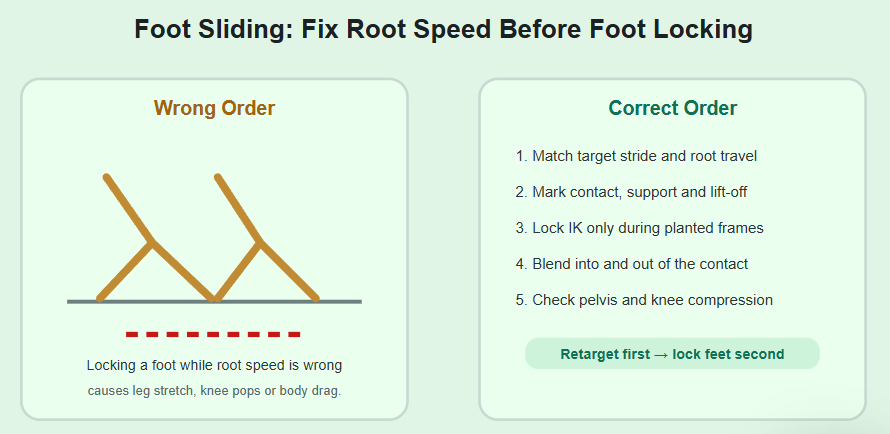
Der Körper wird in ein konsistentes Koordinatensystem gesetzt und erhält eine Root-Trajektorie. Fußkontaktschätzungen helfen zu bestimmen, wann ein Fuß stehen bleiben sollte, wodurch Drift und Fußrutschen reduziert werden.
Die Bewegung konvertieren und umzielen
Die berechnete Performance wird zur bearbeitbaren Skelettanimation. Sie kann dann auf ein Charakter-Rig abgebildet, überprüft und in einer 3D-Software oder Spiel-Engine verfeinert werden.
Statische Kamera vs. bewegte Kamera für KI-Video-Mocap
| Faktor | Statische Kamera | Bewegte Kamera |
|---|---|---|
| Tracking-Schwierigkeit | Niedriger, da Hintergrund und Blickwinkel stabil bleiben. | Höher, da Kamera- und menschliche Bewegung getrennt werden müssen. |
| Kreative Freiheit | Am besten für kontrollierte Aufnahmen und wiederholbare Bildausschnitte. | Besser für Follow-Shots, filmische Blockings, Sport und Archivmaterial. |
| Root-Trajektorie | Einfacher aus der Bildverschiebung abzuleiten. | Erfordert stärkeres kamerabewusstes und zeitliches Denken. |
| Häufige Artefakte | Pose-Jitter, Tiefenfehler oder Fußrutschen. | Dieselben Artefakte plus Drift, Maßstabsänderungen und falsche Weltrichtung. |
| Beste Wahl | Wenn Aufnahmequalität und schnelle Nachbearbeitung Priorität haben. | Wenn die Aktion oder vorhandenes Filmmaterial einen wechselnden Blickwinkel erfordert. |
Eine bewegte Kamera ist nicht automatisch ein schlechtes Eingangsmaterial. Ein ruhiger Follow-Shot mit einem sichtbaren Darsteller kann einfacher zu berechnen sein als eine fixierte Kameraeinstellung mit starker Verdeckung, schlechter Beleuchtung oder starker Unschärfe. Die Eingangsqualität ist eine Kombination mehrerer Faktoren, nicht eine einzelne Einstellung.
So nimmst du besseres Filmmaterial für Mocap mit bewegter Kamera auf
KI kann viele reale Bedingungen kompensieren, aber sie kann keine visuellen Informationen wiederherstellen, die nie im Bild waren. Diese Aufnahmeentscheidungen geben dem Modell stärkere Informationen und reduzieren die spätere Animationsnachbearbeitung.
- Halte den ganzen Körper sichtbar. Für Ganzkörperaufnahmen Kopf, Hände und Füße mit einem kleinen Sicherheitsabstand um den Darsteller einschließen.
- Bewege die Kamera sanft und zielgerichtet. Ein Gimbal ist hilfreich, aber nicht erforderlich. Vermeide plötzliche Reißschwenks und wiederholte Richtungswechsel, wenn möglich.
- Verwende genügend Licht für eine scharfe Belichtung. Bessere Beleuchtung ermöglicht einen schnelleren Verschluss und reduziert Bewegungsunschärfe um Hände und Füße.
- Bewahre Hintergrunddetails. Eine völlig strukturlose Wand, reflektierende Oberfläche oder stark unscharfer Hintergrund liefern schwache Hinweise für die Kamerabewegung.
- Vermeide lange Verdeckungen. Kurze Gliedmaßenkreuzungen sind normal; wenn der Großteil des Körpers für viele Frames hinter Requisiten oder anderen Personen versteckt ist, wird es schwieriger.
- Beschränke aggressive Zooms. Allmähliche Brennweitenänderungen sind einfacher zu interpretieren als schnelle Zooms in Kombination mit Kameratranslation.
- Halte das Motiv groß genug, um es lesen zu können. Ein entfernter Darsteller enthält möglicherweise zu wenige Pixel für zuverlässige Hände, Füße und Gelenkwinkel.
- Nimm ein sauberes Aktionsfenster auf. Gib dem Schauspieler eine klare Startpose, nimm die gesamte Bewegung auf und lasse einen kurzen Puffer vor und nach der Performance.
- Vermeide lockere Kleidung, die die Gelenkstruktur verbirgt. Klare Gliedmaßensilhouetten helfen dem Modell, Ellbogen, Knie und Hüftausrichtung zu lesen.
- Wähle die endgültige Bildrate früh. Eine konsistente Quell- und Zielbildrate reduziert unnötige Zeitkonvertierungen während Export und Retargeting.
Ein Workflow mit bewegter Kamera in QuickMagic
QuickMagic AI Body Tracking verwandelt geeignetes Filmmaterial von einem Telefon, einer Webcam oder einer Kamera in bearbeitbare 3D-Körperbewegung – ohne Mocap-Anzug, Marker, Tiefenhardware oder ein Multi-Kamera-Studio. Der offizielle Workflow umfasst Modi für statische und bewegte Kameras sowie Optionen für Ganzkörper, Oberkörper und unterstütztes Multi-Subjekt.1
- Überprüfe den Quellclip. Kontrolliere Sichtbarkeit des Körpers, Unschärfe, Verdeckung, Überlappung der Motive und ob die Aufnahme eine statische oder bewegte Kamera verwendet.
- Lade das Video hoch. Verwende eine unterstützte Quelle, die mit einem Telefon, einer Webcam, einer DSLR oder einer Standardkamera aufgenommen wurde.
- Wähle das richtige Tracking-Setup. Wähle den Darsteller, Ganzkörper- oder Oberkörperverarbeitung, Bildrate, Kameramodus und verfügbare Bereinigungseinstellungen.
- Generiere und zeige die Bewegung in der Vorschau an. Überprüfe das Gelenkverhalten, die Körperrichtung, die globale Bewegung und wichtige Kontakte, anstatt nur einen Frame zu beurteilen.
- Korrigiere sichtbare Fehler. Behebe Tracking-Probleme, wo unterstützt, und entscheide dann, ob der Charakter die Root-Bewegung behalten oder sich auf der Stelle bewegen soll.
- Exportiere für das Zielsystem. Wähle ein verfügbares Format oder eine Voreinstellung für deinen Ziel-Workflow. QuickMagic listet FBX und workflussspezifische Optionen für Tools wie Blender, Unreal Engine, Unity, Maya, 3ds Max, MotionBuilder, Cascadeur, iClone, MMD und Roblox auf; die Verfügbarkeit variiert je nach Tarif und Workflow.1
- Retarget und schließe ab. Wende die Bewegung auf einen geriggten Charakter an und bereinige Fußkontakte, Root-Bewegung, Jitter, Handplatzierung oder Netzüberschneidungen, wie es die Aufnahme erfordert.2
Die nützlichste Qualitätskontrolle ist ein Side-by-Side-Vergleich: Vergleiche gleichzeitig den Quelldarsteller, das getrackte Skelett und den retargetierten Charakter. Dies trennt Aufnahmefehler von Retargeting-Problemen wie nicht übereinstimmenden Proportionen oder Gelenkausrichtung.
Häufige Tracking-Probleme bei bewegter Kamera – und wie man sie behebt
| Problem | Wahrscheinliche Ursache | Was du versuchen kannst |
|---|---|---|
| Füße gleiten über den Boden | Falsche Root-Bewegung, Bodenhöhe, |