Generative Bewegung · Prompt Engineering · 3D-Animation · FBX
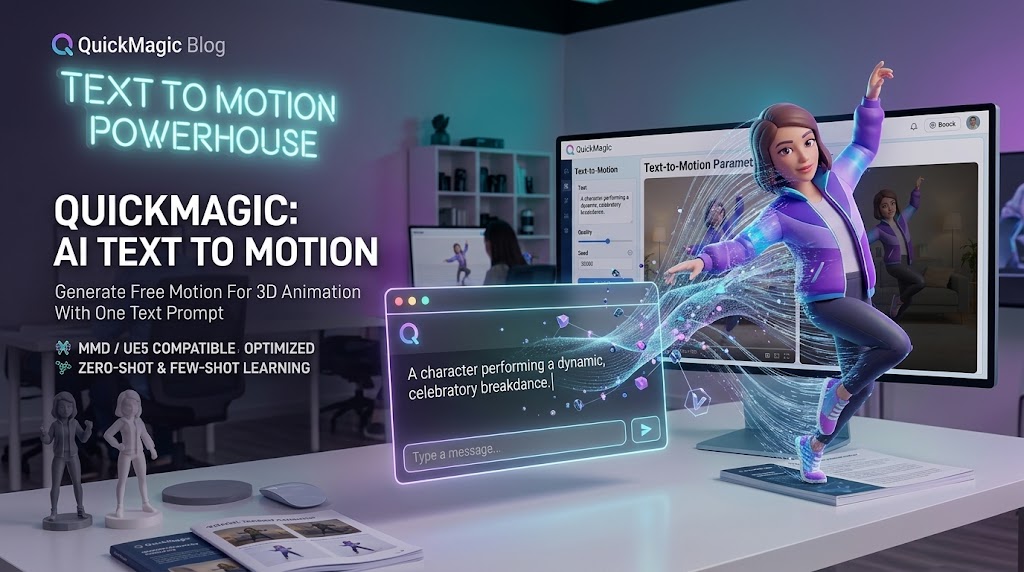
KI Text zu Bewegung: Kostenlose Bewegungsgenerierung für 3D-Animation
Beschreiben Sie eine Aktion in natürlicher Sprache, generieren Sie mehrere bearbeitbare 3D-Bewegungskandidaten, wählen Sie die beste Performance aus und exportieren Sie sie für Blender, Unreal Engine, Unity, Maya, Mixamo, iClone, MMD oder einen anderen Charakter-Animations-Workflow.

QuickMagic Text to Motion – Start-Fakten
Text-zu-Bewegung und Blender-Workflow-Videos
QuickMagic Text to Motion → Mixamo-Charakter → Blender
Zeigt Textgenerierung, einen Mixamo-Charakter und nachgelagerte Blender-Animation.
Auf YouTube öffnenQuickMagic + Mixamo + Blender Animations-Workflow
Erklärt die Mixamo- und Blender-Übergabe, die nach dem Export von QuickMagic-Bewegung verwendet wird.
Auf YouTube öffnenWas ist KI-Text-zu-Bewegung?
Text-zu-Bewegung wandelt natürlichsprachliche Beschreibungen in Sequenzen menschlicher Posen um. Die Ausgabe ist normalerweise Skelettanimation data: joint rotations or positions over time, root movement and a reference-skeleton format that can be imported or retargeted.
Research systems commonly use diffusion models or discrete motion representations with Transformer-style sequence models. QuickMagic has not publicly documented the architecture of its production model, so those methods explain the field rather than the proprietary implementation.

Wie Text zu bearbeitbarer 3D-Bewegung wird

Moderne Systeme lernen Zusammenhänge zwischen Sprache und aufgezeichneten Bewegungsdatensätzen. HumanML3D zum Beispiel führte einen großen gepaarten Bewegungs-Sprachdatensatz ein, während MDM, T2M-GPT und MotionGPT Diffusions-, diskrete Token- und Bewegungs-Sprachansätze demonstrierten. Diese Systeme offenbaren auch eine entscheidende Einschränkung: Datensätze und Textbeschreibungen decken nur einen Teil der Bewegungsvielfalt ab, die für echte Produktionen erforderlich ist.
So schreiben Sie einen guten Text-zu-Bewegungs-Prompt

Prompt-Schreibregeln
- Beginnen Sie mit einem klaren Subjekt, z. B. „Eine Person.“
- Verwenden Sie konkrete physikalische Verben anstatt abstrakter Geschichte.
- Halten Sie die Aktionssequenz kurz genug für die gewählte Dauer.
- Geben Sie links/rechts, vorwärts/rückwärts oder die Drehrichtung an, wenn wichtig.
- Fügen Sie nützliche Modifikatoren für Geschwindigkeit, Haltung, Höhe oder Körperteile hinzu.
- Geben Sie die Endposition an, wenn Looping oder Blending relevant ist.
- Generieren Sie mehrere Kandidaten anstatt einen Prompt zu überladen.
Schwache vs. stärkere Prompts
| Schwacher Prompt | Warum mehrdeutig | Stärkerer Prompt |
|---|---|---|
| „Ein heldenhafter Kampf.“ | Keine spezifische Bewegung, Richtung oder Sequenz | „Eine Person tritt vor, blockt mit dem linken Unterarm, schlägt eine rechte Gerade und kehrt in die Deckung zurück.“ |
| „Nervös gehen.“ | Emotion lässt sich möglicherweise nicht auf präzise Körperbewegung abbilden | „Eine Person geht mit kurzen zögerlichen Schritten vorwärts, Schultern hochgezogen, und hält inne, um über die linke Schulter zu schauen.“ |
| „Cooler Tanz.“ | Stil, Timing und Körperteile sind undefiniert | „Eine Person tritt rechts, dreht den Oberkörper, schwingt beide Arme nach außen und endet in einer breiten, tiefen Pose.“ |
| „Eine Kiste aufheben.“ | Objektgröße und -position unbekannt | „Eine Person beugt die Knie, greift mit beiden Händen nach einem hüftbreiten Objekt auf dem Boden, hebt es auf Brusthöhe und steht auf.“ |
QuickMagic Text to Motion: Schritt für Schritt
1Produktionsziel definieren
Entscheiden Sie, ob der Clip für Previs, einen Game-Prototypen, eine Leerlaufanimation, eine digitale menschliche Geste, eine MMD-Sequenz, eine Roboterbewegungsreferenz oder eine finale Charakteranimation gedacht ist. Der Anwendungsfall bestimmt Dauer, Endpose, Root-Bewegung und Exportvoreinstellung.
2Prompt schreiben oder verfeinern
Geben Sie eine prägnante Aktionsbeschreibung ein. Verwenden Sie Verfeinern oder Polieren, wenn die Anweisung vage ist, oder wählen Sie Beispielskript für ein strukturiertes Beispiel.
3Dauer und Anzahl wählen
Die Startoberfläche unterstützt eine Dauer von 0–10 Sekunden und bis zu 10 generierte Kandidaten. Verwenden Sie mehrere Kandidaten für Prompts mit Stil-, Gleichgewichts- oder Choreografie-Mehrdeutigkeit. Vermeiden Sie es, viele aufeinanderfolgende Aktionen in eine kurze Dauer zu packen.
4Zielformat auswählen
Wählen Sie das nächstgelegene Ziel-Skelett oder Voreinstellung. Die Start-Screenshots zeigen Optionen für Boy FBX, Girl FBX, Mixamo, Unreal 4, Unreal 5.6 und BIP. Die vollständige Produktseite listet zusätzliche workflowspezifische Formate auf, aber die Verfügbarkeit variiert je nach Plan und Workflow.
5Generieren und vergleichen
Zeigen Sie eine Vorschau jedes Kandidaten in normaler und langsamer Geschwindigkeit an. Verwenden Sie Favoriten- oder Bewertungssteuerelemente, um nützliche Ergebnisse zu behalten. Generieren Sie neu, wenn die Bewegung den Prompt verfehlt, anstatt einen grundlegend falschen Kandidaten zu reparieren.
6Exportieren und Animation fertigstellen
Exportieren Sie die ausgewählte Quellbewegung, bewahren Sie eine unbearbeitete Kopie auf, retargetieren Sie sie auf die Produktionsfigur und korrigieren Sie Kontakte, Schleifen, Requisiten, Root-Bewegung und Zielnetzverformung.
10 kopierfertige Text-zu-Bewegungs-Prompts
Gehzyklus
Eine Person geht in entspanntem Tempo vorwärts mit natürlichem Armschwung und kommt zu einem ausbalancierten Stopp.
Boxen
Eine Person steht in einer Boxdeckung, tritt links, schlägt eine schnelle rechte Gerade und kehrt in die Deckung zurück.
Spiel-Ausweichen
Eine Person duckt sich leicht, weicht schnell nach rechts aus und erhebt sich in eine Bereitschaftshaltung.
Sprung
Eine Person macht zwei schnelle Schritte vorwärts, springt mit beiden erhobenen Armen nach oben und landet mit gebeugten Knien.
Begrüßung
Eine Person dreht sich leicht nach links, hebt die rechte Hand, winkt zweimal und senkt den Arm in eine entspannte Pose.
Hinsetzen
Eine Person tritt rückwärts auf einen Stuhl zu, beugt die Knie, setzt sich vorsichtig hin und legt beide Hände auf die Oberschenkel.
Tanzakzent
Eine Person tritt nach rechts, dreht den Oberkörper, schwingt beide Arme nach außen und endet in einer breiten Pose.
Schleichen
Eine Person geht langsam in einer tiefen Hocke mit vorsichtigen Schritten vorwärts und hält inne, um nach links zu schauen.
Roboter-Stil
Eine Person geht mit steifen, segmentierten Bewegungen vorwärts, hält inne, dreht sich neunzig Grad nach rechts und bleibt stehen.
Wiederholbare Leerlaufanimation
Eine Person steht in einer entspannten Deckung, verlagert das Gewicht sanft von einer Seite zur anderen und kehrt in die Ausgangspose zurück.
So wählen Sie den besten generierten Kandidaten aus

| Bewertungskategorie | Fragen, die Sie stellen sollten |
|---|---|
| Prompt-Übereinstimmung | Sind Aktionsreihenfolge, Körperseite, Richtung, Geschwindigkeit und Endpose korrekt? |
| Gleichgewicht und Gewicht | Bewegt sich der Schwerpunkt plausibel durch Schritte, Beugen, Sprünge und Stöße? |
| Root-Trajektorie | Bewegt sich der Charakter, dreht er sich oder bleibt er wie erforderlich an Ort und Stelle? |
| Kontakte | Berühren Füße, Hände und imaginäre Objekte in brauchbaren Frames? |
| Übergang | Lassen sich Start- und Endposen in benachbarte Clips einblenden? |
| Bereinigungskosten | Welcher Kandidat erfordert den geringsten Retargeting-, IK- und Kurvenaufwand? |
Export, Retargeting und Produktionsbereinigung
- Laden Sie die ausgewählte Quellbewegung herunter und bewahren Sie eine unbearbeitete Version auf.
- Importieren Sie mit der richtigen Bildrate, Achse und Einheitenskala.
- Passen Sie die T-Pose oder A-Pose von Quelle und Ziel an.
- Ordnen Sie Root, Becken, Wirbelsäule, Gliedmaßen und optionale Hand-/Gesichtsketten zu.
- Überprüfen Sie Charakterproportionen, Schrittlänge und Root-Bewegung.
- Verwenden Sie IK oder Animationsebenen für Füße, Hände, Requisiten und Gelände.
- Passen Sie Anfangs- und Endposen für Schleifen und Übergänge an.
- Importieren Sie den finalen Export zur Validierung in eine saubere Szene.
Beste Anwendungsfälle für Text-zu-Bewegung
| Anwendungsfall | Warum Text gut funktioniert | Wann eine andere Methode verwenden |
|---|---|---|
| Storyboards und Previs | Testet schnell Bewegungsideen vor dem Casting oder der Aufnahme | Verwenden Sie Video oder Keyframes für exakte finale Schauspielleistungen |
| Game-Prototypen | Erstellt Platzhalter-Angriffe, Leerlaufanimationen, Ausweichbewegungen und Reaktionen | Verwenden Sie finale Aufnahmen für Heldenkämpfe und Interaktionen |
| NPC-Bibliotheken | Generiert viele Varianten alltäglicher Aktionen | Standardisieren Sie Schleifen, Root und Kontakte manuell |
| Digitale Menschen / VTuber | Produziert Gesten, Posen und kurze Reaktionen | Verwenden Sie Live-Tracking für interaktive Echtzeit-Performance |
| MMD / virtuelle Idole | Beschleunigt Bewegungsfindung und kurze Sequenzen | Verwenden Sie Choreografie-Referenzen für synchronisierten Tanz |
| Robotik-Referenz | Erstellt Konzepte menschlicher Bewegung für Simulation und Prototyping | Validieren Sie Machbarkeit, Gelenkgrenzen und Sicherheit am Roboter |