Hand Tracking for VTubers: Animate Expressive Hand Gestures for Free
Your face is tracked. Your head tilts. Your mouth syncs. And then your hands just… float there like two dead fish. If you have ever watched your own VTuber stream back and felt that something was missing, this is almost always it. Hands carry a huge share of human expression, and most VTubing setups ignore them completely. This guide shows you how to animate genuinely expressive hand gestures using free AI motion capture — no gloves, no Leap Motion, no mocap suit, and no keyframing by hand at 3am.
What you will learn
- Why VTuber hands look wrong (and why it matters)
- Every hand tracking option compared
- How AI hand tracking actually works
- Doing it for free with QuickMagic
- Step-by-step: video to expressive hand gestures
- Motion retargeting to VRM, MMD and custom rigs
- Text to 3D animation: gestures without filming
- Nine tips for finger-level accuracy
- QuickMagic vs Animate 3D, SayMotion and others
- FAQ
Why VTuber Hands Look Wrong (And Why It Matters)
Most VTubing software today is built around the face. Webcam-based trackers do a decent job on eyebrows, blink, and mouth shapes, and for a talking-head stream that is genuinely enough. But the moment you move into dancing, singing, ASMR, cooking content, product reviews, TCG openings, or narrative skits, your audience starts looking at your hands — and finds nothing there.
The failure modes are predictable:
- Frozen T-pose hands. The model has fingers, but they never move. Every gesture reads as a mannequin holding an invisible tray.
- Loop-triggered gestures. You hotkey a wave, a heart, a point. They are technically animation, but they repeat identically forever and viewers pattern-match them within twenty minutes.
- IK arms without fingers. Some setups track wrist position from a webcam but leave the fingers rigid, which is arguably worse — moving arms plus dead hands lands squarely in the uncanny valley.
- Interpenetration. Fingers clip through props, mics, mugs, and the character's own chest because nothing is actually driving the joint rotations.
This matters commercially, not just aesthetically. Gesture is how humans signal emphasis, warmth, hesitation, and humour. Strip it out and your character reads as flatter and less alive than your actual personality, which directly suppresses the parameter every VTuber cares about: watch time. Clips that circulate on TikTok and YouTube Shorts overwhelmingly feature motion, and hand-driven moments — the exaggerated shrug, the double finger-guns, the facepalm — are disproportionately clippable.
A human hand has 27 degrees of freedom. A typical VTuber rig animates zero of them. That gap is the single largest untapped expressiveness upgrade available to most streamers right now.
Every Hand Tracking Option, Honestly Compared
Before reaching for a specific tool, it helps to see the whole landscape. There are five realistic routes to animated VTuber hands, and they differ wildly in cost, fidelity, and how much of your life they consume.
| Method | Typical cost | Finger fidelity | Setup friction | Best for |
|---|---|---|---|---|
| Data gloves (Manus, StretchSense) | $1,500 – $8,000+ | Excellent | High — calibration, drivers, per-session drift | Funded studios, virtual production |
| Leap Motion / Ultraleap | $120 – $300 | Good, within a narrow cone | Medium — desk mount, lighting sensitive | Seated streams, hands kept near the sensor |
| VR controllers / trackers | $400 – $1,200 | Poor to fair — mostly presets | Medium — base stations, headset weight | VRChat social, full-body VR content |
| Manual keyframing | Free (costs time) | Perfect, if you are skilled | Extreme — hours per minute of animation | Pre-rendered music videos, short films |
| AI motion capture from video | Free tier available | Very good, improving fast | Low — record on a phone, upload | Most VTubers, MMD creators, indie animators |
The last row is what changed in the past two years. Markerless motion capture driven by neural networks has closed most of the gap with hardware solutions for the kinds of gestures VTubers actually perform — conversational hand movement, dance choreography, prop handling, emote-style poses. You film yourself, the model infers 3D joint rotations for body, hands, and face, and you get editable animation data out the other side.
Crucially, it is the only option on that list where the fidelity ceiling rises every few months without you spending another cent on hardware.
How AI Hand Tracking Actually Works
Understanding the pipeline helps you get better results, so here is the short version without the research-paper vocabulary.
Step 1 — 2D keypoint detection
A convolutional or transformer-based network scans each frame and predicts the pixel location of anatomical landmarks: wrist, knuckles, each finger joint, fingertips. For hands this is typically 21 keypoints per hand. This stage is why lighting and motion blur matter so much — the model can only find what is visible.
Step 2 — 3D pose lifting
Those flat 2D points get lifted into three-dimensional space using a learned prior about how human anatomy is shaped and how joints can physically rotate. This is where a good model separates itself from a bad one: fingers occlude each other constantly, and the network has to infer plausible positions for joints it literally cannot see.
Step 3 — Temporal smoothing
Frame-by-frame estimates jitter. A temporal model looks across a window of frames to enforce continuity, removing the high-frequency noise that makes raw output look like the character has a caffeine problem. Good AI 3D animation systems do this without flattening genuinely fast movement.
Step 4 — Skeleton solving and export
Finally, the 3D positions are converted into a joint hierarchy with rotation values — an actual animation skeleton rather than a point cloud. That skeleton is what gets written into FBX, BVH, or VMD so your DCC application can read it.
Doing It For Free With QuickMagic
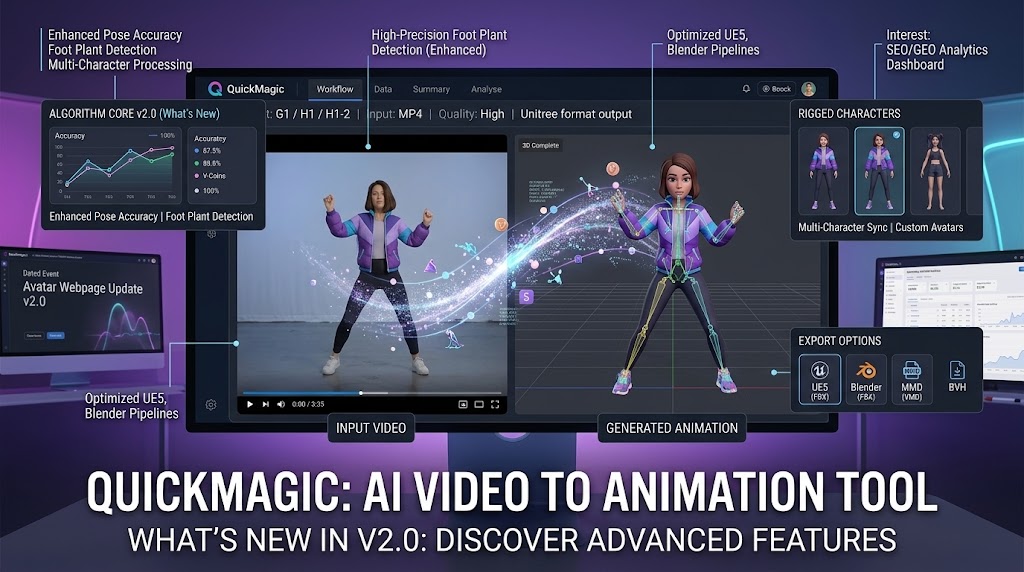
QuickMagic is a browser-based AI motion capture platform that estimates full-body, hand, and facial movement from ordinary footage and converts it into editable 3D motion data. There is nothing to install, no GPU requirement on your side, and the free tier includes hand tracking rather than paywalling it.
Here is what the free plan actually gives you, stated plainly so you can judge whether it fits your workflow:
| Free plan detail | What it means in practice |
|---|---|
| 50 credits per month | Roughly 50 seconds of captured motion, refreshed monthly |
| Body + hand + face tracking | Finger-level capture is not locked behind a paid tier |
| 30-second maximum clip length | Ideal for gesture libraries, emotes, dance segments, short skits |
| 50 MB upload limit | Compress to 1080p H.264 and you will rarely hit this |
| FBX export | Universally readable by Blender, Unity, Unreal, Maya, 3ds Max |
| 15-day asset storage | Download what you like promptly; keep a local library |
Fifty seconds a month sounds small until you think in terms of gestures rather than streams. A wave is two seconds. A shrug is one and a half. A heart sign, a peace sign, a facepalm, a "come here" beckon, a thinking chin-scratch — you can bank fifteen to twenty distinct, high-quality reusable gestures in a single month's free allocation, then trigger them on hotkeys forever. Motion data does not expire.
If you outgrow that, the paid tiers scale sensibly: Basic at $14.9/mo (200 credits, 60-second clips, and the full export matrix including VMD for MikuMikuDance, BVH, BIP, C4D, Unreal, Mixamo, Unity Anim, CC & iClone, and Roblox), Pro at $49.9/mo (1,000 credits, 90-second clips, high queue priority), and Max/Studio tiers for teams running high-volume production.
Capture your first hand gesture in the next ten minutes
Free plan, no credit card, hand and face tracking included. Film on your phone, export to your rig.
Try QuickMagic Free →Step by Step: From Phone Video to Expressive Hand Gestures
This is the complete video to 3D animation workflow. Budget about fifteen minutes for your first run and three minutes for every run after that.
- Set up a clean shotPosition your phone or webcam so your upper body and both hands stay fully in frame. Use even, front-facing light — a ring light or a window works. Avoid backlighting, which silhouettes your fingers and destroys keypoint detection. A plain wall behind you helps the model separate you from the background.
- Perform the gesture deliberatelySlightly exaggerate. Hold the peak of each gesture for half a second longer than feels natural. Keep your palms oriented toward the camera when possible, because fingers curled away from the lens are inferred rather than observed. Record several takes back to back in one clip.
- Upload to QuickMagicDrag your MP4, MOV, AVI, or WebM into the capture interface. Trim to just the segment you need before uploading — this conserves credits, since billing tracks seconds of processed footage.
- Enable hand and face trackingIn the configuration panel, switch on hand tracking explicitly. Select your subject if multiple people appear, set the frame rate to match your target pipeline (30fps for most VTubing, 60fps for dance), and choose static or moving camera mode to match how you filmed.
- Review the 3D previewThe platform renders your captured motion on a preview skeleton. Orbit the camera and specifically inspect the fingers during fast movement and any moment where one hand crossed the other. Catching problems here saves you a re-export later.
- Apply motion cleanupUse the built-in smoothing and pose controls to damp residual jitter. Be conservative — over-smoothing turns crisp finger snaps into mush. Fix the worst 20% and leave the rest.
- Export to your formatFBX on the free plan covers Blender, Unity, Unreal, Maya, and 3ds Max. On paid plans, choose VMD if you are working in MikuMikuDance, BVH for maximum interoperability, or the Unreal and CC/iClone presets for those specific pipelines.
- Retarget and refineImport into your DCC application, retarget onto your avatar's skeleton, then trim the clip, loop it if needed, and add hold frames at the start and end so hotkey triggering looks clean.
Motion Retargeting to VRM, MMD and Custom Rigs
Motion retargeting is the step where captured data meets your actual character, and it is where most beginners lose an afternoon. The core problem is simple: the skeleton QuickMagic outputs has its own bone names and proportions, while your VRM avatar or MMD model has different ones. Retargeting maps one onto the other.
For VRM avatars (VSeeFace, VNyan, Warudo)
VRM uses a standardised humanoid bone list, which makes this relatively painless. Import your FBX into Blender, use the Rokoko Studio Live add-on or Auto-Rig Pro's remap panel to build the bone mapping, bake the animation onto your VRM armature, and export. Finger bones in VRM follow a predictable naming pattern — Left Thumb Proximal through Right Little Distal — so once you save a mapping preset it applies to every future clip in seconds.
For MMD models
Export directly to VMD on a paid plan and you skip retargeting almost entirely, since VMD is MikuMikuDance's native motion format and QuickMagic writes standard Japanese bone names. Load the VMD onto your model, and the finger bones animate natively. This is by a wide margin the fastest path if you are producing MMD dance content, and it is worth the Basic tier on its own.
For custom and stylised rigs
Characters with four fingers, oversized mitten hands, or non-human proportions need a manual mapping pass. Map thumb and index precisely, then group the remaining digits. Add a corrective layer above the imported animation rather than editing the baked keys directly — that way you can swap in a new capture later without redoing your fixes.
Text to 3D Animation: Gestures Without Filming Anything
Sometimes you need a gesture you cannot or would rather not perform: a movement that requires a prop you do not own, an action that is physically awkward, or you simply do not want to set up a camera at midnight. Text to 3D animation covers that gap.
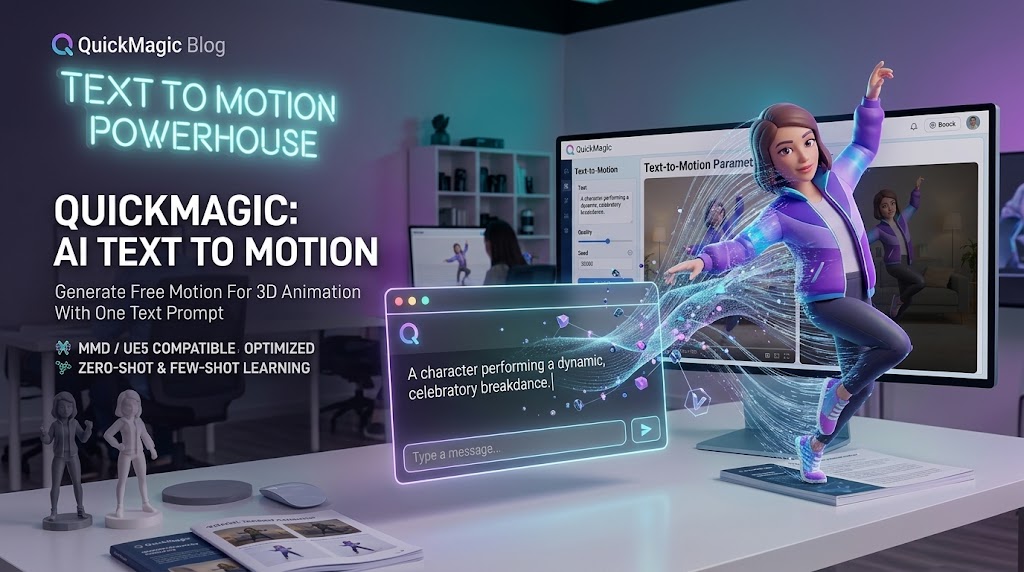
QuickMagic's generative 3D motion feature takes a plain-language description — "character waves enthusiastically with both hands above head," "performs a slow bow with hands clasped," "points forward then crosses arms" — and produces an editable motion draft. Treat the output as a strong first pass rather than a finished take: preview it, export it, and refine it in your animation software exactly as you would with captured data.
Where this genuinely shines for VTubers:
- Storyboarding skits before committing to a filmed performance
- Filler gestures for background characters in group streams and collabs
- Rapid iteration — try eight variations of a greeting in the time one filmed take would cost
- Physically awkward actions you would rather not perform on camera in your bedroom
The two approaches complement each other. Film the gestures where your specific personality matters — your signature laugh-and-facepalm, your particular way of pointing at chat — and generate the generic connective motion.
Nine Tips for Finger-Level Accuracy
The difference between mediocre and genuinely impressive hand capture comes down to how you shoot. These are ordered by impact.
- Light your hands, not just your face. Most webcam setups light the face and let the hands fall into shadow as they move forward. A second soft light aimed at chest height fixes this instantly and is the single highest-leverage change you can make.
- Shoot at 60fps if you can. Higher frame rates mean less motion blur per frame, and motion blur is the primary enemy of keypoint detection. You can always resample down to 30fps afterward.
- Keep palms camera-facing during key poses. Fingers pointing directly at or away from the lens are foreshortened into near-nothing, forcing the model to guess.
- Avoid hand-over-hand occlusion. Clasping, interlacing fingers, or crossing one hand fully behind the other are the hardest cases in the entire problem space. Separate your hands laterally when performing complex gestures.
- Wear contrasting sleeves. Long sleeves in a colour distinct from your skin tone give the network a crisp wrist boundary. Skin-tone clothing against skin is genuinely confusing to segmentation.
- Remove reflective jewellery. Rings and metallic watches create specular highlights that read as false edges. Take them off for the session.
- Hold the peak pose. A gesture snapped through in three frames gives temporal smoothing nothing to lock onto. Half a second at the extreme reads far better after processing.
- Stay within a consistent distance. Hands thrust dramatically toward the lens change apparent scale rapidly and can destabilise depth estimation. Keep gestures within a comfortable envelope in front of your torso.
- Record multiple takes in one clip. Since billing is per second of footage, three variations in a single 20-second upload is far more credit-efficient than three separate 20-second uploads, and you keep the best one.
QuickMagic vs Animate 3D, SayMotion and Other AI Mocap Tools
QuickMagic is not the only player in this space, and being straight about the alternatives is more useful to you than pretending otherwise. Here is how the main AI motion capture options compare specifically for VTuber hand work.
| Tool | Approach | Hand tracking | Free tier | VTuber-relevant strengths |
|---|---|---|---|---|
| QuickMagic | Video + text to 3D motion, browser-based | Yes, included on free tier | 50 credits/month, FBX export | Native VMD export for MMD, face + hand + body in one pass, text-to-motion, broad export matrix |
| DeepMotion Animate 3D | Video to 3D animation, browser-based | Yes, on higher tiers | Limited monthly minutes | Mature platform, physics simulation options, established API |
| SayMotion | Text-driven generative 3D motion | Generated rather than captured | Limited generations | Strong text-to-motion, LLM-style prompt editing, good for previs |
| Rokoko Vision | Video mocap, single or dual camera | Limited on the free web tool | Yes, with constraints | Integrates with the wider Rokoko hardware and plugin ecosystem |
| Move AI | Multi-camera markerless capture | Strong | No meaningful free tier | Highest fidelity, but priced and structured for studios |
The honest summary: if you are a studio with a multi-camera volume and a real budget, Move AI produces the best raw data. If you want text-only motion generation, SayMotion is purpose-built for it. Animate 3D is a solid, well-established general option.
QuickMagic's specific advantage for VTubers is the combination that matters to this audience — hand tracking on the free tier, body and face captured in the same pass, native VMD export for MikuMikuDance, plus text to 3D animation in the same interface. For MMD and VTuber creators in particular, that last point removes an entire conversion step that other tools force you through.
Beyond VTubing: The Same Pipeline Powers Digital Humans
Worth knowing, because the skills transfer directly. The identical capture-and-retarget workflow used to animate your VTuber's hands underpins production of digital humans across games, virtual production, and interactive media. The same FBX you export for your avatar can drive a MetaHuman in Unreal Engine, a character in Unity, or a stylised model in Blender.
QuickMagic's real-time body tracking and offline capture pipelines feed the same downstream tooling that studios use for previsualisation and background character animation. Human motion references generated this way even support humanoid robotics and embodied AI research, with export presets for Unitree G1, H1, and H1_2 platforms — a reminder of how far the underlying markerless motion capture technology now reaches beyond entertainment.
For you as a creator, the practical implication is that time spent learning this workflow is not niche VTubing knowledge. It is transferable 3D animation skill with a genuine commercial market attached.
Give your VTuber model hands that actually say something
Markerless AI motion capture with body, hand, and face tracking. Free to start, exports to Blender, Unity, Unreal, and MMD.
Start Capturing Free →Frequently Asked Questions
Is hand tracking really free on QuickMagic?
Yes. Body, hand, and facial tracking options are available on the free plan, which includes 50 credits per month, clips up to 30 seconds, and FBX export. Finger capture is not restricted to paid tiers.
Do I need special hardware or a mocap suit?
No. A phone, webcam, or standard camera is sufficient. QuickMagic uses markerless motion capture, so no gloves, markers, sensors, or depth cameras are required.
Can I use this for live streaming, or only pre-recorded content?
The video capture pipeline is offline — you upload footage and receive animation data. Most VTubers use it to build a library of high-quality gesture clips that they trigger live on hotkeys, while a webcam tracker handles real-time face and head movement. The two approaches layer well together.
Will it work with my VRM or MMD model?
Yes. Export FBX and retarget in Blender for VRM avatars, or export VMD on a paid plan for direct use in MikuMikuDance. Both routes preserve finger animation.
How accurate is the finger tracking compared to gloves?
Data gloves remain more accurate for extreme cases such as interlaced fingers or heavily occluded poses. For the conversational gestures, dance choreography, and emotes VTubers actually perform, AI hand tracking from clear, well-lit footage is close enough that viewers will not notice a difference — at roughly one percent of the cost.
What video length and format should I use?
MP4, MOV, AVI, and WebM are supported. The free plan caps single clips at 30 seconds and 50 MB. Trim before uploading, since credits are consumed per second of processed footage.
Can I capture two people at once for collab content?
Multi-subject workflows are supported for suitable footage. Keep both performers fully visible and avoid prolonged overlap, since one person passing in front of another creates occlusion the model has to guess through.
What if I cannot film the gesture I need?
Use text to 3D animation. Describe the action in plain language and QuickMagic generates an editable motion draft you can refine in your animation pipeline — useful for previs, background characters, and rapid iteration.
The Bottom Line
Expressive hands used to be the dividing line between hobbyist VTubing and studio-grade character animation, because the only routes there were expensive hardware or expensive labour. That is no longer true. AI motion capture has made finger-level gesture animation accessible to anyone with a phone camera and a well-lit room.
Start small and specific. Pick your five most-used gestures, film them properly in one 30-second take, capture them, retarget them, and bind them to hotkeys. The upgrade in how alive your character feels — on stream, in clips, in thumbnails — is out of all proportion to the effort involved. Then keep building the library one month of free credits at a time.
Your face has been doing all the work. Give your hands something to say.