How to Use AI Video Motion Capture to Record Realistic Football Gameplay Animations

This guide is based on hands-on testing with QuickMagic V2.0, Blender 4.2, Unreal Engine 5.5, and Unity 2023 LTS. All workflows have been verified with real football movement footage.

TL;DR AI video motion capture lets you create realistic football gameplay animations from a single camera video — no mocap suits or studio equipment required. Using QuickMagic AI, you upload footage of football movements (running, shooting, passing, dribbling), the AI extracts 3D skeletal motion data, and you download it as FBX for retargeting to your game character in Unreal Engine, Unity, Blender, or Maya. The complete workflow covers seven steps: planning your animation set, recording reference video, processing in QuickMagic, refining animation data, retargeting to your character rig, importing into your game engine, and building animation blueprints for gameplay. This approach is 10-50x cheaper than traditional motion capture while delivering production-ready results for indie and mid-tier football games.

Introduction: Why AI Mocap for Football Games?

Football games demand a massive volume of realistic animations — running, sprinting, shooting, passing, dribbling, tackling, goalkeeping, and celebrations. Traditionally, capturing these movements required expensive motion capture studios with optical camera systems or inertial suits, costing tens of thousands of dollars per session. EA Sports used Xsens motion capture suits to capture 22 professional players simultaneously for FIFA 22's HyperMotion technology, generating over 4,000 new animations from millions of frames of match data. More recently, Sports Interactive partnered with Hawk-Eye to feed real match broadcast camera data directly into Football Manager 2026's animation system.

Not every studio has that budget. AI video motion capture changes the game by extracting 3D skeletal animation data from ordinary video footage using artificial intelligence. With a smartphone, a tripod, and a tool like QuickMagic AI, you can capture realistic football movements and convert them into game-ready animation files in minutes — at a fraction of the cost.

This guide walks you through the complete workflow: from planning your animation set and recording football movements, through AI processing and retargeting, to integrating final animations into Unreal Engine 5 or Unity. Whether you're building an indie football game, a mobile soccer app, or prototyping gameplay mechanics, this workflow delivers professional-quality results without the studio price tag.

What Is AI Video Motion Capture?

AI video motion capture (also called markerless mocap or AI mocap) is the process of using artificial intelligence to analyze 2D video footage and extract 3D skeletal motion data. Unlike traditional motion capture, which requires performers to wear specialized suits covered in reflective markers or inertial sensors, AI mocap works with standard video from a single camera.

The AI identifies human body keypoints in each frame — head, shoulders, elbows, wrists, hips, knees, ankles — and reconstructs their 3D positions over time. This produces a skeletal animation that can be exported as FBX, BVH, or other standard formats and applied to any 3D character rig.

QuickMagic AI is a browser-based platform that implements this technology specifically for animation and game development workflows. It supports multiple export formats including Mixamo, Unreal Engine skeleton, 3ds Max BIP, and VMD, and offers built-in tools for refining animation data before export. Independent reviews from CGDive and Sabbirz confirm that QuickMagic produces grounded, stable motion with accurate foot-planting detection — critical for football animations.

Pro Tip: AI mocap excels at capturing full-body locomotion and actions. For ball interaction (passing, shooting, dribbling), capture the body motion without the ball and add ball physics in your game engine using animation notify events. This produces more controllable and consistent results than trying to track both the ball and the player simultaneously.

Prerequisites and Tools

Before you start, gather the following:

  • Camera: Any smartphone or camera capable of 1080p video at 30fps. 60fps is preferable for fast movements like shooting and sprinting.
  • Tripod: Essential for stable, fixed-camera recording. Handheld footage introduces motion that degrades AI tracking accuracy.
  • QuickMagic account: The free tier provides 50 coins per month (1 coin = 1 second of video processing). Paid plans offer more coins and advanced features.
  • 3D software: Blender (free), Autodesk Maya, Unreal Engine 5, or Unity. You'll use this for retargeting and cleanup.
  • Recording space: An open area with enough room to perform football movements safely — at least 5x5 meters for running and shooting actions.
  • Clothing: Tight-fitting, brightly colored clothing that contrasts with the background. This helps the AI distinguish limbs and track joint positions accurately.
1

Plan Your Football Animation Set

Before recording anything, list every animation your football game needs. A typical football game requires 30-50+ unique animations across several categories:

  • Locomotion: Walk, jog, run, sprint, backpedal, lateral shuffle, sudden stop, change of direction
  • Ball interaction: Short pass, long pass, driven shot, finesse shot, volley, header, dribble moves, ball control/trap
  • Defensive actions: Standing tackle, sliding tackle, jockey/contain, interception, block
  • Goalkeeper: Dive left/right/center, catch, punch, goal kick, throw distribution, one-on-one rush
  • Set pieces: Throw-in, corner kick, free kick run-up, penalty kick
  • Celebrations: Goal celebrations, team celebrations, crowd reactions
  • Transitions: Idle to jog, jog to sprint, sprint to stop, get-up from ground

Prioritize by gameplay impact. Start with locomotion and core actions (pass, shoot, tackle) — these form the backbone of your animation system. Secondary animations like celebrations and set pieces can be added later.

Pro Tip: Create a spreadsheet listing each animation, its estimated duration (3-10 seconds per clip), priority level, and filming notes. This keeps your recording session organized and ensures you don't miss critical movements.
2

Record Football Movement Reference Video

Recording quality footage is the single most important factor in getting good AI mocap results. Follow these guidelines:

Camera Setup

  • Mount your camera on a tripod at approximately hip height (1-1.5 meters)
  • Position the camera 5-8 meters from the performer, ensuring the full body remains in frame throughout the action
  • Use a fixed camera position — do not pan, tilt, or zoom during recording
  • Set resolution to 1080p and frame rate to 30fps minimum (60fps for fast movements like shooting)
  • If your camera allows, use a faster shutter speed (1/500 or higher) to reduce motion blur

Environment and Lighting

  • Record outdoors in natural daylight, or indoors with bright, even lighting
  • Avoid harsh shadows, backlighting, or mixed lighting conditions
  • Choose a clean, uncluttered background — a plain wall, open field, or gym works well
  • Ensure the background color contrasts with the performer's clothing

Performer Guidelines

  • Wear tight-fitting clothing — shorts and a fitted shirt are ideal for football movements
  • Bright, solid colors work best. Avoid patterns, logos, or all-black outfits
  • Perform each action at game-realistic speed — don't exaggerate or slow down
  • Start each clip with a 1-second T-pose or neutral stance for easier calibration
  • End each clip with a clear stop pose
  • For directional movements (sprinting left, cutting right), record separate clips for each direction

Football-Specific Recording Tips

Movement TypeRecording TipsDuration
Running / SprintingRun across the frame, not toward or away from camera. Keep full body visible throughout.5-8 sec
ShootingStand at 3/4 angle to camera. Perform the full shooting motion without a ball. Include approach, plant foot, swing, and follow-through.4-6 sec
PassingFace camera at slight angle. Perform inside-foot pass motion without ball. Show full leg swing.3-5 sec
DribblingPerform footwork patterns (step-overs, cuts) without ball. Keep feet clearly visible.5-10 sec
TacklingPerform slide tackle on soft surface. Camera at side angle to capture full body extension.4-6 sec
Goalkeeper DiveDive to each direction separately. Camera positioned at frontal angle. Land on soft mat.4-6 sec
CelebrationsPerform naturally. Full body in frame. Record multiple variations.5-10 sec
3

Upload to QuickMagic and Generate Mocap

Once you have your recorded videos, the QuickMagic workflow is straightforward:

  1. Log in to QuickMagic and click "AI Mocap"
  2. Upload your video by clicking the upload button and selecting your file. The free tier supports videos up to 30 seconds and 100MB.
  3. Trim the video using the built-in editor. Cut to only the action portion — remove the setup and recovery frames to save processing coins.
  4. Set the export format. Drag your preferred skeleton format onto the character in the preview. QuickMagic supports:
    • FBX — Universal format, works with Blender, Maya, 3ds Max
    • Mixamo — Direct compatibility with Adobe Mixamo rigs
    • Unreal Engine — Pre-configured for UE Mannequin skeleton
    • VMD — For MikuMikuDance projects
  5. Name your project and click "Generate Motion."
  6. Wait for processing. QuickMagic's AI analyzes the video and extracts 3D skeletal data. This typically takes 1-3 minutes per clip depending on length and complexity.
  7. Preview the result. Click the thumbnail to view the generated motion in 3D. Check for obvious tracking errors before downloading.
Important: Each second of video consumes 1 coin. The free tier provides 50 coins per month (50 seconds of processing). Plan your recordings to stay within your coin budget, or upgrade to a paid plan for larger animation sets.
4

Refine Animation Data in QuickMagic

Raw AI mocap data often needs refinement before it's production-ready. QuickMagic provides several tools for this:

2D Refinement Tool

If the AI mis-tracks a limb (common with fast movements or partial occlusion), use the 2D Refinement panel to manually adjust keyframes:

  • Navigate frame-by-frame using arrow keys
  • Click and drag limb positions to correct tracking errors
  • Focus on foot contact frames — these are the most critical for football animations
  • Save your adjustments before downloading

Physical Optimization

QuickMagic offers Physical Optimization settings that apply physics-based stabilization to reduce jitter:

  • 1x-3x: Light stabilization — preserves motion detail while reducing high-frequency noise. Best for fast football movements like shooting and sprinting.
  • 5x: Moderate stabilization — good balance for general locomotion and passing animations.
  • 10x: Heavy stabilization — can over-restrict movement. Avoid for football animations where natural body motion is important.

IK Settings

For football animations, foot-ground contact is critical. Use the IK tab in the 2D Correction panel to:

  • Lock foot positions during contact phases (when the foot should be planted on the ground)
  • Adjust foot height constraints to prevent floating or ground penetration
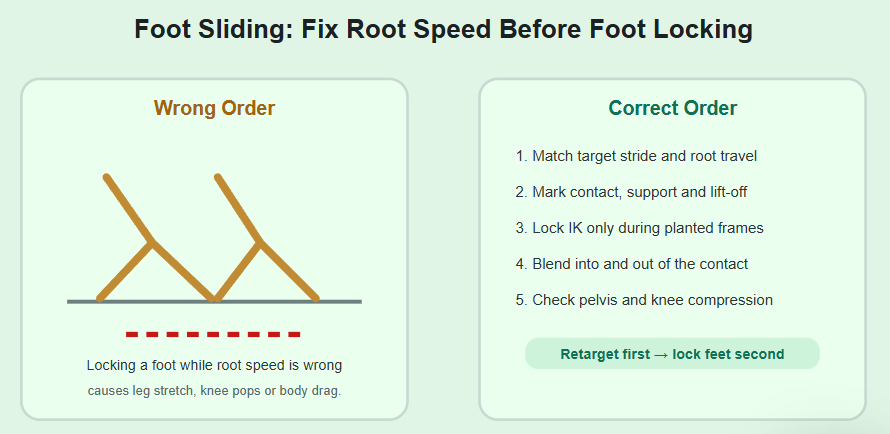
  • Fix the "random bouncing" artifact common in AI mocap of walking/running motions
Pro Tip: For shooting animations, pay special attention to the plant foot (the non-kicking foot). If it slides during the shot, the entire animation will look wrong. Use IK locking to fix the plant foot position during the kick phase.
5

Retarget Mocap to Your Game Character

The mocap data from QuickMagic uses a standard humanoid skeleton. Your game character likely has a different bone structure — different proportions, naming conventions, or hierarchy. Retargeting maps the motion data from the source skeleton to your target character.

Retargeting in Unreal Engine 5

UE5's IK Retargeter system is the most powerful retargeting solution:

  1. Create an IK Rig for the QuickMagic source skeleton (import the FBX first)
  2. Create an IK Rig for your target character skeleton
  3. In each IK Rig, define the retarget root (pelvis) and retarget chains (spine, arms, legs, head)
  4. Create an IK Retargeter asset, selecting source and target IK Rigs
  5. Auto-map chains and fix any mismatches in the preview window
  6. Right-click any animation and select "Retarget Animations" to batch-export

If you exported from QuickMagic using the Unreal Engine skeleton format, your animations should be close to Mannequin-compatible and may require minimal retargeting adjustments.

Retargeting in Unity

Unity's Humanoid Avatar system handles retargeting automatically:

  1. Import the QuickMagic FBX file
  2. In the Inspector, go to the Rig tab and set Animation Type to Humanoid
  3. Click Configure and verify all bones are mapped (green checkmarks)
  4. Do the same for your target character
  5. With both configured as Humanoid, animations automatically retarget — just drag them into an Animator controller

Retargeting in Blender

  1. Install the free Rokoko Studio Live add-on or use Auto-Rig Pro
  2. Import both the mocap FBX and your character rig
  3. Use the retarget panel to map bones between source and target
  4. Bake the retargeted animation to your character's action
  5. Export as FBX with "All Actions" checked for game engine import
Common Retargeting Issue: If your character has significantly different proportions (e.g., a stylized character with short legs), foot sliding and hand clipping may occur. Fix these in your game engine using IK constraints (UE5 Control Rig or Unity Animation Rigging).
6

Import Animations into Your Game Engine

Unreal Engine 5 Import

  1. Right-click in the Content Browser and select "Import to /Game/..."
  2. Select your retargeted FBX file
  3. In the import dialog:
    • Set Skeleton to your character's skeleton asset
    • Enable Import Mesh = false (you only need the animation)
    • Set Animation Length to "Exported Time"
    • Enable Use Default Sample Rate for consistent playback
    • For locomotion animations, enable Root Motion — this moves the character based on the animation's root bone translation
    • For action animations (shot, pass, tackle), disable Root Motion — these should play in-place
  4. Click "Import All" if you have multiple FBX files

Unity Import

  1. Drag the FBX file into your Project window (Assets folder)
  2. Select the imported file and in the Inspector:
    • Go to the Rig tab → Animation Type: Humanoid
    • Go to the Animation tab → adjust loop settings for locomotion clips
    • Enable Loop Pose for walk/run/jog cycles
  3. Click "Apply"

Organizing Your Animation Assets

Create a clear folder structure for your football animations:

/Animations/
    /Locomotion/     — walk, jog, run, sprint, stop, cut
    /Actions/        — shoot, pass, dribble, tackle
    /Goalkeeper/     — dive, catch, punch, distribute
    /SetPieces/      — throw-in, corner, free kick, penalty
    /Celebrations/   — goal celebrations, team celebrations
    /Transitions/    — idle-to-jog, jog-to-sprint, get-up
    
7

Build Football Animation Blueprints

With your animations imported, the final step is building the animation logic that drives your football gameplay.

Locomotion Blend Spaces

Football games need multi-directional locomotion. Create a 2D blend space in UE5 or a 2D Freeform Directional blend tree in Unity:

  • X-axis: Strafe direction (-1 = full left, 0 = forward, +1 = full right)
  • Y-axis: Speed (0 = idle, 0.5 = jog, 1.0 = sprint)
  • Place your mocap animations at appropriate positions in the grid
  • Add directional variants (run left, run right, backpedal) at corresponding positions

Action Animation Montages

For shooting, passing, and tackling, use Animation Montages (UE5) or Animation Layers (Unity):

  • Create a montage for each action type (left-foot shot, right-foot shot, short pass, long pass)
  • Add Animation Notifies at key frames:
    • Foot Contact: The frame where the foot strikes the ball — triggers ball physics impulse
    • Sound Event: Plays kick sound effect
    • Gameplay Tag: Marks the action window for gameplay logic (can the player cancel? Can they be tackled?)
  • Configure montage to blend in/out smoothly from locomotion

State Machine Setup

Build an Animation Blueprint state machine with these core states:

  • Idle → transitions to Locomotion when speed > 0
  • Locomotion → blend space driven by character velocity and direction
  • Action → montage-driven states for shooting, passing, tackling
  • Goalkeeper → separate state machine for keeper-specific animations
  • Celebration → triggered by goal event
  • Knocked Down → play fall animation, then get-up animation
Pro Tip: For AAA-quality locomotion, consider implementing Motion Matching in UE5. This technique searches a database of mocap frames in real-time and selects the best-matching animation based on the character's current velocity and desired trajectory. It produces incredibly natural movement from your mocap library without manual blend tree construction. UE5.4+ has built-in Motion Matching support.

Football Animation Types Reference

Here's a comprehensive reference of football animation types, their recommended QuickMagic settings, and integration notes:

Animation TypeClip DurationOptimizationExport FormatGame Engine Notes
Walk Cycle5-8 sec3xFBX / UELoop pose enabled. Root motion on. Blend space position: speed 0.2
Jog Cycle5-8 sec3xFBX / UELoop pose enabled. Root motion on. Blend space position: speed 0.5
Sprint5-8 sec1xFBX / UELoop pose enabled. Root motion on. Blend space position: speed 1.0
Shot (Power)4-6 sec1xFBX / UEMontage. Notify at foot-ball contact frame. Root motion off
Shot (Finesse)4-6 sec1xFBX / UEMontage. Different approach angle. Root motion off
Short Pass3-5 sec3xFBX / UEMontage. Notify at contact. Quick recovery to locomotion
Long Pass / Cross4-6 sec1xFBX / UEMontage. Full body motion. Notify at contact
Dribble (Step-over)5-10 sec3xFBX / UECan be additive or full-body. Blend with locomotion
Standing Tackle3-5 sec1xFBX / UEMontage. Quick in/out. Can be cancelled in early frames
Slide Tackle4-6 sec1xFBX / UEMontage. Cannot cancel. Get-up animation follows
GK Dive (per direction)4-6 sec1xFBX / UEMontage. Separate clips for L/R/center. Get-up follows
Throw-in4-6 sec3xFBX / UEMontage. Ball release notify. Both hands above head
Goal Celebration5-10 sec3xFBX / UEFull body. Multiple variations. Camera may zoom

Best Practices for Football Mocap

Recording Quality

  • Film in segments: Record each movement type as a separate clip. Don't try to capture everything in one long take — QuickMagic processes each clip independently and you'll get better results with focused, short recordings.
  • Use a neutral start pose: Begin each clip with a 1-second T-pose or standing-neutral position. This gives the AI a clean reference frame to initialize tracking.
  • Avoid occlusion: If a limb is hidden from the camera (e.g., behind the body during a turn), the AI cannot track it. Record complex movements from multiple angles and use the best result.
  • Record at game speed: Don't slow down movements for easier recording. The mocap should match the speed and intensity of actual gameplay. If you need slow-motion replays, slow down the animation in your game engine, not during recording.

Post-Processing

  • Clean before retargeting: Fix obvious tracking errors in QuickMagic's 2D Refinement tool before exporting. It's much easier to fix issues at the source than after retargeting.
  • Test in-game early: Don't wait until all animations are polished. Import a rough version into your engine and test how it feels in gameplay. This reveals issues that aren't visible in isolation.
  • Keep original FBX files: Always keep unmodified QuickMagic exports as backups. If you need to re-retarget or re-import, you'll want the clean source data.

Football-Specific Tips

  • Capture without the ball: Record body movements without a ball. Add ball physics in your game engine using animation notifies. This gives you precise control over ball trajectory, spin, and power — impossible to achieve consistently with real ball tracking.
  • Record directional variants: For movements like shooting and passing, record left-foot and right-foot versions. For running, record forward, left, right, and backward variants.
  • Use reference footage: Watch professional football match footage before recording. Mimic the actual biomechanics of professional players — their running form, shooting technique, and body language.
  • Capture transitions: The moments between actions are just as important as the actions themselves. Record idle-to-jog, jog-to-sprint, sprint-to-stop, and standing-to-ground transitions.

Troubleshooting Common Issues

ProblemCauseSolution
Foot sliding during runningAI mis-tracks foot-ground contact; stride length mismatch after retargetingUse IK settings in QuickMagic 2D Correction panel to lock foot contact. Apply 1x-3x Physical Optimization. In engine, use IK foot-locking during contact phases (UE5 Control Rig or Unity Animation Rigging).
Jitter in fast movements (shooting, sprinting)Per-frame prediction noise in AI tracking; motion blur in source videoRecord with faster shutter speed (1/500+). Apply 1x Physical Optimization (not higher — you need to preserve fast motion detail). In Blender/UE5, apply low-pass filter to rotation curves.
Mesh clipping during shooting motionExtreme joint rotations from mocap exceed rig limitsAdjust skin weights at problem joints in your character rig. Use corrective blend shapes in UE5/Unity. Limit joint rotation ranges in the Animation Blueprint.
Character floats above groundRoot bone Y-position offset; source skeleton not at originIn QuickMagic, adjust root position in 2D Correction. In your 3D software, zero out the root bone Y-translation. In UE5, set the mesh Z-offset in the character blueprint.
Arms rotate unnaturallyAI loses arm tracking during fast lateral movementRe-record with tighter clothing and better lighting. Use 2D Refinement to manually fix arm keyframes. In QuickMagic, try Animation Basic Model V2.0 for improved arm stability.
Poor tracking during turns/rotationsCamera angle doesn't capture body rotation clearly; motion blurRecord turns at 3/4 angle to camera. Use 60fps recording. Record separate clips for each turn direction. Avoid full 360-degree rotations in a single clip.
Animation feels stiff after optimizationPhysical Optimization set too high (5x-10x)Reduce to 1x-3x Physical Optimization. For football animations, natural body motion is critical — over-stabilization kills realism.
Retargeting produces distorted posesSkeleton proportions significantly different; bone mapping errorsVerify all bone mappings in IK Retargeter (UE5) or Avatar Configuration (Unity). Adjust chain settings for proportions. Use Retarget Override Sets (UE5.8+) for characters with very different builds.

Advanced Tips for Football Game Animation

Motion Matching for Natural Locomotion

Instead of building complex blend trees, Motion Matching (available in UE5.4+) searches your entire mocap database in real-time and selects the best animation frames to match the character's current movement. This produces incredibly fluid, natural movement that adapts to any direction and speed. To set it up:

  • Compile all your locomotion mocap clips into a Motion Matching database
  • Define the trajectory prediction settings (how far ahead the system looks)
  • Tag animation sections for specific contexts (e.g., "with ball" vs. "without ball")
  • The system automatically blends between clips for seamless transitions

Animation Layering for Contextual Variations

Use additive animation layers to add context-specific modifications on top of base locomotion:

  • Fatigue layer: Add upper-body slumping and heavier breathing when stamina is low
  • Ball-carrying layer: Slightly different arm positions when dribbling vs. running without ball
  • Pressure layer: Tense body language when defenders are near
  • Mood layer: Different idle poses based on match situation (winning, losing, tied)

Combining AI Mocap with Procedural Animation

For the best results, combine AI mocap data with procedural animation systems:

  • Procedural head tracking: Players look toward the ball or nearest opponent — procedural, not mocap
  • Foot IK for uneven terrain: Mocap provides the base motion; IK adjusts foot positions to match ground slope
  • Hand IK for ball control: Procedural hand placement for throw-ins and goalkeeper catches
  • Ragdoll blending: Blend from mocap to ragdoll physics for collision impacts and falls

Scaling Your Animation Library

For larger football games requiring 100+ animations, consider these strategies:

  • Record in batches: Film 10-15 movements per session for efficiency
  • Reuse and modify: One running clip can be modified (speed, direction, additive layers) to create multiple variants
  • Priority queue: Always capture core locomotion and primary actions first; fill in secondary animations later
  • Community assets: Supplement your custom mocap with professional animation packs from libraries like MoCap Online for movements you can't easily record yourself

Frequently Asked Questions

Can AI video motion capture produce quality football gameplay animations?

Yes. AI video motion capture tools like QuickMagic can produce high-quality football gameplay animations suitable for indie and mid-tier game projects. While they don't match the precision of professional optical mocap systems used by AAA studios like EA Sports, they capture realistic human movement from a single camera video at a fraction of the cost. For locomotion, passing, shooting, and celebration animations, AI mocap delivers production-ready results when combined with proper cleanup and retargeting.

What equipment do I need for AI motion capture of football movements?

You need a smartphone or camera capable of 1080p at 30fps, a tripod for stable recording, a QuickMagic account (free tier provides 50 coins per month, where 1 coin equals 1 second of video processing), and 3D software such as Blender (free), Maya, Unreal Engine 5, or Unity. No mocap suits, markers, or multi-camera setups are required.

How do I record football movements for the best AI mocap results?

Record with a fixed camera position, full body visible in frame, tight-fitting clothing for clear limb tracking, even lighting without harsh shadows, and a clean uncluttered background. Film each action for 3-10 seconds with a clear start and end pose. For fast movements like shooting, use higher frame rates (60fps) if available. Avoid motion blur by ensuring adequate lighting and faster shutter speeds.

What football animations can I capture with AI video motion capture?

You can capture running, jogging, sprinting, directional changes, shooting, passing, dribbling moves, tackling, sliding, goalkeeper dives and catches, throw-ins, corner kicks, free kick run-ups, goal celebrations, and idle poses. AI mocap handles full-body movements well; for ball interaction, capture the motion without the ball and add ball physics in the game engine using animation notify events.

How does AI motion capture compare to traditional mocap for football games?

Traditional mocap uses specialized suits with markers (like Xsens) or optical camera systems in dedicated studios, costing $10,000-$50,000+ per day. AI video motion capture uses a single camera and AI algorithms to extract 3D motion data, making it accessible to indie developers at little to no cost. While traditional mocap offers higher precision for AAA productions, AI mocap delivers excellent results for locomotion, actions, and prototyping, with quality suitable for most indie and mid-tier football games.

How do I fix foot sliding in football motion capture animations?

Foot sliding is a common issue in AI mocap. Fix it by: (1) using QuickMagic's IK settings in the 2D Correction panel to manually adjust foot-ground contact, (2) applying 1x-3x Physical Optimization to stabilize lower-body tracking, (3) using IK foot-locking in your game engine (UE5 Control Rig or Unity Animation Rigging) during contact phases, and (4) adjusting stride length during retargeting if the source and target skeletons have different leg proportions.

Can I use QuickMagic mocap data in Unreal Engine 5 for a football game?

Yes. QuickMagic exports FBX files compatible with the UE5 Mannequin skeleton. Import the FBX, use the IK Retargeter if your character uses a custom rig, create Animation Montages for shots and passes with notify events for ball physics, and build 2D blend spaces for directional locomotion. QuickMagic also offers a direct Unreal Engine skeleton export format for seamless integration.

How long does it take to create a full football animation set with AI mocap?

A basic football animation set (10-15 animations including locomotion, shooting, passing, and celebrations) can be created in approximately 4-6 hours: 1 hour for recording, 30 minutes for QuickMagic processing, 2-3 hours for cleanup and retargeting, and 1 hour for game engine integration. This compares to 2-3 days of manual keyframe animation for the same set.

Ready to Bring Your Football Game to Life?

Start capturing realistic football gameplay animations with AI video motion capture today. No mocap suit required — just your smartphone and QuickMagic.

Try QuickMagic Free

References: EA Sports HyperMotion technology — FIFA 23 Gameplay Deep Dive | Xsens motion capture in FIFA — Xsens Case Study | UE5 Motion Matching — Unreal Engine Documentation | Mocap retargeting guide — MocapWork Retargeting Guide