QuickMagic · Blender · Maya · Unreal Engine
How to Fix Common Motion Capture Problems: Foot Sliding, Mesh Clipping, Jitter & More
Diagnose whether an artifact comes from video tracking, skeleton retargeting or the final character rig, then apply the correct QuickMagic, Blender, Maya or Unreal Engine fix without flattening the performance.

Most common problems

Video tutorials
QuickMagic in-depth test and capture-quality tips
Useful for diagnosing source-video visibility, motion blur and model behavior.
Open on YouTubeFoot sliding correction with motion contacts
Demonstrates contact phases, correction tools and target-specific locking.
Open on YouTubeUse the correct cleanup order
- Check the original video and QuickMagic preview.
- Correct obvious 2D keypoint and foot-ground errors before regenerating.
- Verify reference pose, target chains, root, scale and frame rate.
- Retarget to the final production character.
- Fix root trajectory and target stride.
- Lock feet and hands only during actual contact intervals.
- Repair mesh weights, joint limits and corrective shapes.
- Smooth only verified noise.
Fix foot sliding and foot skating

QuickMagic
- Inspect foot-ground frames in the 2D Correction IK workflow when available.
- Correct incorrect planted intervals and regenerate.
- Use the base model suited to the action; complex floor movement may benefit from V2.0.
Final target rig
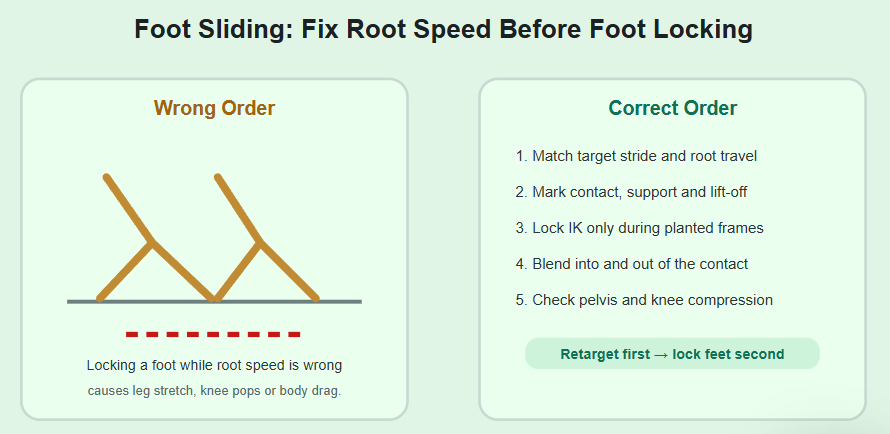
- Match root travel and target stride.
- Mark contact, support and lift-off.
- Set foot IK/world position at first contact.
- Hold it through the planted interval.
- Blend the lock on approach and release.
- Check pelvis height and knee compression.
Fix mesh clipping and self-intersection

| Cause | Evidence | Fix |
|---|---|---|
| Source tracking | Source skeleton has an impossible joint angle | Use 2D Correction, another model or a cleaner take |
| Retargeting | Source is clean but target limb crosses the body | Match T/A pose, chains, bone axes and joint limits |
| Skin weights | Bones are correct but vertices collapse or fold | Weight paint / Paint Skin Weights |
| Extreme deformation | Clipping appears only in a valid extreme pose | Corrective blend shape / pose-space deformation |
| Runtime interaction | Character collides with props or another body | IK/contact constraints or runtime collision system |
Reduce jitter without destroying performance

- Identify the exact noisy bones and frame ranges.
- Correct poor source footage or keypoint tracking first.
- Start with the lowest QuickMagic Physics Optimization that removes visible noise.
- In the DCC, smooth only the affected curves.
- Reduce keys after retargeting and contact approval.
- Compare impacts, head turns, kicks and hand gestures before and after.
Fix floating, sinking and sudden launching
- Verify the source ground reference and full-body visibility.
- Check which bone is the true root and which is the pelvis.
- Remove first-frame root offsets deliberately; do not force every project to world zero.
- Align the target floor and target foot height.
- Correct vertical root drift before adding foot locks.
- Split long drifting clips into shorter sections when necessary.
Fix hip stretching and lower-body twitching
Hip stretching can come from aggressive physical stabilization, incorrect pelvis/root mapping, an impossible foot lock, or a large source/target proportion difference.
- Reduce Physics Optimization from very high values to 1x–5x and compare.
- Release foot IK if the root cannot reach the locked foot naturally.
- Check leg-length scale and retarget pose.
- Correct pelvis trajectory before editing individual hip keys.
Fix arm spinning and rotation flips
- Check whether the source arm already spins.
- Compare V1.0 and V2.0 on a short segment when reconstruction is uncertain.
- Verify left/right chain mapping and local bone axes.
- Inspect Euler rotation curves for ±180/360-degree discontinuities.
- Apply an Euler filter only after mapping and axes are correct.
High kicks, splits and extreme poses
- Use 60 FPS source footage when fast motion truly requires temporal detail.
- Use low-to-moderate Physics Optimization to preserve leg height and timing.
- Keep both legs visible and visually separated from the background.
- Avoid loose clothing that hides the hip and knee.
- For splits, use wide framing and clear floor visibility.
- Validate joint limits and mesh deformation on the final character.
Software-specific cleanup summary
| Software | Jitter | Foot sliding | Clipping |
|---|---|---|---|
| Blender | Graph Editor Smooth/Decimate on selected channels | Foot IK constraints or held foot-control keys | Weight Paint, constraints and corrective shape keys |
| Maya | Graph Editor filters on affected curves | IK controls, planted keys and root correction | Paint Skin Weights, pose-space correctives and limits |
| Unreal Engine | Compression review, Control Rig or modifiers | IK Retargeter/FBIK, foot-lock curves and root motion | Control Rig constraints, correctives and runtime collision |
Final validation checklist
- The source preview no longer contains major identity swaps or impossible joints.
- Source and target reference poses match.
- Root and pelvis responsibilities are clear.
- Animation duration and frame rate are correct.
- Foot locks occur only during contact.
- Knees and elbows do not pop or stretch.
- Mesh deformation is valid at extreme poses.
- Filtering preserves intentional accents.
- The exported file works after reimport.
Frequently asked questions
How do I fix foot sliding?
Retarget first, correct root speed and target stride, then lock the foot with IK only during planted frames.
How do I fix mesh clipping?
Determine whether the source skeleton, retarget mapping or final skinning is wrong. Use source correction, pose/chain correction, or weights/correctives respectively.
How do I reduce jitter?
Improve source visibility, use minimum necessary Physics Optimization and smooth only affected curves and intervals.
Why does the character float?
The root or floor reference is wrong. Correct vertical trajectory and target floor alignment before locking contacts.
Why do arms spin?
Possible causes include reconstruction, chain mapping, local axes and Euler discontinuities. Diagnose in that order.
Should all keys be decimated?
No. Key reduction should happen after retargeting and contact validation and should preserve impacts and deliberate gestures.
Fix the earliest wrong stage
Compare the original video, QuickMagic source skeleton and final target rig before editing. The correct diagnosis usually removes more artifacts with fewer keys.