Why Hand Keyframing Slows Down Modern 3D Pipelines
Hand keyframing gives animators precise control, but it is also time-intensive. Every wrist rotation, finger curl, thumb contact, and object interaction requires manual posing. When a character is gesturing, gripping a prop, signing, dancing, or acting with subtle emotion, hand animation can consume a huge share of the production schedule.
That is why teams are now adopting QuickMagic: a high-efficiency AI 3D animation platform designed for creators who want professional motion without a complicated studio setup. Instead of drawing every hand pose frame by frame, QuickMagic helps convert real human motion into editable 3D animation data.
Hand Tracking vs Hand Keyframing: The Practical Difference
| Workflow | Traditional Hand Keyframing | QuickMagic Hand Tracking |
|---|---|---|
| Setup | Requires rig knowledge, pose libraries, references, and manual blocking. | Uses AI Motion Capture from video with No Mocap Suit required. |
| Speed | Hours or days for complex hand gestures. | Minutes to generate a strong first pass for editing and refinement. |
| Realism | Depends heavily on animator experience and reference quality. | Captures natural timing, rhythm, finger tracking, and body-hand coordination from real movement. |
| Scalability | Hard to scale across many shots or characters. | Supports video to 3d animation, Motion Retargeting, and faster batch iteration. |
QuickMagic: Built for AI 3D Animation, Not Just Motion Capture
QuickMagic is more than a motion extraction utility. It is part of a new generation of intelligent tools that bring Generative 3D Motion into everyday production. Whether you are building short-form content, virtual influencers, game characters, animated explainers, or Digital Humans, QuickMagic helps transform motion ideas into production-ready assets.
Many creators compare solutions such as Animate 3D, SayMotion, AI Motion Capture platforms, single camera motion capture tools, and Multi-Camera mocap systems. The biggest difference is workflow complexity. Traditional Multi-Camera mocap can be powerful, but it usually needs calibrated cameras, a controlled environment, dedicated operators, and cleanup. QuickMagic focuses on accessibility: upload video, generate motion, retarget, refine, and export.
From Video to Motion: A Faster Path from Reference to Rig
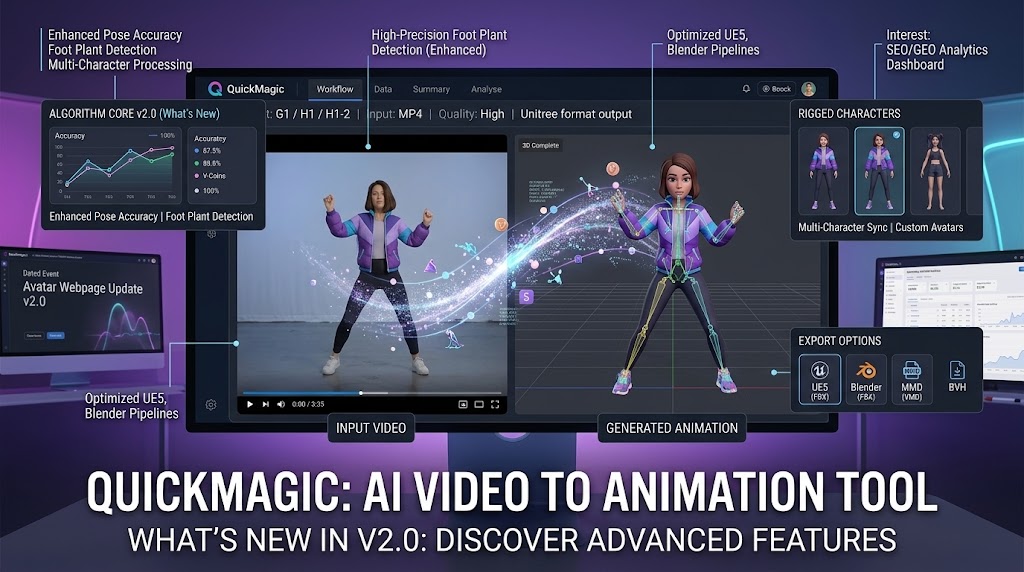
The core value of QuickMagic is simple: turn video to motion and video to 3d animation with less friction. A creator can record an actor, dancer, performer, or hand gesture using an ordinary camera, then use QuickMagic to generate animation data that can be applied to 3D characters.
This Video to 3D Animation process is ideal for teams that need speed but cannot afford to compromise on natural human movement. With Markerless Motion Capture and Real-Time Body Tracking capabilities, creators can validate performance timing faster and reduce the need for expensive reshoots or tedious pose-by-pose blocking.
Use a standard camera or existing footage. QuickMagic supports single camera motion capture workflows for lean production teams.
The system analyzes body movement, hand gestures, and finger tracking to create a strong animation base.
Use Motion Retargeting to apply the motion to game characters, cinematic avatars, Digital Humans, or stylized rigs.
Animators keep control. Instead of starting from zero, they polish timing, exaggeration, contact, and personality.
Why Finger Tracking Matters
Hands communicate emotion. A nervous finger tap, a confident point, a careful grab, or a subtle open-palm gesture can make a character feel alive. Without finger tracking, motion capture often looks incomplete, forcing animators back into manual cleanup.
QuickMagic helps bridge that gap by making hand tracking a natural part of the motion workflow. For Digital Humans, virtual presenters, game NPCs, AR characters, and social media avatars, realistic hand movement can be the difference between an average animation and a believable performance.
Text to 3D Animation and Generative 3D Motion Are Changing Production
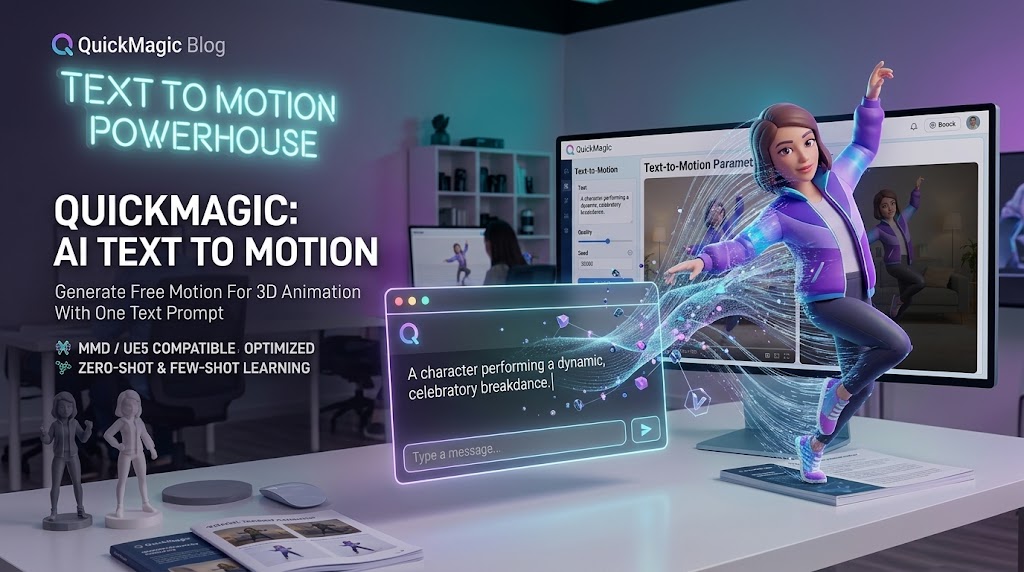
Video-based workflows are only one part of the future. The rise of text to 3d animation and Generative 3D Motion means creators can increasingly describe a performance, generate motion variations, and iterate faster than ever. QuickMagic fits into this future by giving creators practical AI-assisted tools today while moving toward more intelligent motion creation tomorrow.
For teams that already rely on AI for concept art, storyboards, editing, or voice generation, QuickMagic extends the same efficiency into character movement. It makes ai 3d animation feel less like a technical bottleneck and more like a creative accelerator.
QuickMagic vs Traditional Mocap: No Studio Bottleneck
Traditional motion capture can still be valuable for large productions, but it is not always the best choice for fast-moving creators. Multi-Camera mocap requires infrastructure. Suit-based capture requires hardware. Manual hand keyframing requires time. QuickMagic offers a more flexible middle path: Markerless Motion Capture, single camera motion capture, and Video to 3D Animation workflows that can start from ordinary footage.
The result is a production process that feels lighter, faster, and more creative. No Mocap Suit required means independent creators, small studios, educators, marketers, and game developers can access motion workflows that once belonged only to specialized mocap stages.
Who Should Use QuickMagic?
QuickMagic is built for anyone who wants faster animation without sacrificing creative control:
- Game developers who need rapid character animation and Motion Retargeting.
- VFX and animation teams that want better first-pass body and hand motion.
- Digital Humans creators who need natural gestures and believable performance.
- Content creators turning dance, fitness, tutorials, or acting clips into 3D animation.
- Educators and marketers creating animated explainers with less production overhead.
SEO Keyword Coverage for the Modern Animation Stack
QuickMagic sits at the intersection of AI Motion Capture, Animate 3D alternatives, SayMotion-style text-driven motion, Real-Time Body Tracking, video to 3d animation, video to motion, text to 3d animation, intelligent tools, finger tracking, Motion Retargeting, Digital Humans, and Generative 3D Motion. This combination gives creators a practical way to move from idea to animated result faster.
Final Takeaway: Let Animators Animate, Not Rebuild Every Finger Pose
Hand keyframing will always have a place in high-end animation, especially for final polish and stylized performance. But using hand keyframing for every frame is no longer the most efficient option. QuickMagic gives animators a faster starting point, helping teams save up to 80% animation time by replacing repetitive manual work with AI-assisted hand tracking, body tracking, and video-to-motion generation.
If your team wants faster AI 3D animation, smoother character workflows, better Digital Humans, and a more scalable path from video to 3D animation, QuickMagic is the intelligent choice.
FAQ
Can QuickMagic replace hand keyframing completely?
QuickMagic is best used as an acceleration tool. It creates a strong motion foundation, while animators can still refine style, timing, contacts, and acting choices.
Do I need a motion capture suit?
No. QuickMagic supports markerless workflows, so No Mocap Suit required. You can begin with ordinary video footage.
Is QuickMagic useful for both body tracking and hand tracking?
Yes. QuickMagic is designed for AI Motion Capture workflows that include Real-Time Body Tracking concepts, finger tracking, Motion Retargeting, and video-based 3D animation generation.
Who benefits most from video to 3D animation?
Game developers, animation studios, VFX artists, virtual influencer teams, Digital Humans creators, educators, and marketing teams all benefit from faster video to motion workflows.
Start Animating Faster with QuickMagic
Stop spending days hand-keyframing motion that AI can help generate in minutes. Use QuickMagic to turn video into editable 3D motion, capture natural gestures, and accelerate your next animation project.
Explore QuickMagic