Guide de la capture de mouvement par IA
Capture de mouvement des mains par IA gratuite : suivez les gestes de la main sans capteurs
Transformez les gestes de la main et les mouvements des doigts d'une vidéo ordinaire en animation 3D modifiable — sans gants de capture de mouvement, marqueurs réfléchissants ou capteurs portables. Ce guide explique comment fonctionne le suivi des mains par IA, comment enregistrer des séquences plus nettes et comment commencer avec le plan gratuit de QuickMagic.
Réponse rapide
Oui, vous pouvez capturer le mouvement des mains sans capteurs. L'IA sans marqueurs analyse une vidéo RGB normale, détecte les poignets, les mains et les articulations visibles des doigts, et convertit leur mouvement dans le temps en données d'animation. Avec QuickMagic, vous pouvez enregistrer avec un téléphone ou une caméra, télécharger le clip, activer le workflow de suivi des mains pris en charge, examiner la résolution et exporter le mouvement pour un pipeline 3D compatible. Le plan gratuit convient pour un court test ; les chevauchements de doigts difficiles, le flou et l'occlusion peuvent encore nécessiter un nettoyage.
Qu'est-ce que la capture de mouvement des mains ?
La capture de mouvement des mains est le processus d'enregistrement de la façon dont un poignet, une paume et des doigts bougent, puis de représentation de cette performance sous forme d'animation numérique. Un rig de main contient de nombreuses articulations très proches, donc une capture utile doit préserver plus que la position globale de la main. Elle doit aussi décrire les flexions, écarts, courbures des doigts et les changements d'orientation dans le temps.
Les systèmes traditionnels peuvent utiliser des gants à capteurs, des marqueurs réfléchissants, des caméras de profondeur ou plusieurs caméras synchronisées. Le suivi des mains par IA sans marqueurs emprunte une voie plus accessible : il estime le mouvement à partir des preuves visibles dans une vidéo standard. Vous avez toujours besoin d'une caméra, mais vous ne portez pas de capteurs spécialisés et vous ne préparez pas un volume de capture.
| Couche de mouvement | Exemples | Principaux facteurs de qualité |
|---|---|---|
| Poignet et main | Rotation, direction, gestes de la main, pointage, gestes larges | Visibilité stable, angle de la caméra, occlusion du corps |
| Articulation des doigts | Courbure, extension, écartement, pincement, changements de pose | Taille de la main dans le cadre, mise au point, résolution, chevauchement des doigts |
| Mouvement temporel | Tempo des gestes, transitions, tenues, actions répétées | Taux d'images, flou de mouvement, visibilité continue |
| Performance combinée | Couches corps, main et visage dans les workflows pris en charge | Cadrage, options de capture sélectionnées, pipeline cible |
Comment fonctionne le suivi des mains par IA à partir d'une seule vidéo ?
Un workflow typique d'IA de suivi des doigts suit quatre étapes. D'abord, la vision par ordinateur trouve l'interprète et les mains visibles dans chaque image. Ensuite, le système estime les points de repère ou les relations articulaires pour les poignets, les paumes et les doigts. Troisièmement, il compare ces estimations entre les images voisines pour que le mouvement se comporte comme une séquence au lieu d'une collection de poses non liées. Enfin, la performance suivie est mappée sur un squelette d'animation ou un préréglage cible qui peut être examiné, exporté et retargeté.
Il s'agit d'une estimation, pas d'une radiographie. Lorsqu'un doigt en cache un autre, qu'une main passe derrière le corps ou qu'un mouvement rapide se transforme en flou, la vidéo contient moins de preuves. L'IA peut déduire une pose plausible, mais elle ne peut pas garantir le mouvement caché exact. C'est pourquoi une bonne technique d'enregistrement est aussi importante pour les mains que le logiciel de capture.
Distinction importante : la capture de mouvement des mains sans capteur est conçue pour reconstruire le mouvement visible pour l'animation. Ce n'est pas automatiquement un système de mesure certifié, un outil d'analyse médicale ou un système de transcription en langue des signes.
Capture de mouvement des mains sans capteur : comment cela se compare-t-il ?
Les personnes qui recherchent « capture de mouvement des mains sans capteur » veulent généralement un moyen plus rapide et moins coûteux de capturer des gestes. L'IA sans marqueurs est bien adaptée à l'itération, aux interprètes à distance, aux créateurs solo et à la production précoce. Les systèmes instrumentés restent précieux lorsqu'un projet nécessite une capture contrôlée, une diffusion en direct ou un mouvement qui reste fiable en cas d'occlusion importante.
| Approche | Configuration | Points forts | Compromis |
|---|---|---|---|
| IA sur une seule vidéo | Téléphone, webcam ou caméra | Configuration rapide, adaptée au travail à distance, faible coût d'entrée, pas de dispositifs portables | Dépend fortement de la visibilité, de l'éclairage et du flou |
| Gants à capteurs | Matériel portable calibré | Mesures directes des doigts et moins de dépendance à la vue de la caméra | Coût du matériel, calibrage, ajustement et configuration de l'interprète |
| Marqueurs optiques | Marqueurs plus un volume de capture multi-caméras | Workflow de studio contrôlé et observations multi-angles | Plus d'équipement, d'espace, de calibrage et de nettoyage |
| Keyframing manuel | Animateur et rig de main | Contrôle artistique complet et poses de contact délibérées | Gourmand en temps pour les performances longues ou naturalistes |
Pour de nombreux créateurs, le workflow le plus pratique est hybride : utilisez la capture de mouvement des mains par IA pour le timing et l'articulation large, puis affinez les contacts et les poses expressives avec des couches d'animation ou des keyframes.
Comment capturer le mouvement des mains et des doigts avec QuickMagic
QuickMagic prend en charge la capture au niveau de la main et des doigts dans les workflows de capture de mouvement pris en charge. Le processus commence par des séquences ordinaires et se termine par un mouvement modifiable qui peut être importé dans un outil 3D compatible.
- Planifiez un court geste de test. Commencez par cinq à dix secondes incluant le mouvement le plus difficile dont vous avez besoin : une courbure de doigt, un pointage, un geste de la main ou un geste à deux mains. Un court test rend les problèmes plus faciles à diagnostiquer avant de traiter une prise plus longue.
- Enregistrez une vidéo source claire. Utilisez 1080p ou plus si possible. Gardez les mains assez grandes pour montrer les doigts individuellement, utilisez un éclairage frontal ou latéral uniforme et choisissez un arrière-plan qui sépare les mains de la scène.
- Téléchargez le clip original. Évitez d'envoyer la séquence via une application de messagerie qui ajoute une compression lourde. Téléchargez le fichier original le plus propre sur QuickMagic et coupez le temps inutilisé.
- Sélectionnez l'interprète et les options de suivi des mains. Confirmez le sujet correct, choisissez les paramètres de corps, main, caméra, pose et fréquence d'images appropriés pour le workflow, puis générez le mouvement source.
- Examinez les doigts avant l'exportation. Inspectez les courbures, écarts, doigts croisés, orientation du poignet et les images où les mains rencontrent le corps ou un objet. Si une section échoue, comparez-la avec la vidéo source et envisagez de réenregistrer depuis un angle plus clair.
- Exportez, retargetez et validez. Choisissez un format disponible ou un préréglage de destination, faites correspondre la fréquence d'images et la pose de référence, et testez l'animation sur le personnage final. Conservez l'export original avant de modifier.
Consultez la page officielle de suivi des mains IA de QuickMagic pour le workflow actuel et le guide d'exportation d'animation 3D pour les considérations de format et de retargeting.
Conseils d'enregistrement pour une IA de suivi des doigts plus précise
La qualité de la capture des mains est en grande partie un problème d'information : le modèle a besoin de pixels propres suffisants pour distinguer chaque doigt de ses voisins. Utilisez cette liste de contrôle avant d'enregistrer.
- Enregistrez en 1080p ou plus si possible.
- Gardez les deux mains confortablement dans le cadre.
- Rapprochez-vous lorsque les doigts semblent petits dans l'aperçu.
- Utilisez une lumière douce et uniforme sans contre-jour sévère.
- Verrouillez la mise au point ou confirmez que la mise au point continue reste sur les mains.
- Utilisez une caméra stable ou un trépied chaque fois que c'est pratique.
- Réduisez la vitesse si les doigts rapides créent un flou de mouvement.
- Évitez les longues périodes de doigts croisés ou entrelacés.
- Portez des manches et utilisez un arrière-plan qui crée du contraste.
- Marquez une brève pause dans les poses importantes pour préserver des formes lisibles.
Cadrez la performance pour la capture dont vous avez besoin
Un plan en pied est utile lorsque le mouvement des mains doit rester synchronisé avec la marche, la danse ou le jeu d'acteur, mais les mains occupent moins de pixels. Un plan plus rapproché du haut du corps ou axé sur les mains fournit plus de détails sur les doigts. Décidez si la performance globale ou l'articulation fine est la priorité, puis cadrez en conséquence.
Considérez les accessoires comme un cas avancé
Les objets peuvent cacher le bout des doigts et modifier la forme de la main. Si l'animation finale a besoin d'une prise, capturez l'approche et le geste large avec l'IA, puis prévoyez d'ajuster la pose de contact exacte, l'espacement et la pénétration sur le personnage cible. Les prises sans objet sont généralement plus faciles pour un test initial.
La capture de mouvement des mains gratuite de QuickMagic est-elle vraiment gratuite ?
QuickMagic propose actuellement un plan à 0 $ pour essayer la capture de mouvement par IA. « Gratuit » signifie un plan limité, pas un traitement illimité. La page de tarification officielle répertorie les allocations de capture de mouvement suivantes au moment de la publication de cet article :
| Prix et crédits | 0 $ avec 50 V Coins répertoriés pour le plan gratuit |
|---|---|
| Durée maximale du clip | 30 secondes à 30 FPS |
| Taille de téléchargement maximale | 100 Mo |
| Traitement | File d'attente à faible priorité ; jusqu'à deux vidéos de capture en file d'attente |
| Exportation | FBX |
| Stockage des actifs | 15 jours |
Les limites des produits, les crédits, les formats et la disponibilité peuvent changer. Consultez la page de tarification en direct de QuickMagic et votre menu d'exportation actuel avant d'engager un pipeline de production.
Problèmes courants de suivi des mains et solutions pratiques
Les doigts s'effondrent, s'échangent ou clignotent
Cela se produit souvent lorsque les doigts se chevauchent ou sont trop petits dans le cadre. Rapprochez la caméra, faites pivoter la main pour que chaque doigt ait une silhouette plus claire, ralentissez le geste et ajoutez plus de lumière pour réduire le flou de mouvement.
Le poignet semble stable, mais le mouvement des doigts est faible
Le mouvement large de la main nécessite moins de pixels que l'articulation individuelle. Enregistrez à une résolution plus élevée, utilisez un recadrage plus rapproché et évitez un cadrage large du corps entier si les doigts détaillés sont la priorité.
Les gestes à deux mains fusionnent
Séparez légèrement les mains en profondeur ou dans l'espace de l'écran. Lorsque les paumes se touchent ou que les doigts s'entrelacent pendant de nombreuses images, une seule caméra dispose de preuves limitées pour savoir quelle articulation appartient à quelle main.
Le mouvement semble incorrect après l'importation
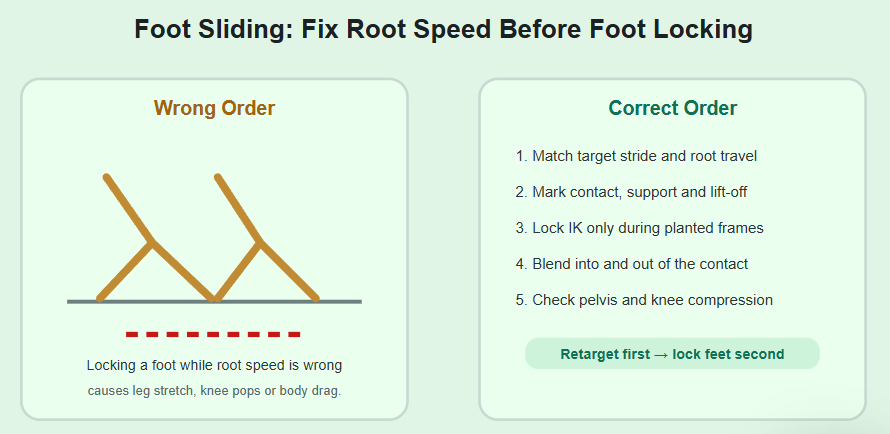
Vérifiez le préréglage du squelette cible, la pose de référence, la fréquence d'images, l'axe vertical, l'échelle et les paramètres de la racine. Un fichier FBX valide peut encore mal jouer lorsque les rigs source et destination utilisent des conventions différentes. Retargetez d'abord, puis évaluez les doigts sur le personnage final.
La main manque un objet
Le retargeting modifie les longueurs et proportions des os, donc un contact qui fonctionnait pour l'interprète peut manquer le personnage. Utilisez l'IK de main ou des couches d'animation pour verrouiller le contact final, corriger l'espacement des doigts et éviter les intersections de maillage.
Où la capture de mouvement des mains sans capteur est la plus utile
- Animation de jeu : prototyper des interactions, des émotes, des gestes conversationnels et des performances cinématiques de première passe.
- Film et prévisualisation : préserver le timing et l'intention avant de commencer l'animation détaillée des personnages.
- VTubers et humains numériques : ajouter une articulation des doigts aux workflows pris en charge pour le corps, la main et le visage.
- Production indépendante et à distance : capturer des interprètes dans différents endroits sans expédier de gants ni construire un studio.
- Référence d'animation : créer une référence de timing et de pose modifiable pour qu'un animateur de mains l'affine.
- Éducation et expérimentation : tester un pipeline de mouvement 3D avec un téléphone et un court clip de plan gratuit.
L'IA sans capteur est particulièrement intéressante lorsque la rapidité et l'accès comptent plus que des données parfaites de première passe. Si une scène dépend d'un contact doigt-objet prolongé, de mains étroitement entrelacées ou d'une précision articulaire de niveau mesure, prévoyez une correction manuelle ou évaluez une méthode de capture plus contrôlée.
FAQ sur la capture de mouvement des mains par IA gratuite
Puis-je faire de la capture de mouvement des mains sans capteurs ?
Oui. L'IA sans marqueurs peut estimer le mouvement du poignet, de la main et des doigts à partir d'une vidéo RGB ordinaire, vous n'avez donc pas besoin de gants de suivi, de marqueurs réfléchissants ou de capteurs portables. Une bonne visibilité des mains et une bonne qualité vidéo restent essentielles.
La capture de mouvement des mains de QuickMagic est-elle gratuite ?
QuickMagic propose actuellement un plan gratuit pour essayer la capture de mouvement par IA. Il a des crédits, une durée de clip, une taille de téléchargement, une priorité de file d'attente, un stockage et des options d'exportation limités. Consultez la page de tarification actuelle car les détails du plan peuvent changer.
L'IA peut-elle suivre les doigts individuels à partir d'une seule caméra ?
Oui, lorsque les doigts sont assez grands dans le cadre, nets, bien éclairés et visibles. Le chevauchement des doigts, le flou de mouvement, les angles extrêmes et les mains qui quittent le cadre peuvent réduire les détails utilisables ou nécessiter un nettoyage.
Quelle caméra ai-je besoin pour la capture de mouvement des mains sans capteur ?
Un téléphone, une webcam, un reflex numérique ou une autre caméra qui enregistre une vidéo RGB claire peut fonctionner. Utilisez 1080p ou plus si possible, un cadrage stable, une lumière uniforme et des réglages qui maintiennent les doigts en mouvement nets.
Quel format de fichier puis-je exporter avec le plan gratuit ?
La page de tarification de QuickMagic répertorie FBX pour le plan de capture de mouvement gratuit actuel. Les autres formats et préréglages de destination varient selon le plan et le workflow, alors confirmez la disponibilité dans le menu d'exportation en direct.
Puis-je capturer le corps, les mains et le visage ensemble ?
QuickMagic fournit des options de mouvement du corps, de la main et du visage dans les workflows pris en charge. Le niveau de détail utilisable dépend du cadrage, de la résolution, de la visibilité, du flou de mouvement et des paramètres de capture sélectionnés.
L'IA de suivi des mains produit-elle automatiquement une animation finale ?
Elle peut produire un point de départ solide, mais le travail de production peut encore nécessiter un retargeting, un nettoyage des courbes, une correction des contacts et des réparations pour les images occultées ou floues. Examinez toujours l'animation sur le personnage final.
Un plan plus rapproché est-il toujours meilleur ?
Un plan plus rapproché fournit généralement plus de détails sur les doigts, mais peut perdre la relation entre les mains et la performance du corps entier. Choisissez le cadrage en fonction de savoir si l'articulation fine ou la synchronisation du corps entier est la plus importante.
Capturez votre première performance des mains
Enregistrez un geste court et bien éclairé, gardez chaque doigt visible et transformez la vidéo en mouvement 3D modifiable avec QuickMagic — sans combinaison, gants, marqueurs ou capteurs portables.
Essayez le suivi des mains IA de QuickMagicLes capacités du produit et les détails du plan gratuit ont été vérifiés sur les pages officielles de suivi des mains IA, de tarification et de formats d'exportation d'animation 3D de QuickMagic le 24 juillet 2026.