Avatar · Image-to-Video · Seedance 2.0 · Character Animation

AI Video to Animation Tool — What’s New in QuickMagic

QuickMagic's Avatar workflow now uses Seedance 2.0 for advanced image-to-video creation. Learn what changed in motion performance, character consistency, camera stability and multimodal direction—and how to turn a still image into a publishable avatar video.

Published May 28, 2026 · Updated July 15, 2026 · QuickMagic Editorial Team

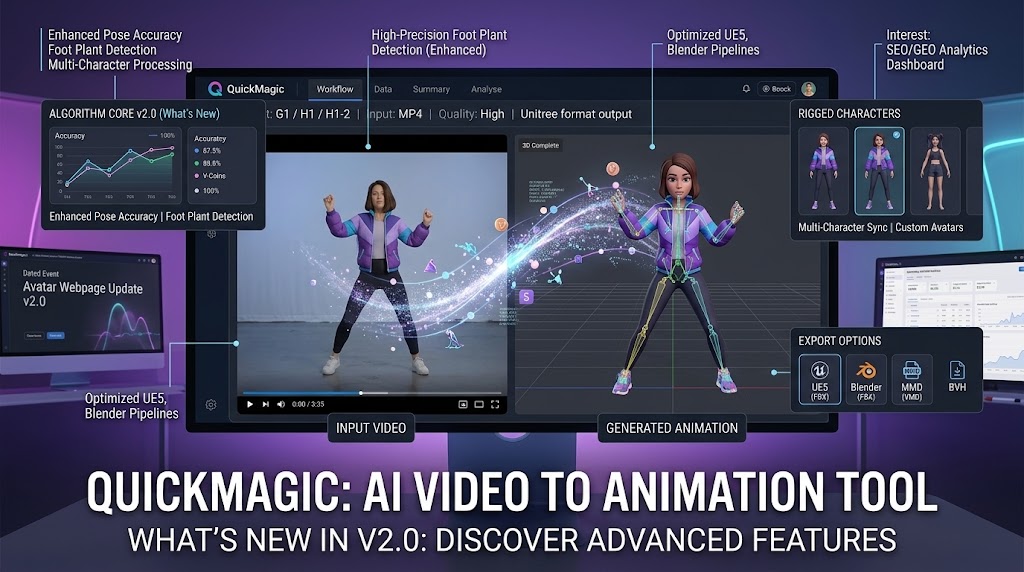
QuickMagic AI video-to-animation workflow using Seedance 2.0 from reference media to MP4 output
Direct answer: QuickMagic's May 2026 update introduced Seedance 2.0 to its Image-to-Video workflow. The upgrade focuses on stronger motion performance, more stable character identity and improved camera behavior. Upload a sharp image, write a focused action and camera prompt, generate several candidates, review identity and anatomy frame by frame and export the selected result as MP4. Use QuickMagic Mocap instead when you need editable 3D skeletal data.
Definition: AI video-to-animation generates a rendered video from an image, prompt, audio or reference motion. The output is a sequence of pixels, not a downloadable rigged character or editable 3D skeleton.

Current QuickMagic Avatar limits

Free duration5 seconds for core Avatar tools
Free resolutionUp to 720p
Paid durationUp to 10s for Image-to-Video, AI Dance and Replacement
Talking AvatarPaid plans list up to 15 seconds
UploadCurrent Free upload limit: 100 MB
OutputMP4; paid plans list up to 1080p

Limits vary by tool, model and plan. Check the current generation screen before production.

Important distinctions: “video-to-animation” can mean rendered Avatar video or editable 3D motion data. QuickMagic Avatar produces MP4; QuickMagic Mocap produces skeletal animation. Seedance 2.0 supports text, image, audio and video at the model level, but QuickMagic may expose only a subset for a specific tool. Better consistency reduces drift—it does not eliminate malformed hands, identity changes or background flicker in every generation.

QuickMagic Avatar and Seedance tutorials

QuickMagic Review: Avatar, Action Imitation, Talking Image and Image-to-Video

Reviews QuickMagic's non-mocap Avatar features and output workflow.

Open on YouTube

How to Use Seedance 2.0: Full AI Video Tutorial

Explains Seedance 2.0 generation, references and practical prompting.

Open on YouTube

The players use static YouTube iframes and no runtime JavaScript. YouTube requires internet access; use the direct buttons if embedded playback is blocked. All article diagrams are embedded and display offline.

What’s new in QuickMagic AI Video to Animation?

Seedance 2.0 upgrades for motion, character consistency, camera control and multimodal references
The original update highlights motion performance, character consistency and camera stability. ByteDance additionally documents multimodal audio-video generation and reference control.

Stronger motion performance

The new model is designed to follow more detailed action instructions and maintain smoother temporal behavior during character movement, facial expression and more demanding camera motion.

Improved character consistency

Reference images can anchor face, clothing, silhouette and style more effectively. Consistency remains most vulnerable during occlusion, rapid turns, hand-to-face contact, lighting changes and scene transitions.

More stable camera behavior

Seedance 2.0 supports direction over camera movement, lighting and shadow. Use one clear camera instruction per short clip; combining an orbit, zoom, pan and handheld shake in one prompt often increases instability.

What Seedance 2.0 can do

ByteDance describes Seedance 2.0 as a unified multimodal audio-video generation model that supports text, image, audio and video inputs. The official model page emphasizes motion stability, joint audio-video generation and control over performance, lighting, shadows and camera movement.

The QuickMagic product interface determines which reference types, durations, resolutions and controls are available. Do not assume every ByteDance API capability is enabled in every QuickMagic Avatar tool.
Model capabilityCreative useProduction check
Image referenceAnimate a portrait, character design or productIdentity, texture and proportions
Text directionSpecify action, scene, style and cameraPrompt conflicts and action density
Video referenceGuide performance or visual behaviorRights, framing and reference relevance
Audio referenceDrive rhythm, speech or audiovisual structureSync, clarity and licensing
Joint audio-video outputCreate a more complete short-form assetDialogue, music and sound continuity

Choose the right QuickMagic Avatar tool

QuickMagic Avatar tool selection for Image-to-Video, AI Dance, Talking Avatar, Character Replacement and Character Generator

Use Image-to-Video when the AI should invent motion. Use AI Dance when a reference performance must be imitated. Use Talking Avatar for speech and lip sync, Character Replacement for an existing video's subject and Character Generator to create a new source image.

QuickMagic Avatar vs QuickMagic Mocap

Comparison of QuickMagic Avatar MP4 output and QuickMagic Mocap editable skeletal animation
NeedChooseOutput
Publish a social reel or promotional videoAvatar Image-to-VideoMP4
Make a character reproduce a danceAvatar AI DanceMP4
Animate a presenter from speechTalking AvatarMP4
Edit bones, curves and root motion in BlenderMocapFBX/BVH or target preset
Retarget motion to Unreal or Unity charactersMocapEditable 3D animation

Step-by-step QuickMagic Image-to-Video workflow

Production workflow from reference preparation through prompt, generation, quality assurance and MP4 finishing

1Prepare the reference

  • Use a sharp, high-resolution image with a clear subject.
  • Avoid cropped hands, hidden face details and confusing overlaps.
  • Use a coherent background or specify that it may change.
  • Confirm permission for faces, characters, logos, audio and footage.

2Choose Seedance 2.0 and current limits

Select the available model, duration, aspect ratio and resolution. The current Free plan lists 5-second core Avatar generations at up to 720p; paid plans list longer durations and up to 1080p.

3Write a focused motion prompt

Describe one short action sequence, one camera behavior, the environment and a stable visual style. Keep identity anchors consistent with the reference rather than redefining the subject.

4Generate alternatives

Create multiple candidates for identity-sensitive, high-motion or camera-heavy shots. Change one variable at a time so the effect of the prompt or reference is measurable.

5Review and export

Scrub the clip frame by frame, choose the strongest candidate, download MP4 and finish captions, color, sound and transitions in a video editor.

Prompt formula for stable AI video animation

Image-to-video prompt formula using subject, action, camera, scene lighting and output style

Prompt rules

  • Describe motion with physical verbs, not only mood words.
  • Keep the clip to one short action beat.
  • Use one primary camera move.
  • Anchor important identity, clothing and object details.
  • Avoid contradicting the reference image.
  • Specify the ending pose when a transition matters.
  • Generate separate clips for major scene or wardrobe changes.

Copy-ready Image-to-Video prompts

Cinematic character reveal

The character looks up and takes one confident step forward. Slow camera push-in, soft rim light, detailed facial expression, cinematic realism.

Anime action beat

The anime hero lowers into a defensive stance, turns toward camera, and raises one hand. Fast side tracking shot, dramatic sunset, crisp cel-shaded style.

Product animation

The product rotates slowly on a clean pedestal while highlights travel across the surface. Controlled orbit camera, premium studio lighting, luxury commercial style.

Social portrait

The portrait smiles naturally, turns slightly left, and the hair moves in a gentle breeze. Static medium close-up, warm daylight, realistic social-video style.

Fantasy creature

The small dragon unfolds its wings and steps onto a rock. Slow low-angle camera rise, misty forest light, cinematic fantasy animation.

Dance teaser

The character performs two rhythmic steps and finishes in a strong pose. Stable full-body camera, colorful stage lights, energetic pop-video style.

Virtual host

The presenter nods, gestures with the right hand, and maintains eye contact. Locked medium shot, clean studio background, polished corporate style.

Game concept

The armored character draws a sword and shifts into a ready stance. Subtle handheld camera, foggy ruins, realistic game-cinematic style.

How to review an AI-generated video

AI video quality checklist for identity, motion, anatomy, camera, scene, audio and delivery

Review at normal speed for storytelling and at slow speed for defects. Focus on scene transitions, head turns, hands crossing the face, contact with objects, logos, small text and frames with fast camera movement.

Rights, consent and commercial use

  • Use faces, voices, images, characters, audio and footage you own or may legally use.
  • Do not imply endorsement by a real person without permission.
  • Verify music, voice and sound-effect licenses separately.
  • Paid-plan commercial rights do not override third-party intellectual-property rights.
  • QuickMagic's current agreement states Free-plan assets may not be used commercially.
  • Retain references, prompts, model/version and final output for production records.
Seedance 2.0 has attracted public copyright and likeness concerns. Strong visual capability increases—not reduces—the need for permission, review and platform-compliant use.

Troubleshooting

ProblemLikely causeFirst fix
Face changes during a turnWeak identity anchor or difficult profile/occlusionUse a clearer reference, shorten the motion and reduce camera complexity
Hands deformFast small motion or hand-to-object interactionReduce action speed, enlarge hands in the reference or choose another candidate
Character ignores the actionPrompt is vague or overloadedUse one concrete action sequence with explicit direction
Camera motion is unstableSeveral conflicting camera instructionsUse one move: static, push-in, pan, tracking or orbit
Background flickersComplex geometry or scene changeSimplify the scene, lock the camera or use a shorter clip
Clothing changesPrompt redefines style or reference is ambiguousAnchor clothing details and remove competing wardrobe descriptions
Lip sync feels lateSpeech clarity, timing or tool mismatchUse Talking Avatar with clean audio and review the supported language/voice
Need editable 3D motionWrong product routeUse QuickMagic Mocap and export FBX/BVH instead of Avatar MP4
Output length or resolution differsPlan/model-specific limitCheck the current interface and Pricing page

Production checklist

  • The correct Avatar tool is selected.
  • The reference is sharp and legally usable.
  • The prompt contains one action and one camera move.
  • Duration, resolution, credits and watermark are confirmed.
  • Multiple candidates are generated for difficult shots.
  • Identity, hands, anatomy and contacts are reviewed frame by frame.
  • Camera, background, lighting and audio remain coherent.
  • Commercial rights and third-party permissions are verified.
  • The final MP4 is tested in the target aspect ratio and platform.
  • Reference, prompt, model and final output are archived together.

Frequently asked questions

What is new in QuickMagic AI Video to Animation?

QuickMagic announced Seedance 2.0 for its Image-to-Video workflow on May 28, 2026, highlighting stronger motion performance, character consistency and camera stability. Current Avatar tools also include AI Dance, Talking Avatar, Character Replacement and Character Generator.

Is Seedance 2.0 the same as QuickMagic Mocap?

No. Seedance 2.0 generates rendered audio-video content. QuickMagic Mocap generates editable skeletal-animation data for 3D software and game engines.

What inputs does Seedance 2.0 support?

ByteDance documents text, image, audio and video as supported model-level reference modalities. QuickMagic may expose only the inputs available in the current Avatar interface.

What does QuickMagic Avatar export?

QuickMagic Avatar exports generated videos as MP4. It does not export a rigged character, FBX skeleton or editable 3D scene.

What are the current Free-plan Avatar limits?

QuickMagic currently lists 5-second outputs, up to 720p, a 100 MB upload limit and MP4 export for core Free Avatar workflows. Model-specific limits and watermark rules are shown in the current interface.

How long can paid Avatar videos be?

The current Avatar page states that Starter and Professional support up to 10 seconds for AI Dance, Character Replacement and Image-to-Video, and up to 15 seconds for Talking Avatar, with up to 1080p output.

How can I improve character consistency?

Use one sharp reference image, keep identity and clothing descriptors stable, avoid conflicting changes, use shorter clips for difficult motion and review turns, occlusions and transitions frame by frame.

What is the difference between AI Dance and Image-to-Video?

AI Dance imitates choreography from a reference motion video. Image-to-Video creates new motion and scene behavior from a still image and prompt.

Can I use the output commercially?

QuickMagic's current User Agreement states that paid users receive commercial usage rights, while Free-plan assets may not be used commercially. Users must also have rights to uploaded faces, images, audio, characters and videos.

What should I review before publishing?

Check identity, face, hands, anatomy, clothing, logos, object contacts, camera continuity, background flicker, lip sync, audio licensing, resolution, watermark and platform-specific aspect ratio.

Related QuickMagic guides

Create one short, controlled test

Begin with a sharp character image, one five-second action and a static or slow camera. Generate several candidates and approve the result only after frame-level identity, anatomy and scene review.

Open QuickMagic Avatar →

Official and primary references