QuickMagic FBX → MetaHuman Body Animation
MetaHuman Retargeting Guide: QuickMagic MoCap to UE5.6/5.7
Import QuickMagic FBX motion into Unreal Engine, create source and MetaHuman IK Rigs, align T-pose and A-pose differences, map retarget chains, export target Animation Sequences, fix foot sliding, and combine body and facial performance in Sequencer.

Workflow at a glance

Watch the original UE5.6/5.7 MetaHuman tutorial
The original QuickMagic video demonstrates the six-step workflow summarized in the source article. The written version below expands it with import decisions, chain validation, pose alignment, foot-contact fixes, facial-track handling and UE5.6+ troubleshooting.
Before you start
You will need:
- A QuickMagic FBX animation export and, when needed, a neutral/T-pose source skeleton
- Unreal Engine 5.6 or 5.7
- An assembled MetaHuman character in the project
- The IK Rig and IK Retargeter features available in the project
- The original performance video for validation
- A decision between exported Animation Sequences and runtime retargeting
| Goal | Recommended route |
|---|---|
| Convert QuickMagic FBX into reusable MetaHuman clips | Create an IK Retargeter and export duplicate Animation Sequences. |
| Drive a MetaHuman dynamically from another character | Use runtime IK retargeting after the retargeter works correctly offline. |
| Add facial expressions to the body mocap | Create or import a separate facial sequence and combine it in Sequencer. |
| Retarget between two MetaHumans | Use the MetaHuman-provided retarget assets or runtime MetaHuman workflow where appropriate. |
1Generate and export a clean QuickMagic motion file
- Upload a clear performance to QuickMagic.
- Review body orientation, root travel, feet, hand direction and subject identity.
- Select an Unreal-oriented output when it matches the intended UE skeleton workflow.
- Use a generic FBX source when you need an explicit source skeleton and custom IK Rig.
- Match the output frame rate to the UE project.
- Preserve an untouched source export.
2Import the QuickMagic skeleton and animation
- Create a folder such as
Animations/QuickMagic/Source. - Import the FBX through the Content Browser.
- Import the source Skeletal Mesh/Skeleton on the first pass when no compatible source asset exists.
- Enable animation import and use the complete exported frame range.
- Disable unnecessary materials and textures for a motion-only source.
- Open the Animation Sequence and verify scale, orientation, duration and root motion.
| Import symptom | Likely cause | Corrective action |
|---|---|---|
| Character lies down or faces sideways | Axis conversion mismatch | Reimport using the correct scene conversion rather than rotating every bone. |
| Source is extremely large or small | Unit or scale mismatch | Fix the FBX import scale before creating IK assets. |
| T-pose only | Animation disabled, wrong take or wrong Skeleton | Reimport with animation enabled and verify the exported range. |
3Create the QuickMagic source IK Rig
- In the Content Browser, create an Animation → IK Rig asset.
- Assign the imported QuickMagic source Skeletal Mesh.
- Set the retarget root to the pelvis or the source bone that represents body motion.
- Use Auto Retarget Chains when the source naming is recognized.
- Manually verify the spine, neck, head, arms and legs.
- Add hand, finger, toe or clavicle chains only when needed and correctly mapped.
4Configure the MetaHuman target IK Rig
Use the MetaHuman body Skeletal Mesh as the target. Depending on the project and MetaHuman version, a suitable MetaHuman IK Rig or retarget asset may already be present. Otherwise, create a target IK Rig.
- Assign the MetaHuman body Skeletal Mesh as the preview mesh.
- Set the target retarget root.
- Use Auto Create Retarget Chains; MetaHuman skeletons are supported by Epic's auto-retarget templates.
- Use Auto Create IK/FBIK when required by the intended contact workflow.
- Verify body chains and IK goals manually.

5Create and validate the IK Retargeter
- Create an Animation → IK Retargeter asset.
- Assign the QuickMagic source IK Rig.
- Assign the MetaHuman target IK Rig.
- Review the Chain Mapping panel and correct unmapped or incorrect chains.
- Offset the preview characters so both remain visible.
- Preview a representative QuickMagic Animation Sequence.
Test more than one movement
- A neutral walk and turn
- A wide arm reach
- A squat or kneel
- A fast action with planted feet
- A clip with visible root travel
Align the source and target retarget poses
A T-pose/A-pose mismatch is a common cause of raised shoulders, twisted wrists, incorrect elbows and poor hand placement. Use Auto Align as a starting point, then inspect the complete body.

- Shoulder height and clavicle angle match.
- Elbows point in comparable directions.
- Wrists and palms have compatible orientation.
- Pelvis and spine face the same direction.
- Knees and feet point forward consistently.
- Character height and root scale are plausible.
6Export retargeted MetaHuman Animation Sequences
- Select one or more source animations in the IK Retargeter Asset Browser.
- Export duplicate animations to a dedicated target folder.
- Use a clear prefix or suffix such as
MH_or_MetaHuman. - Open each target Animation Sequence on the MetaHuman body mesh.
- Validate the beginning, ending, looping, contacts and root trajectory.
Fix MetaHuman foot sliding and contact errors
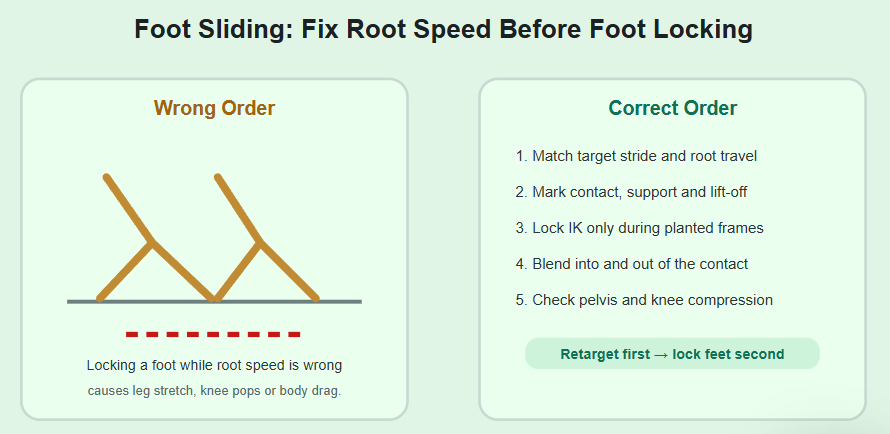
Epic documents Speed Planting as a solution for retargeted feet that slide because the source and target have different leg lengths or stances. Before adding contact logic, verify the retarget pose, pelvis and root behavior.

- Confirm the source and target retarget poses.
- Check the leg-chain mapping and target IK goals.
- Inspect pelvis height and root translation.
- Configure Speed Planting or equivalent IK Retargeter contact behavior.
- Use Control Rig corrections for remaining shot-specific contact problems.
- Validate both feet from side and front views.
Combine retargeted body motion with facial animation
The MetaHuman body and face are separate animation groupings in Sequencer. A body FBX or retargeted body Animation Sequence does not automatically create facial expressions, lip sync or eye animation.

Recommended Sequencer structure
- Body Animation Sequence: the retargeted QuickMagic body motion.
- Body Control Rig: contact, hand, prop and silhouette corrections.
- Face Animation or Face Control Rig: facial capture, lip sync, blinks and gaze.
- Camera and audio tracks: evaluated independently from body retargeting.
Epic's MetaHuman documentation notes that body animation is applied to the Body skeletal mesh component and propagates through the character's body parts. This propagation should not be confused with generating facial expression animation.
Exported clips vs. runtime retargeting
| Approach | Use it when | Trade-off |
|---|---|---|
| Export target Animation Sequences | Cinematics, asset libraries, compression, editing and predictable delivery | Creates additional assets and must be regenerated after retargeter changes |
| Runtime Retarget Pose From Mesh | Live character sharing, dynamic gameplay or reducing duplicated animation assets | Requires runtime Blueprint setup and ongoing performance/compatibility testing |
| MetaHuman retarget component workflow | MetaHuman-specific live workflows where available | May rely on experimental or version-specific components |
Common QuickMagic-to-MetaHuman problems
| Problem | Likely cause | Recommended fix |
|---|---|---|
| Source imports as a T-pose only | Animation import disabled, wrong take or wrong Skeleton asset | Reimport the source animation and verify the exported frame range. |
| MetaHuman shoulders are raised or wrists twist | T-pose/A-pose mismatch or incorrect arm chains | Align retarget poses and verify shoulder-to-hand chain mapping. |
| Character floats or sinks | Retarget root, scale or pelvis translation mismatch | Correct source/target scale and root settings before adding IK offsets. |
| Feet slide | Different leg proportions, wrong root speed or missing contact IK | Verify pose/root motion and configure Speed Planting or Control Rig contact corrections. |
| Face remains neutral | Only body animation was retargeted | Add a separate facial sequence or Face Control Rig performance. |
| UE5.6 Bridge-imported MetaHuman has unexpected transforms | Pose Assets may have an outdated Retarget Source Asset | Update the Retarget Source Asset in the affected Post Process Animation Blueprint Pose Asset nodes. |
| Clothing or body components do not follow runtime retargeting | Animation Blueprint is not assigned consistently | Verify the Body and applicable clothing components use the intended runtime retarget Animation Blueprint. |
Final validation checklist
- The QuickMagic source clip has the correct duration, orientation and frame rate.
- The source and target retarget roots are correct.
- Every major body chain is mapped to its intended counterpart.
- The source and target retarget poses match.
- Hands, shoulders, knees and feet preserve the intended orientation.
- Root travel matches the target stride.
- Planted feet remain stable without knee stretching.
- Body and facial tracks are tested independently and together.
- The target animation works in Sequencer or the final Animation Blueprint.
- The approved target animation is stored separately from the source asset.
Frequently asked questions
Can QuickMagic FBX motion be retargeted to a MetaHuman in UE5.6 or UE5.7?
Yes. Import the QuickMagic source skeleton and animation, create or configure source and MetaHuman IK Rigs, map equivalent chains, align the retarget poses and export target Animation Sequences for the MetaHuman body.
Do I need separate IK Rigs for the source and MetaHuman?
Yes. The IK Retargeter references a source IK Rig and a target IK Rig. Each defines the retarget root, chains and optional IK goals for its own Skeletal Mesh.
Why do the shoulders or arms look wrong?
The source and target poses may not match. Correct T-pose/A-pose differences and inspect the clavicle, arm, forearm, hand and wrist orientation before changing retarget chain parameters.
How do I fix MetaHuman foot sliding?
Verify the retarget pose, leg chains and pelvis/root motion first. Then configure foot IK goals and Speed Planting, or add shot-specific Control Rig corrections to the final MetaHuman animation.
Does the body FBX include facial expressions?
Not automatically. Body retargeting and facial performance are separate data paths. Add a compatible face animation or Face Control Rig track and combine it with the body motion in Sequencer.
Should I export animations or use runtime retargeting?
Export target Animation Sequences for reusable offline assets, editing and cinematic delivery. Use runtime retargeting when the project needs dynamic character sharing, live workflows or fewer duplicated animation assets.
Why does a UE5.6 MetaHuman imported through Bridge have strange transforms?
Epic documents a UE5.6-or-later issue in which older Bridge-imported MetaHumans may require the Retarget Source Asset to be updated in Pose Asset nodes inside the body Post Process Animation Blueprint.
Related QuickMagic guides
Generate body motion, then retarget it to MetaHuman
Process a short performance in QuickMagic, import the source FBX into Unreal Engine, build the retargeter and validate the result on the actual MetaHuman body type.