Generative Motion · Prompt Engineering · 3D Animation · FBX
AI Text to Motion: Free Motion Generation for 3D Animation
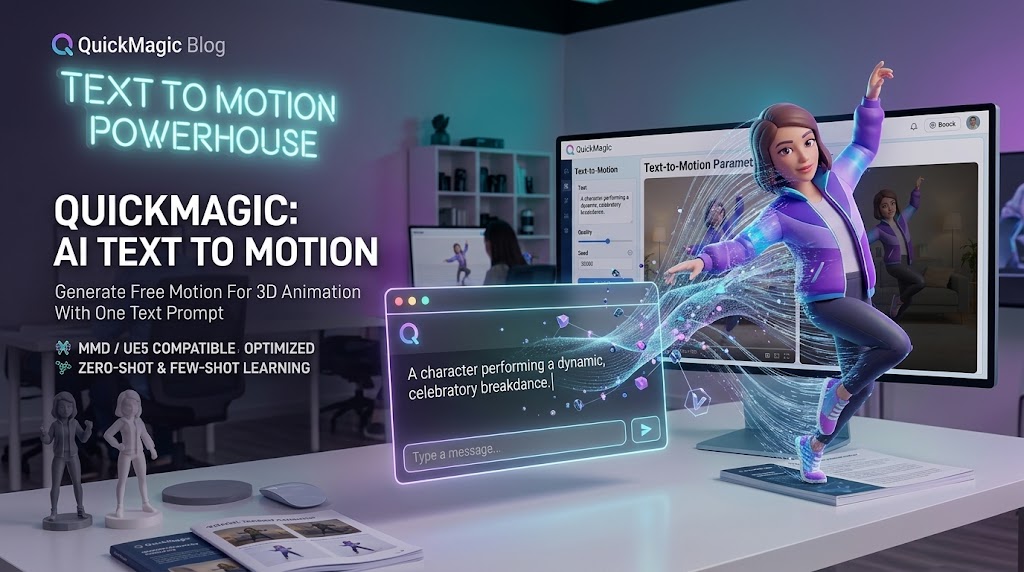
Describe an action in natural language, generate several editable 3D motion candidates, select the best performance and export it for Blender, Unreal Engine, Unity, Maya, Mixamo, iClone, MMD or another character-animation workflow.
QuickMagic Text to Motion launch facts
Text-to-motion and Blender workflow videos
QuickMagic Text to Motion → Mixamo Character → Blender
Shows text generation, a Mixamo character and downstream Blender animation.
Open on YouTubeQuickMagic + Mixamo + Blender Animation Workflow
Explains the Mixamo and Blender handoff used after QuickMagic motion export.
Open on YouTubeWhat is AI text-to-motion?
Text-to-motion converts natural-language descriptions into sequences of human poses. The output is normally skeletal animation data: joint rotations or positions over time, root movement and a reference-skeleton format that can be imported or retargeted.
Research systems commonly use diffusion models or discrete motion representations with Transformer-style sequence models. QuickMagic has not publicly documented the architecture of its production model, so those methods explain the field rather than the proprietary implementation.
How text becomes editable 3D motion
Modern systems learn relationships between language and recorded motion datasets. HumanML3D, for example, introduced a large paired motion-language dataset, while MDM, T2M-GPT and MotionGPT demonstrated diffusion, discrete-token and motion-language approaches. These systems also reveal a key limitation: datasets and text descriptions cover only part of the movement diversity required by real productions.
How to write a strong text-to-motion prompt
Prompt-writing rules
- Start with one clear subject, such as “A person.”
- Use concrete physical verbs rather than abstract storytelling.
- Keep the action sequence short enough for the selected duration.
- Specify left/right, forward/backward or turn direction when important.
- Add useful speed, posture, height or body-part modifiers.
- State the final stance when looping or blending matters.
- Generate multiple candidates instead of overloading one prompt.
Weak vs stronger prompts
| Weak prompt | Why it is ambiguous | Stronger prompt |
|---|---|---|
| “A heroic fight.” | No specific movement, direction or sequence | “A person steps forward, blocks with the left forearm, throws a right cross, and returns to guard.” |
| “Walk nervously.” | Emotion may not map to precise body motion | “A person walks forward with short hesitant steps, shoulders raised, and pauses to look over the left shoulder.” |
| “Cool dance.” | Style, timing and body parts are undefined | “A person steps right, rotates the torso, swings both arms outward, and finishes in a wide low pose.” |
| “Pick up a box.” | Object size and location are unknown | “A person bends at the knees, reaches both hands toward a waist-wide object on the floor, lifts it to chest height, and stands.” |
QuickMagic Text to Motion: step-by-step
1Define the production goal
Decide whether the clip is for previs, a game prototype, an idle, a digital-human gesture, an MMD sequence, a robot-motion reference or a final character animation. The use case determines duration, ending pose, root travel and export preset.
2Write or refine the prompt
Enter a concise action description. Use Refine or Polish when the instruction is vague, or choose Sample Script for a structured example.
3Choose duration and quantity
The launch interface supports a 0–10 second duration and up to 10 generated candidates. Use several candidates for prompts with style, balance or choreography ambiguity. Avoid squeezing many sequential actions into a short duration.
4Select the target format
Choose the closest target skeleton or preset. The launch screenshots show Boy FBX, Girl FBX, Mixamo, Unreal 4, Unreal 5.6 and BIP options. The full product site lists additional workflow-specific formats, but availability varies by plan and workflow.
5Generate and compare
Preview every candidate at normal and slow speed. Use favorites or grading controls to retain useful results. Regenerate when the motion misses the prompt rather than repairing a fundamentally wrong candidate.
6Export and finish the animation
Export the selected source motion, preserve an untouched copy, retarget it to the production character and correct contacts, loops, props, root movement and target-mesh deformation.
10 copy-ready text-to-motion prompts
Walk cycle
A person walks forward at a relaxed pace with natural arm swing and comes to a balanced stop.
Boxing
A person stands in a boxing guard, steps left, throws a fast right jab, and returns to guard.
Game dodge
A person crouches slightly, dodges quickly to the right, and rises into a ready stance.
Jump
A person takes two quick steps forward, jumps upward with both arms raised, and lands with bent knees.
Greeting
A person turns slightly left, raises the right hand, waves twice, and lowers the arm to a relaxed pose.
Sit
A person steps backward toward a chair, bends the knees, sits carefully, and rests both hands on the thighs.
Dance accent
A person steps to the right, rotates the torso, swings both arms outward, and finishes in a wide pose.
Sneak
A person walks forward slowly in a low crouch with careful steps and pauses to look left.
Robot style
A person walks forward with stiff segmented movements, pauses, turns ninety degrees right, and stops.
Loopable idle
A person stands in a relaxed guard, shifts weight gently from side to side, and returns to the starting pose.
How to select the best generated candidate
| Review category | Questions to ask |
|---|---|
| Prompt alignment | Are the action order, body side, direction, speed and ending pose correct? |
| Balance and weight | Does the center of mass move plausibly through steps, bends, jumps and impacts? |
| Root trajectory | Does the character travel, turn or stay in place as required? |
| Contacts | Do feet, hands and imagined objects contact at usable frames? |
| Transition | Can the start and end poses blend into neighboring clips? |
| Cleanup cost | Which candidate requires the least retarget, IK and curve work? |
Export, retarget and production cleanup
- Download the selected source motion and preserve an untouched version.
- Import with the correct frame rate, axis and unit scale.
- Match source and target T-pose or A-pose.
- Map root, pelvis, spine, limbs and optional hand/face chains.
- Check character proportions, stride and root travel.
- Use IK or animation layers for feet, hands, props and terrain.
- Adjust the beginning and ending poses for loops and transitions.
- Reimport the final export into a clean scene for validation.
Best uses for text-to-motion
| Use case | Why text works well | When to use another method |
|---|---|---|
| Storyboards and previs | Rapidly tests movement ideas before casting or recording | Use video or keyframes for exact final acting |
| Game prototypes | Creates placeholder attacks, idles, dodges and reactions | Use final capture for hero combat and interactions |
| NPC libraries | Generates many everyday action variants | Manually standardize loops, root and contacts |
| Digital humans / VTubers | Produces gestures, poses and short reactions | Use live tracking for interactive real-time performance |
| MMD / virtual idols | Speeds up motion ideation and short sequences | Use choreography reference for synchronized dance |
| Robotics reference | Creates human-motion concepts for simulation and prototyping | Validate feasibility, joint limits and safety on the robot |
What text-to-motion does not reliably specify
- Exact frame-by-frame choreography from a short natural-language sentence
- Precise object dimensions, grip points and collision geometry
- Reliable multiple-person interaction without explicit system support
- Detailed finger or facial acting from a body-motion prompt
- Physically exact terrain, stair, chair or prop contact
- Long narratives that exceed the model’s duration and action capacity
- A unique interpretation of words such as cinematic, elegant, heroic or nervous
- Medical, ergonomic or safety-critical movement without task-specific validation
Original QuickMagic interface images
Main interface
Prompt, Animation Model V2.0, duration, candidate count and export presets.
Refine prompt
Converts a vague instruction into a clearer motion-oriented prompt.
Sample Script
Provides structured examples such as a balanced circular kick.
Generation controls
Choose duration and number of candidate animations.
Candidate viewer
Compare, favorite, grade, inspect prompts, regenerate and download results.
Original article cover
Compressed and embedded directly in this HTML file.
Text-to-motion troubleshooting
| Problem | Likely cause | Recommended fix |
|---|---|---|
| The wrong action is generated | Vague verb or too much narrative context | Use concrete verbs and remove non-motion details |
| Action order is wrong | Sequence is too long or unclear | Use “and then,” reduce the number of actions or split into clips |
| Left/right direction is ignored | Direction competes with other prompt details | Move the side/direction next to the main verb and generate alternatives |
| Motion is rushed | Too many actions for the selected duration | Increase duration or simplify the sequence |
| Motion lacks style | Modifier is abstract | Describe posture, step length, speed, height and body-part behavior |
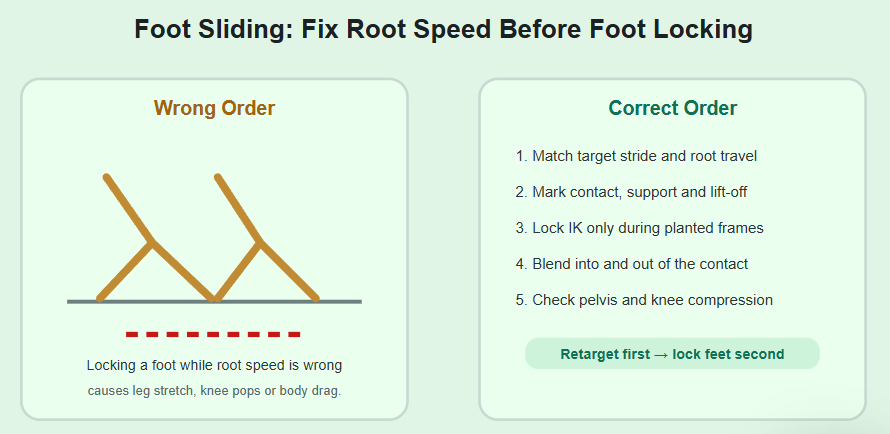
| Feet slide after retargeting | Root/stride mismatch or weak contacts | Correct root speed and target stride, then apply timed foot IK |
| Hands miss an imagined prop | No exact object geometry in the generation | Add hand IK, constraints and keyframes in the target scene |
| Animation does not loop | Start/end poses differ | Specify a return pose and edit the loop transition after export |
| Export preset is missing | Plan, workflow or interface version | Use the current export menu as the final source of truth |
Production checklist
- The prompt describes one clear subject and physical action.
- The sequence fits inside the selected duration.
- Direction, speed, posture and end state are explicit where important.
- Several candidates are generated for ambiguous performances.
- The selected candidate is checked for balance, root and contacts.
- The target preset matches the intended skeleton workflow.
- An untouched source-motion export is preserved.
- The target character is checked for pose, proportions and deformation.
- Loops, transitions, props and terrain are corrected after retargeting.
- The final file is reimported and tested before approval.
Frequently asked questions
What is AI text-to-motion?
AI text-to-motion generates a plausible 3D skeletal animation from a written action description. It creates a new motion draft rather than reconstructing a recorded performance.
Is QuickMagic Text to Motion free?
The June 5, 2026 launch page and interface show a daily free allowance of 15 seconds. Product limits can change, so the current Text to Motion interface is the final source of truth.
How long can one generated animation be?
The launch page states that one animation can be up to 10 seconds and one project can generate up to 10 animation candidates.
Which languages can I use?
QuickMagic describes multilingual prompt input and includes a Refine or Polish function that rewrites instructions into a recommended motion-oriented structure.
How should I write a good prompt?
Start with one subject, use concrete action verbs, add direction, speed or posture, connect a short sequence with 'and then' and state the final pose when transitions matter.
Why do identical prompts generate different motions?
A text description usually allows several valid performances. Generative motion systems sample plausible alternatives, so variation is expected and useful for candidate selection.
Can text-to-motion create exact choreography?
It is better for ideation and motion drafts than exact choreography. Use video-to-mocap or manual keyframing when a specific performance, trajectory or contact sequence must be matched precisely.
Does text-to-motion generate a 3D character?
No. It generates motion data for a skeleton or export preset. The target character, rig, skinning, materials and rendering are separate parts of the pipeline.
Which export formats are supported?
QuickMagic's interface shows target presets such as FBX, Mixamo, Unreal and BIP, while the main product site lists a broader set of workflow-specific formats. Availability varies by plan and workflow, so use the current export menu.
Does generated motion need cleanup?
Often yes. Review prompt alignment, balance, root movement, foot and hand contacts, retarget pose, character proportions, loops, props and target-mesh deformation before production use.
Related QuickMagic guides
Generate alternatives before polishing one clip
Start with a concise five-second action, create several candidates and test the best result on the final character. Regenerate a fundamentally wrong motion; edit a promising motion whose contacts, loop or style need refinement.
Official and technical references
- QuickMagic: Original Text to Motion launch guide
- QuickMagic: Current text-to-motion and export overview
- QuickMagic: Current membership and mocap plan information
- HumanML3D: Motion-language dataset
- MDM: Human Motion Diffusion Model
- T2M-GPT: Text-conditioned discrete motion generation
- MotionGPT: Motion-language modeling
- QuickMagic Text to Motion → Mixamo Character → Blender
- QuickMagic + Mixamo + Blender Animation Workflow