AI Video · Optical Markers · Inertial IMU · Multi-View · Hybrid

AI Motion Capture vs Traditional MoCap: Pros, Cons and the Right Choice

Compare single-video AI mocap, optical marker-based systems, inertial IMU suits and calibrated multi-view markerless capture across fidelity, latency, setup, portability, occlusion, props, multiple actors, research use and total production cost.

Published July 14, 2026 · Updated July 15, 2026 · QuickMagic Editorial Team

Comparison of single-video AI, optical marker, inertial IMU and hybrid motion capture
Direct answer: Choose single-video AI for fast, low-equipment animation drafts, indie production and scalable secondary content. Choose inertial IMU when portable real-time body motion and a large capture area matter more than native absolute position. Choose optical marker-based capture when precise spatial alignment, props, repeatability and low latency justify a calibrated volume. Choose professional multi-view markerless when you need suit-free performers but can support a camera array. Use a hybrid workflow when different shots require different levels of evidence.
Accuracy and cost corrections: this edition removes universal AI joint-error figures, fixed cleanup percentages, fixed optical/inertial price ranges, “250×–500× cheaper” claims and a universal “60%–80% hybrid saving.” Those numbers depend on the evaluated model, action, ground truth, hardware configuration, region, staff, rental/purchase decision and what counts as cleanup. The article uses published QuickMagic plan prices and qualitative, requirement-based comparisons for quote-based professional systems.

Current QuickMagic reference point

Free$0 · 50 V Coins · 30-second/100 MB mocap · FBX
Starter$9.9 · 150 V Coins · 60 seconds · 200 MB · 2D Refinement
Professional$49.9 · 1000 V Coins · 60 seconds · 200 MB · 2D Refinement
Frame-rate limitsFree 30 FPS; paid 24/30/60/120 with duration limits
InputOrdinary video or a text prompt
OutputFBX on Free; additional target formats on paid plans

Pricing and entitlements checked July 15, 2026.

See the three workflows

QuickMagic Markerless AI MoCap from Ordinary Footage

Single-video markerless AI capture with no wearable hardware.

Open on YouTube

Vicon Optical Motion Capture: Collection and Processing

Calibrated optical cameras, markers, collection and processing.

Open on YouTube

Xsens Inertial MoCap Session Setup

Wearable inertial sensors, software setup and performer calibration.

Open on YouTube

The players use static YouTube iframes and no runtime JavaScript. YouTube requires internet access; use the direct buttons when an iframe is blocked. All article images are embedded and display offline.

“AI vs traditional” is useful—but incomplete

Four motion capture categories: monocular AI, optical marker-based, inertial IMU and multi-view markerless
Professional markerless mocap may use several calibrated cameras. It has more visual evidence than a single consumer video and should be evaluated as a separate workflow.

Optical, inertial and markerless systems do not measure the same signals. Optical systems triangulate visible markers or multi-view features; inertial systems estimate body-segment orientation from wearable sensors; single-video AI infers 3D pose from image patterns and learned motion priors. A comparison must therefore start from the deliverable rather than a single “accuracy” label.

Head-to-head production comparison

CriterionSingle-Video AIOptical Marker-BasedInertial IMU SuitMulti-View Markerless
Capture hardwareOne ordinary video/cameraCalibrated cameras, markers and computeWearable IMUs, receiver/body pack and softwareSeveral calibrated video cameras and compute
Performer preparationLowHighMediumLow–medium
PortabilityVery highLow–mediumHighMedium
Absolute positionEstimated from videoDirect spatial reconstructionNot native; aiding can be addedReconstructed from calibrated views
Camera occlusionSingle-view sensitiveMarkers need camera visibilityNot camera-dependentMultiple views reduce but do not remove occlusion
Real-time useDepends on product/workflowEstablished low-latency workflowsCore strengthAvailable in selected professional systems
Large capture areaLimited by framing and pixelsRequires expanded camera volumeCore strengthRequires expanded camera coverage
Props and exact contactsRequires visible evidence and cleanupStrong with tracked anchorsNeeds prop sensors/position aidsStrong when props and views are supported
Multiple actorsPossible; overlap is difficultScales with markers/cameras and workflowScales with suits and radio setupDepends on system, views and compute
Research measurementUse only after task-specific validationCommon for calibrated measurementUsed for kinematics with protocol limitsGrowing; requires validation for the metric
Best starting usePrevis, indie animation, creator content, NPC librariesHero capture, props, VP, biomechanics, robotics ground truthField/live body capture, virtual production, large spacesSuit-free studio previs and production coverage

Single-video AI motion capture: pros and cons

Advantages

  • Uses existing cameras and previously recorded footage.
  • Minimal performer preparation and no wearable suit.
  • Easy to repeat, distribute and scale across remote creators.
  • Strong for blocking, iteration, content libraries and lower-budget projects.
  • Can turn archival or reference video into an editable motion draft.

Limitations

  • A single view contains ambiguous depth and hidden-body information.
  • Motion blur, cropping, loose clothing and subject overlap reduce usable evidence.
  • Exact object contact, absolute position and multi-actor interaction need more cleanup.
  • Cloud processing, clip-length limits and plan entitlements may shape the workflow.
  • Result quality must be judged after retargeting to the final character.

Optical marker-based motion capture: pros and cons

Advantages

  • Calibrated cameras reconstruct marker positions in a defined 3D volume.
  • Supports precise absolute positioning, real-time visualization and repeatable sessions.
  • Markers can be added to props, rigid bodies, cameras and critical contact points.
  • Established pipelines exist for entertainment, biomechanics, robotics and virtual production.

Limitations

  • Requires a capture volume, calibration, camera visibility and trained operation.
  • Markers can be occluded, swapped or lost during close interaction.
  • Performer preparation, labeling and post-processing remain part of the workflow.
  • Total cost varies sharply with camera count, volume, software, staff and services.

Inertial IMU motion capture: pros and cons

Advantages

  • Portable, fast to deploy and usable outside a calibrated camera volume.
  • Body-segment orientation is not lost when the performer is visually occluded.
  • Well suited to real-time streaming, field capture and large movement areas.
  • Systems such as Xsens provide purpose-built animation, analysis and robotics workflows.

Limitations

  • Wearable sensors and performer calibration are still required.
  • Absolute position is not measured natively; positional drift can occur.
  • Feet, hands, props and world contacts may need position-aiding or downstream constraints.
  • Sensor placement, body dimensions and environment can affect results.

Professional multi-view markerless capture

Multi-view markerless systems record a performer from several calibrated angles and solve the body without physical markers. Compared with one video, multiple views add depth and occlusion evidence. Compared with marker-based capture, performer preparation can be faster, but camera layout, calibration, compute and workflow support remain important.

Vicon and OptiTrack now describe workflows that combine markerless and marker-based data. This reflects a broader industry direction: markerless for speed and coverage, markers for the beats or objects that must be exact.

Accuracy is not one number

Typical tradeoff map comparing setup cost and absolute spatial evidence for AI, inertial, multi-view and optical mocap
This map is directional. Real systems overlap, and measurement results depend on hardware, calibration, action, protocol and metric.

Ask which evidence matters:

  • Marker or joint position: spatial coordinates in a calibrated frame.
  • Segment orientation: how the body segment rotates.
  • Joint center: often modeled rather than directly measured.
  • Contact timing: when feet, hands or props become fixed.
  • Visual animation quality: whether the target character looks convincing.
  • Repeatability: whether the same protocol produces comparable data across sessions.
A sub-millimeter marker-position specification is not automatically a sub-millimeter anatomical joint-center result. Conversely, animation can look usable even when it is not appropriate as scientific ground truth.

Compare total workflow cost—not a universal price range

Cost componentSingle-Video AIOpticalInertialMulti-View Markerless
Capture hardwareExisting camera may be sufficientCamera array, markers, sync, compute and accessoriesSuit/sensors, receiver/body pack and computeCamera array, sync/network and compute
SpaceAny safe, trackable locationDefined calibrated volumeFlexible field/stage spaceDefined camera coverage
OperatorsCan be self-serviceSystem and capture operators often requiredSmaller crew possibleSystem/operator support often required
Performer prepNormal suitable clothingSuit/markers and calibration poseSuit/sensors and calibrationMinimal wearables; camera setup remains
CleanupAction and video dependentLabeling, gap filling, solve and retargetingDrift/contact/position correction and retargetingTracking review, solve and retargeting
Pricing modelPublished subscription/creditsPurchase, rental, studio day or quotePurchase, subscription, rental or quotePurchase/service/quote

Build a shot-based estimate: preparation hours + capture hours + retakes + processing + cleanup + retargeting + asset management + the cost of a failed result. AI may have the lowest entry cost but not always the lowest cost for an interaction-heavy hero shot.

Decision guide: choose by the hardest requirement

Decision tree for choosing AI, inertial, optical or validated motion capture
Start with the final requirement, then select the least complex workflow that passes the acceptance criteria.

Seven questions to answer before purchasing or booking

  1. Is the output previs, final animation, live performance or measurement data?
  2. Must the system know absolute world position?
  3. Are exact hand, foot or prop contacts required?
  4. How many performers overlap, fight or embrace?
  5. Is real-time latency part of the deliverable?
  6. Can the action stay inside a calibrated camera volume?
  7. How many animator/technician hours are acceptable after capture?

The hybrid approach

Hybrid motion capture workflow using AI previs, selective high-end capture, unified retargeting and final quality assurance
Calculate hybrid savings from the actual shot list. No percentage applies to every production.

Use QuickMagic for blocking, rehearsal review, NPCs, background characters and alternative takes. Escalate only the hero shots, prop interactions or measurement sequences that fail defined acceptance criteria. Keep a common reference pose, skeleton convention, frame-rate policy and metadata schema so outputs from different systems can enter one retargeting pipeline.

Recommended starting method by use case

Use caseRecommended starting methodEscalate when
Indie game animation librarySingle-video AIHero interactions or contact accuracy exceed cleanup budget
AAA cinematic hero performanceOptical, inertial or hybridAI can still supply blocking and alternate takes
VTuber / creator / social animationSingle-video AILive latency or exact props require dedicated hardware
Live concert or virtual productionInertial or optical real-timeAdd optical anchors for precise stage/camera/prop alignment
Fight choreography with overlapOptical multi-camera or hybridUse AI for rehearsal and shot planning
Biomechanics or clinical studyValidated optical/inertial/multi-view protocolAI only after metric-specific validation
Robotics imitation-learning datasetDepends on ground-truth requirementUse optical anchors or fused sensors when world position must be trusted
Remote previs across many contributorsSingle-video AIRecapture selected final shots in a controlled system

Original article graphics and why they need context

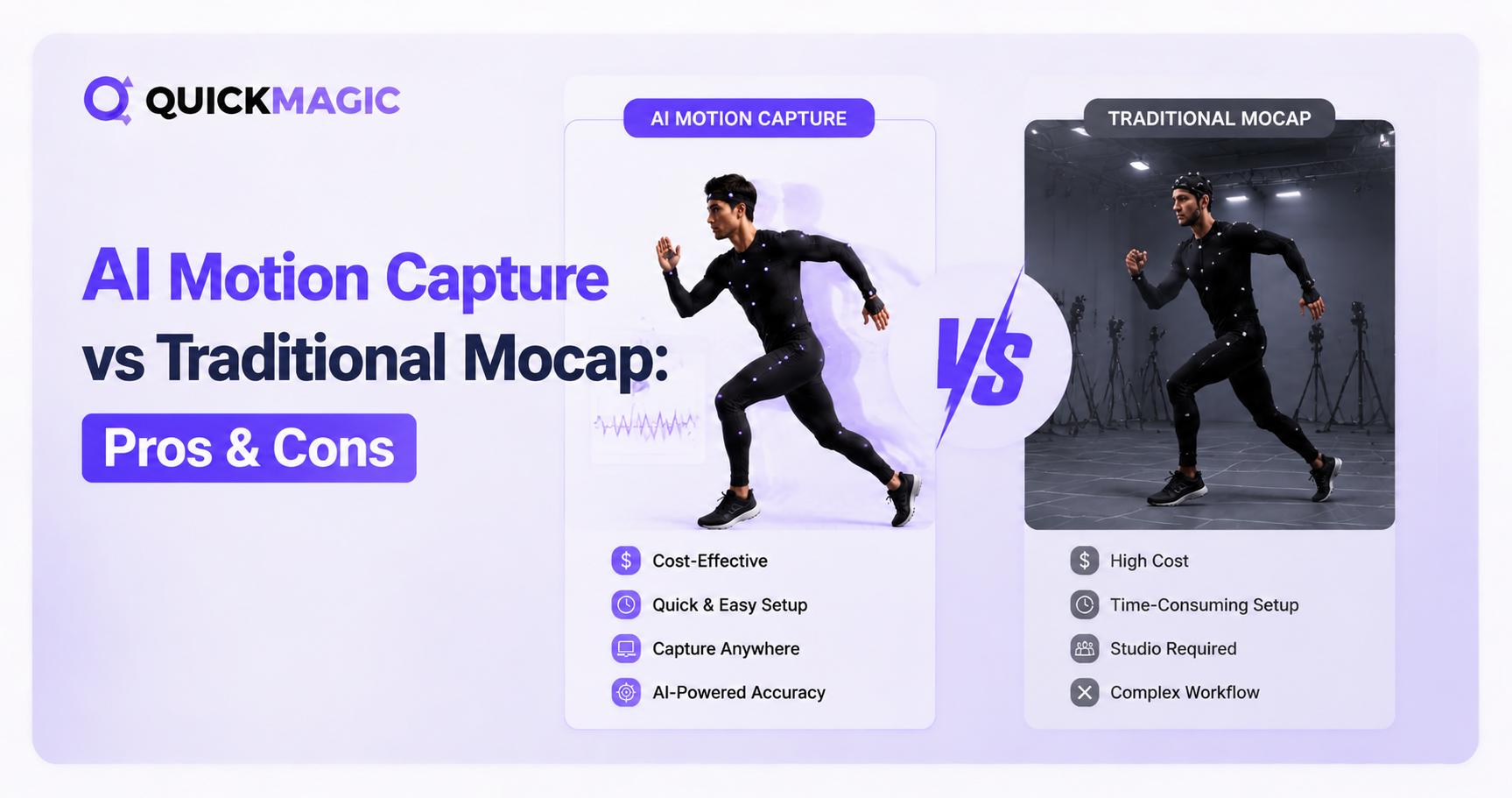
Original QuickMagic AI Motion Capture versus Traditional Mocap cover graphic
The original cover is compressed and embedded directly in this HTML.
Original QuickMagic comparison table for optical, inertial and AI motion capture
Original comparison table. Its fixed accuracy, setup and cost labels are useful as a broad introduction but should not be interpreted as universal specifications.
Original QuickMagic cost comparison table for optical, inertial and AI motion capture
Original cost table. Actual optical and inertial pricing often depends on system configuration, purchase versus rental, support, studio services and location.

Evaluation checklist

  • The final use is defined as animation, live control or measurement.
  • Acceptance criteria include contacts, world position, latency and cleanup.
  • The candidate technology is identified precisely—not only “AI” or “traditional.”
  • A representative hard action is tested before a large purchase or shoot.
  • Results are compared after retargeting to the actual target character.
  • Total cost includes staff, space, retakes, cleanup and pipeline integration.
  • Research or robotics data uses a validated protocol for the required metric.
  • A hybrid escalation path is defined for shots that fail the first method.
  • Source technology, calibration and cleanup metadata are retained with each clip.

Frequently asked questions

Is AI mocap accurate enough for professional use?

It can be, especially for animation drafts, indie production and scalable content. Test the exact action and final rig rather than relying on a universal accuracy number.

Is optical mocap always the most accurate?

It can provide very high spatial fidelity, but performance depends on calibration, camera layout, marker visibility, labeling and what is being measured.

What is the main advantage of inertial mocap?

Portable real-time body tracking without camera occlusion or a fixed optical volume. Native absolute position is the main limitation.

How much does each method cost?

QuickMagic publishes creator plan prices. Professional optical, inertial and multi-view systems vary by configuration and are often quote-based. Compare total workflow cost.

Can AI replace traditional mocap?

It can replace it for many tasks but not every requirement. Precise props, calibrated measurement, high-speed research and complex multi-actor interaction may need optical, inertial or hybrid systems.

Which method is best for game development?

AI is an efficient starting point for prototypes and large libraries. Optical or inertial systems become valuable for hero capture, live visualization and complex interactions.

What is professional markerless mocap?

It typically uses multiple calibrated cameras and multi-view pose estimation, giving it more depth and occlusion evidence than one consumer video.

When should I use a hybrid workflow?

When most content can use AI or inertial capture but selected contacts, props, hero shots or measurements need marker-level or multi-view evidence.

Related QuickMagic guides

Test the hardest ten seconds before choosing a system

Capture the clip with the most occlusion, contact, speed or prop interaction. Retarget every candidate result to the final character and compare the actual correction time.

Try QuickMagic AI Motion Capture →

Official and primary references